


Midterms are almost always a referendum on the president and party in power, and this year is no different. Three key trends are defining the midterm cycle, and the first is the biggest: a deeply unpopular president. President Trump’s job approval rating has plummeted, falling to 36 percent in Navigator Research’s latest tracking, with 62 percent of Americans disapproving. Pew Research has Trump’s approval rating even lower, at only 30 percent. The last time a U.S. president’s approval rating was this low before the midterms was eight decades ago under Harry Truman back in 1946, during which Republicans gained 55 seats in Congress.
Views of the economy are driving this dissatisfaction with Trump. Trump’s handling of the economy is even more negative than his approval rating, with 65 percent disapproving, including 50 percent strongly disapproving, and only 32 percent approving in Navigator’s latest polling.
Two major inflection points in Trump’s second term precipitated these drops. The first was Trump’s so-called Liberation Day, when he levied chaotic global tariffs leading to a major dip in his approval and economic ratings. The second: Starting a war with Iran that sent gas prices skyrocketing, with Trump’s net approval dropping seven points and his net approval of handling the economy dropping 12 points since the conflict began.

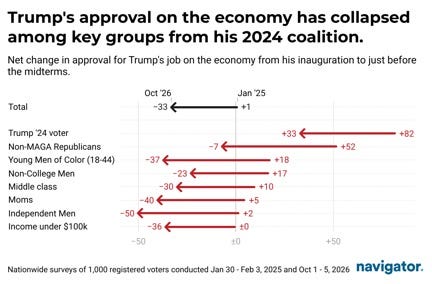
Though Trump’s overall economic numbers are bad, looking under the hood at key groups that made up Trump’s 2024 coalition shows a worrying picture for Republicans. Trump’s net approval on the economy has fallen nearly 50 points with his 2024 voters, from +82 to +33. He’s now underwater on the economy with young men of color, non-college educated men, moms, and those making less than $100,000 per year.
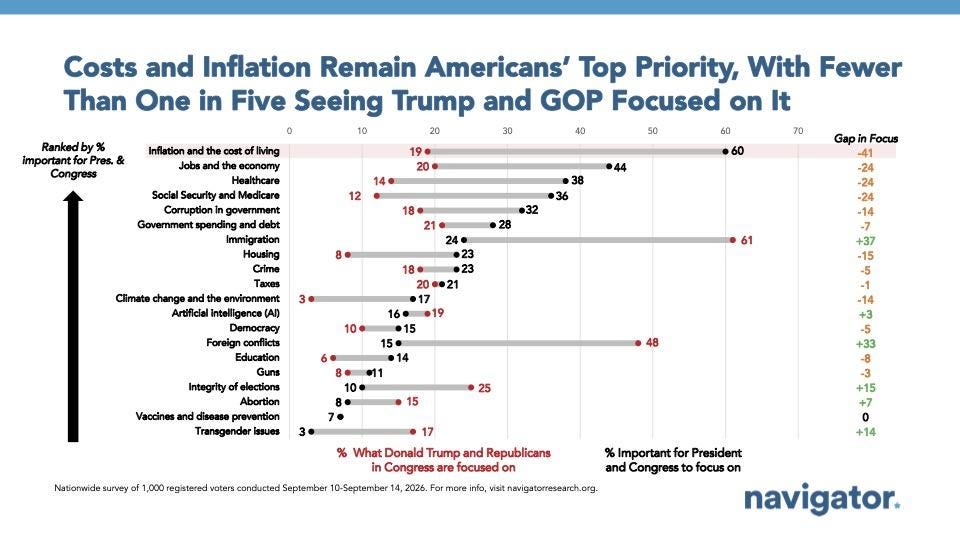
The second key trend is a massive gap in focus. Consistently in Navigator’s polling, about three in five Americans across partisan ideologies say the president and Congress should prioritize inflation and the cost of living, but only about one in five think Trump and congressional Republicans are doing that. That roughly 40-point gap echoes what Americans consistently share in focus groups: They feel Trump and Republicans are focused on the wrong things.
Americans view Trump and Republicans in Congress as most focused on immigration, foreign conflicts, and election integrity. None of those issues are a top priority for most Americans. One focus group participant from Texas who voted for Trump in 2024 and now regrets it said, “[Trump] cares more about foreign affairs than American people.”
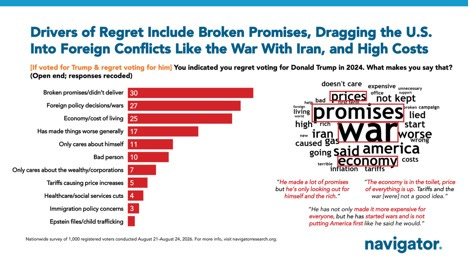
These two trends fuel the third: One in four Americans who voted for Trump in 2024 now say they regret their choice. Regret is even higher for young, Black, and Latino Americans who swung toward Trump and made up the coalition that brought him back to power. Thirty percent of Trump voters ages 18 to 34 regret their vote, as do 34 percent of Black Americans and 32 percent of Latino Americans.
As for what’s driving their regret, in focus groups with more than two dozen Trump regretters, the same reasons come up again and again: broken promises, the war with Iran, high prices, and a bad economy.
One Trump 2024 voter from Georgia described feeling “catfished” by Trump and viewing the country in crisis, saying, “if you see a house on fire, you would call 911. I feel like we should call 911.”
Another Trump regretter said, “people voted for Trump because we thought we were going to get lower costs of living, to some degree at least, and everything has just increased in price.”
And a Trump regretter from Texas said, “There’s people I know personally struggling to buy groceries. … I just feel like we’re drowning, and it only started when Trump got in office. I was fully a diehard fan of Trump. Now I feel like I regret voting for him.”
These midterms are a referendum on an unpopular president, a bad economy, and priorities from those in power that don’t match their own. A looming question is whether Trump regret from those who are disillusioned and negative on the economy will turn into votes for Democrats. While several Trump regretters in our focus groups in early October said they will swing left, the majority were undecided and a few planned to stick with Republicans.
Either way, the message from Americans across political parties has been consistent all year. They want leaders focused on lowering costs at the pump and the grocery store, and whoever wins control of Congress will be judged on whether they deliver on it.
Melissa Toufanian is managing director of Navigator Research.

"While several Trump regretters in our focus groups in early October said they will swing left, the majority were undecided and a few planned to stick with Republicans."
The second group needs to have their heads examined and the third group should not be allowed to vote at all. Sorry.