

By Frederic J. Frommer
It wasn’t your typical baseball game when the Ku Klux Klan faced off against the all-Black Monrovians in Wichita a century ago.
In the 1920s, the KKK was at the peak of its popularity. The group had more than 4 million members and would often feign as a civic organization, participating in picnics and parades and donating to charities. So, staging a baseball game was a way for it to whitewash, if you will, its well-deserved reputation for bigotry and terror at a time when baseball was by far America’s most popular sport.
The Klan had overcome government efforts dating back to Reconstruction to rein it in, such as the Ku Klux Klan Act of 1871, which aimed to enforce the 14th Amendment to the Constitution. That amendment had extended citizenship and equal protection to Black Americans.
Today, in a twist, the legacy of the law has led to the end of a Black college scholarship. After a conservative legal group, the Pacific Legal Foundation, cited the 19th-century statute in its challenge to the University of California at San Diego scholarship, the school agreed in a recent settlement to make the scholarship available to all students.
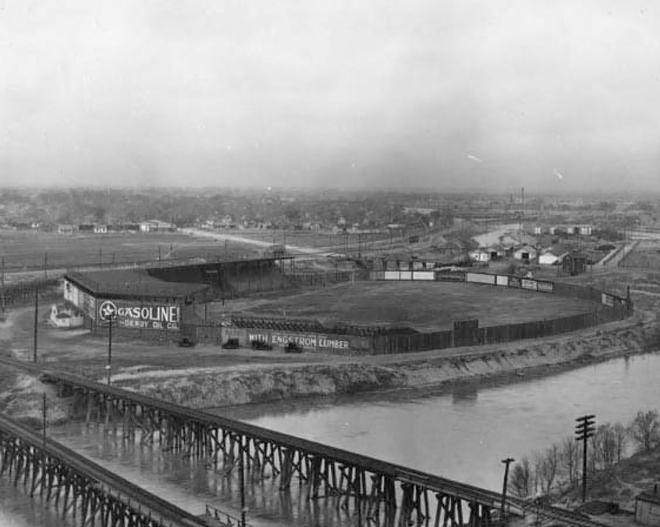
Back in 1925, the Klan was in full PR mode leading up to its June 21 game, agreeing to have a pair of Catholic umpires—Irish Garrety and Dan Dwyer—“to get away from all possible favoritism,” as The Wichita Beacon reported. The story was headlined, “Only Baseball is on Tap at Island Park: Klan and Colored Team to Mix on the Diamond Today.”
Still, there were clearly concerns about security, given the track record of the KKK and the kinds of fans it would likely draw to the game. Three years earlier, for example, the mayor of Liberty, Kan., who had spoken out against the KKK, was dragged out of his office on a Saturday night by 15 men, who drove him to the country and whipped him. They told the mayor, “We are unknown to you. You have never seen us. Your neighbors have had us do this to you. You are one of those fellows that has denounced the Klan.”
In its preview story of the baseball game, the Beacon warned attendees they were prohibited from bringing “strangle holds, razors, horsewhips, and other violent implements of argument.” (Evidently, backpacks were still OK back then.)
“The colored boys are asking all their supporters to be on hand to watch the contest, which besides its peculiar attraction due to the wide differences of the two organizations, should be a well played amateur contest,” the newspaper predicted, according to research by authors John Florio and Ouisie Shapiro.
Barnstorming games between white and Black players were not unusual at the time; in fact teams featuring Major League Baseball stars such as Dizzy Dean would often play in offseason exhibitions against Black teams. But the KKK vs. an all-Black team was in another category altogether—in a city segregated by Jim Crow, no less.
Black players, of course, were still excluded from the major leagues. That season, Yankees first baseman Lou Gehrig played in the first of his 2,130 consecutive games, but New York finished seventh in the American League, before regaining its footing to win the American League pennant the following season.
The Monrovians’ game against the KKK might have been set in motion by an open invitation that the Black team had announced in the Wichita Eagle three weeks earlier, saying they were “open for games with any team in Kansas,” according to a 2008 story by the Society of American Baseball Research.
The game, which took place 11 years before Jesse Owens would shatter the myth of white supremacy by winning four gold medals at the 1936 Nazi Olympics, provided a less-noticed dent, with the Monrovians winning, 10-8.
There was little coverage of it in the press. “Monrovians Beat K.K.K.,” ran the headline in the Wichita Eagle, in a story that was just two sentences long: “The Wichita Monrovians won from the K.K.K. team in a close and interesting baseball battle at Island Park, Sunday 10 to 8. A good sized crowd watched the colored team win the contest.”
Twenty years later, Jackie Robinson would play his sole Negro League season in neighboring Missouri, hitting .375 for the Kansas City Monarchs in 1945. That same year, Branch Rickey signed him to a minor league contract, setting the stage for Robinson to break MLB’s color barrier in 1947.
Back in 1925, the KKK was operating in a kind of legal limbo in Kansas. Earlier that year, acting on a motion by Kansas’s Republican attorney general, the state Supreme Court barred it because it lacked a state charter, making Kansas the first state to ban the organization. The ruling was in abeyance while it appealed to the U.S. Supreme Court. In 1927, that court refused to take up the case, but by then, the KKK was waning in Kansas (and the country as a whole).
Frederic J. Frommer, a writer and sports and politics historian, has written for the Washington Post, the New York Times, the Atlantic, History.com and other national publications. A former Associated Press reporter, Frommer is the author of several books, including “You Gotta Have Heart: Washington Baseball from Walter Johnson to the 2019 World Series Champion Nationals.” Follow him on X.
A racist match race--exploitation from the whites, courage and dignity from the Blacks. Can we next talk about how the Loser administration is rescinding visas and deporting POC while their ranks in major-league baseball are only increasing?
As a lifelong fan, it has been thrilling to watch the waves of talent come from Mexico, the Caribbean, South America, and now across Asia. How could anyone believe that diversity is bad for America? Now, gambling--that's something else entirely.
Now we know.