


Nora Neus’s “24 Hours at the Capitol: An Oral History of the January 6th Insurrection” came out just ahead of the fifth anniversary of the attack on the Capitol. In it, she creates a minute-by-minute account by weaving together multiple sources — including original interviews along with established records. Neus spoke with The Contrarian about her book. The following is excerpted from that conversation, with edits for length and clarity.
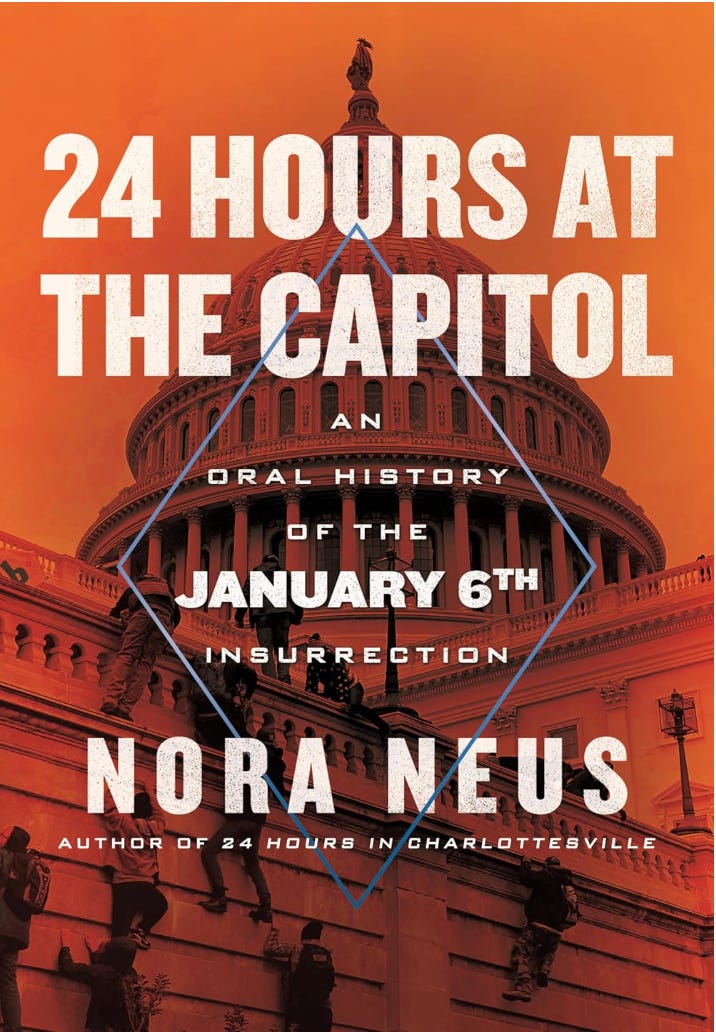
First of all, tell me a little bit about how this book came to be. What made you want to write this?
This book was really an outgrowth of my previous book, “24 Hours in Charlottesville,” which was an oral history of the 2017 white nationalist uprising there. By the time that book came out, January 6 had just happened, and all people wanted to talk to me about was the connections between January 6 and Charlottesville. On the most basic level, some of the same guys were in the streets. But even deeper than that, there is a story thread of the rise of white nationalism and armed white nationalism in this country that we saw hit a new level on January 6.
What do you think was missing from the public perception, the public narrative around J6?
I thought I knew what the book was going to be, and I thought I understood January 6, but I fundamentally did not understand just how brutal and violent it really was. I think the fundamental thing that I took away from my research process is that it was so much worse than we even knew.
And also, how close it came to working. The insurrection almost worked in terms of stopping the certification of the election.
This is very chronological, very beat by beat. Why did you want to do this book in that way?
I think that’s the comparative advantage of this book, and the reason I even bothered doing it. There are so many stories of January 6 out there, but what I wanted to do is bring all those narratives together and do a lot of behind-the-scenes work to fact-check. The effect is you’re reading it and it kind of feels like you’re in the action.
It also helps place where things were happening side by side. The more well-known stories, Michael Fanone, for example, and Officer Sicknick and Brian Sicknick, and a few others. It was really cool to see how all those stories intersected and created one larger story, which I don’t think you get from a limited perspective.
What else surprised you as you were pulling those threads into this book?
I was really surprised by how many of the rioters felt duped by President Trump and were really upset afterward. And after the fact felt really let down by this man that they had, for many of them(until the pardons came through), gave up so much for.
This book weaves together depositions, court records, other oral histories, and your own original interviews. Over what time period were these interviews conducted? Did you notice any differences in the histories being remembered as people moved further away from the events?
Yes, and that’s something that fascinates me about oral history: even the same people will remember the same events differently, especially traumatic events. I did my personal interviews a few years later, up through just before the election last year. But the book draws on sources from day-of, contemporaneous text messages, journal entries, things of that nature. Interviews conducted that night and in the days afterward, all the way through my print deadline.
I feel really strongly about fact-checking oral histories and about making sure that oral history is still accurate. Not all oral historians feel that way, some oral historians feel that the truth is what one remembers. I talk about this from a journalism perspective. So I’m using oral history as method, but also fact-checking.
What was the most difficult interview that you did for this book?
Surprisingly, one of the war correspondents that I interviewed. I interviewed a few different war photo journalists who had spent their entire careers overseas. The only reason they were stateside was because of COVID. And they went into the day thinking they had seen much worse.
I will never forget this one interview with a hardened, grizzled war correspondent saying it was the most traumatic thing he had ever witnessed. He was the most fearful for his own safety, both at the hands of the rioters around him but also the police, if they started shooting, because he was physically within the crowd. And the fact that he lived miles away and this was his home and his country. And he cried on the phone to me, reliving it, almost like having a panic attack on the phone.
It happens to me kind of all the time where I feel like I need to be a therapist, and I’m not a therapist, and I always am careful to say I’m not trained in therapy, but I can’t tell you how often journalism interviews kind of veer into a cathartic experience.
I really thought the perspective of Nancy Pelosi’s daughter [Alexandra] who you interviewed, was fascinating. That wasn’t something that I’d seen anywhere else.
I was shocked she said yes, to be honest. I think that really made the book. I really loved speaking to her, and I really loved being able to include that perspective. Nancy Pelosi’s daughter was a filmmaker who was in the Capitol Building on the name of January 6 with her mother, just as a daughter. I cold emailed Alexandra and made my case in an email. And she emailed me back immediately and said, “okay,” like, one word.
What was the one interview you really wanted to have for this book that you weren’t able to get?
An honest, genuine interview with Vice President Pence would be fascinating. I don’t think he is equipped to do that in any genuine way. He’s given a lot of interviews about what it was like that day, and he’s spoken frankly about the level of betrayal he’s felt. I would love to get his, like, really honest, unfiltered opinions.
I was struck by the same thing you were about the sheer level of violence. And one [thing] I came away with was how shocking it is that only one person got shot.
I know!
What do you think allowed the day to conclude without a whole lot more people firing their weapons?
This goes into a little bit of a counterfactual, right?
Totally.
So I’m just totally speculating here — race played a huge part in it. If you had a massive crowd of hundreds of mostly armed people of color attacking the Capitol building, I think it would have been a lot less likely that there wouldn’t have been more bloodshed.
I’ve interviewed police officers who, on an individual level, felt like they had to hold back from shooting because they knew it would just escalate the continuum of violence. And as soon as someone starts shooting, then everyone starts shooting.
What are you hoping that readers will take away from this book when they pick it up, and might very well think that they kind of know what happened on J6?
I hope readers get a new understanding and appreciation for both just how violent and horrific the day was, and also how close we came to an armed coup. And how important it is to keep talking about that. There is such an effort to whitewash, to rewrite history, to say it didn’t happen the way that we said that it did.
So we haven’t seen anything quite like Charlottesville since Charlottesville happened. We haven’t seen anything quite like J6 since J6 happened. But you end the book talking to experts who are like, “this is absolutely a possibility in the future.” What do you think people need to be watching for?
I think the big thing is to have your eyes open and listen to people who are paying attention. Like January 6, we knew exactly what was going to happen. I mean, not exactly, but we knew that January 6 was a day that was going to turn into a massive protest. And we even knew that there were odds they were going to storm the Capitol. I mean, the intelligence community had proof and maps that they had shared of the tunnels. Listening to citizens, even if the government itself is saying, like, “oh, it’s fine.” You know January 6 was a permitted event. It started off as an event with a permit.
It can happen, and it’s not so far-fetched to imagine.

It is good to have record & testimony of this horrendous day. It was a day I had never, ever, expected to see occur in the USA. One day, when we "awaken" from the trauma of this Administration, it will be excellent to have these testimonies as truth to power. The officers/staff who personally suffered through that day are true heroes.
Watching events unfold at the capitol on January 6th flipped a switch in my head. I will never forget watching the mostly white male law enforcement presence take a “hands off” approach as the overwhelmingly white male mob of insurrectionists ran roughshod through, around and over such feeble attempts to maintain order and safety. Racism on display in broad daylight! I phoned my brother who was also watching. He had the same reaction. Never again could I say, “We’ve made a lot of progress fighting racism in America since the 60’s civil rights era.” Racism is alive in America just as it has always existed. I thought we were better than this.