

By Frederic J. Frommer
In the summer of 1986, a jury awarded a single dollar to the United States Football League in its antitrust case against the NFL, the fatal blow to the upstart USFL. But Donald Trump, a key player in the litigation as owner of the USFL’s New Jersey Generals, somehow spun it into a positive.
“We won a great moral victory,” he said the day of the jury’s finding, July 29, 1986 — forty years ago today. “But now with the confusion and what seems to be a hung jury, we expect to win a total victory.”
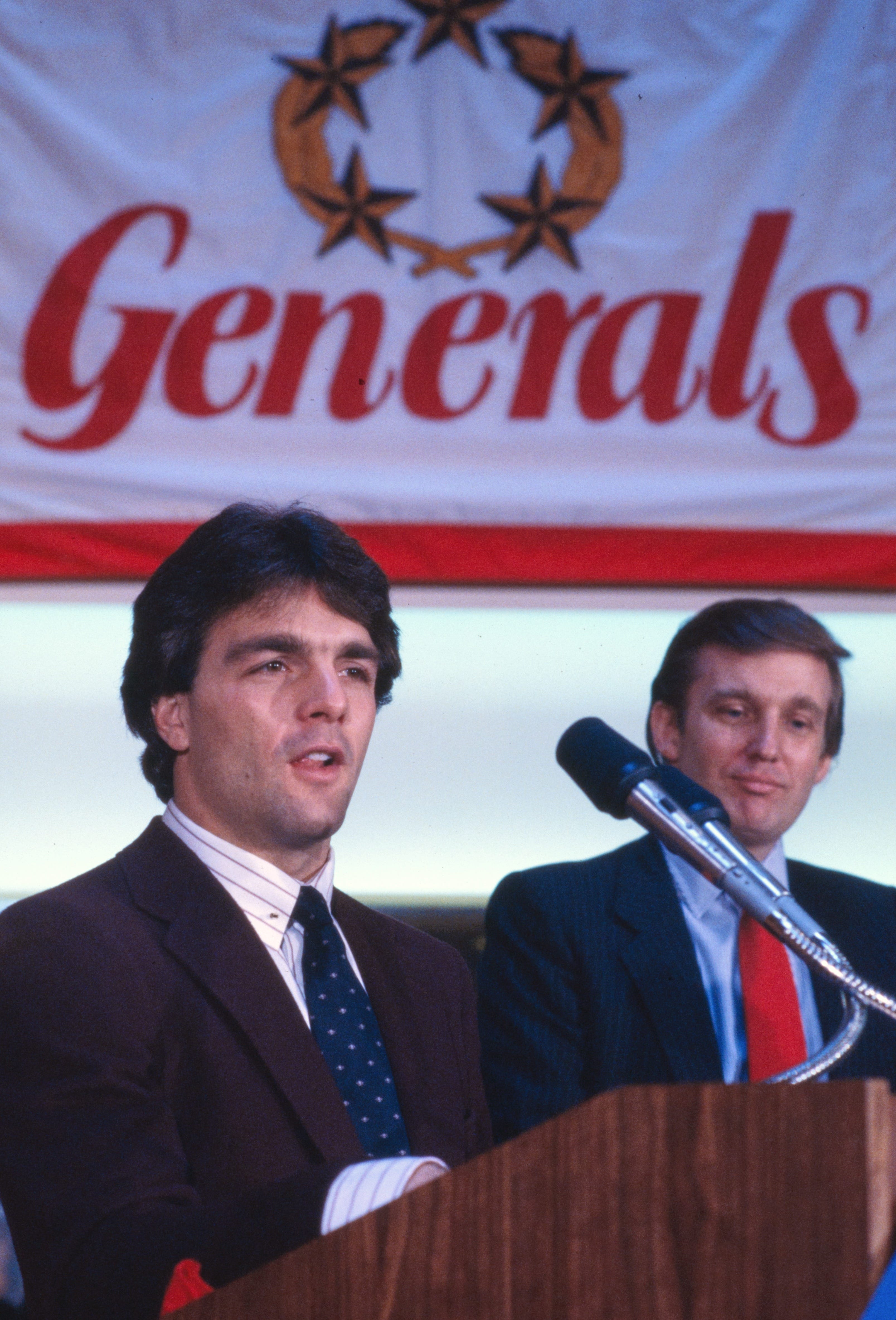
The six-person jury was divided on what to award the upstart league before settling on a buck, which was trebled to $3 in accordance with antitrust law. One of the jurors said she thought the USFL deserved between $200 million and $300 million before going along with the rest of the jury. The USFL had sought $1.69 billion.
The case had come out of the USFL’s decision, largely at Trump’s prodding, to go head-to-head with the NFL in the fall of 1986 after three seasons of spring football.
“If God wanted football in the spring, he would have never created baseball,” he said.
The USFL was one of several leagues to challenge the NFL’s supremacy. The American Football League, for example, took on the NFL directly in the 1960s before the two leagues announced a merger in 1966, leading to the Super Bowl. The World Football League lasted less than two seasons before folding in 1975.
In his book, America’s Game: The Epic Story of How Pro Football Captured a Nation, Michael MacCambridge wrote that the USFL had a far superior operation than the old WFL, with high-quality teams and top coaches like Steve Spurrier, George Allen, and Marv Levy.
“But the USFL was largely defined — some would say hijacked — by the desires and delusions of real estate tycoon Donald Trump,” MacCambridge observed.
Trump was not an original owner when the USFL started operations in 1983. He bought the Generals from Oklahoma City oilman Walter Duncan and team president and coach Chuck Fairbanks that September. (Duncan owned 90 percent, and Fairbanks the remaining 10 percent.)
Duncan had created waves by signing University of Georgia star running back Herschel Walker, the 1982 Heisman Trophy winner, with a year left of college eligibility, to the richest contract in football history. But the Generals struggled that first season with a 6-12 record.
Within a week of buying the team, the 37-year-old Trump was already calling for moving the USFL schedule to the fall to take on the NFL.
In a September 29, 1983, interview with the New York Times from his office on the 26th floor of New York’s Trump Tower, Trump predicted the USFL would achieve parity with the NFL “in two or three years,” at which point the new league could “perhaps go head to head with the NFL.”
USFL Commissioner Chet Simmons, who had been ESPN’s first president, gave lip service to Trump’s idea before gently knocking it down. ‘’What we have in Don, is an active young guy who is doing a lot of thinking, some of it off the cuff. I’m glad he’s thinking,” he said.
“However, for the moment we are concentrating on building the league in its present format. As I have said many times before we would be foolish to challenge an organization as well established as the NFL.”
But within a year, the USFL announced plans to do just that, starting with the 1986 season. Soon after that announcement, the league in October 1984 filed its antitrust lawsuit against the NFL, accusing it of conspiring to control “the business of major league professional football.” One of the lawyers who signed the complaint for the USFL was Trump’s longtime consigliere, Roy Cohn. (He would eventually drop from the case.)
The goal of the lawsuit was to either win a big settlement or force the NFL to accept a merger.
In the meantime, Trump was signing stars for the Generals such as Doug Flutie, who had won the Heisman Trophy as Boston College quarterback. But he asked other teams to kick in some dough for the five-year, $5.5 million deal.
“People wanted me to get him for the good of the league,” Trump told UPI in April 1985. “I told them I would sign him, but at some point I wanted partial reimbursement for the cost.”
During Trump’s two seasons of ownership, the Generals went 14-4 and 11-7 — a big improvement from the team’s first year — but lost in the first round of the playoffs both years.
After the ’85 season, the Generals merged with the Houston Gamblers, which would have paired Walker with Houston quarterback Jim Kelly and wide receiver Ricky Sanders. Trump called it “probably the best team in football” when the merger was announced. The so-called “dream team” would have retained the Generals name but with significant Gambler star power.
Trump testified at the antitrust trial that in 1984, NFL Commissioner Pete Rozelle had offered him an NFL franchise if he dropped the suit, a claim that Rozelle denied. According to Jeff Pearlman’s book, Football For A Buck: The Crazy Rise and Crazier Demise of the USFL, it was Trump who made a play for an NFL team, which Rozelle rebuffed by telling him, “As long as I or my heirs are involved in the NFL, you will never be a franchise owner in the league.”
In its findings, the jury agreed that the NFL had used its monopoly power to corner the football market but found against the USFL in its central claim that the NFL had blocked the upstart league from a network TV contract. ABC broadcast the USFL’s spring games but didn’t want any part of a USFL fall season.
“A clean sweep,” Rozelle said after the jury’s findings. “All the jury said was what I had testified: that we are a natural monopoly. In my view, all professional sports leagues are that and have been since before the turn of the century. Now we can go back to playing football.”
Six days later, the USFL called off plans for its fall season. The “dream team” never took a snap, and the short-lived league never played another game.
Frederic J. Frommer, a sports and politics historian who has written for the Washington Post, the New York Times, the Atlantic and other national publications, is working on a book on ‘70s baseball.
This shows, better than anything else, the orange convicted felon has always been a loser.
Has Trump ever done anything legitimate that was successful?