

By Frederic J. Frommer
Sixty-five years ago this month, President John F. Kennedy inspired a new generation in his iconic 1961 inaugural speech. He also won praise from both sides of the political aisle and from enemies overseas, in a way that would be hard to imagine in today’s hyper-polarized era.
On Jan. 20, 1961, JFK spoke in 22-degree weather, right after a storm had dumped nearly eight inches of snow on the capital. At 43, Kennedy was the youngest man elected president, succeeding 70-year-old Dwight D. Eisenhower — at the time the oldest president — who was born in the 19th century. And the new president made a point of highlighting that contrast, telling the world:
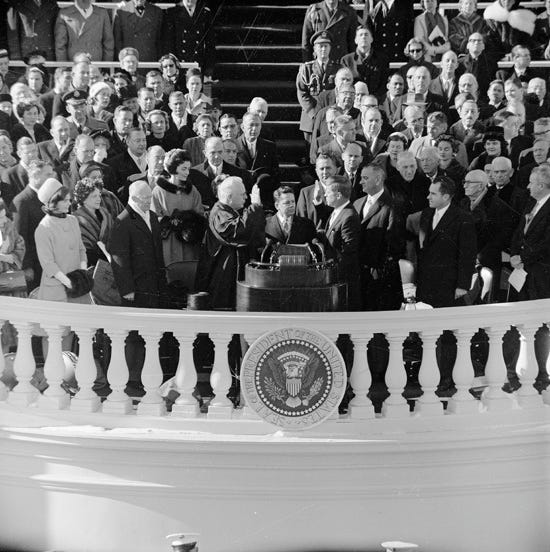
“Let the word go forth from this time and place, to friend and foe alike, that the torch has been passed to a new generation of Americans — born in this century, tempered by war, disciplined by a hard and bitter peace, proud of our ancient heritage — and unwilling to witness or permit the slow undoing of those human rights to which this nation has always been committed, and to which we are committed today at home and around the world. Let every nation know, whether it wishes us well or ill, that we shall pay any price, bear any burden, meet any hardship, support any friend, oppose any foe to assure the survival and the success of liberty.”
(After President Trump deposed Venezuelan leader Nicolás Maduro and threatened to go after other nations, comedian Jon Stewart joked, “Let the word go forth, to a new generation of Americans, that if we need shit, and it’s not too far away, we are going to take it.”)
At the height of the Cold War, Kennedy also extended an olive branch to America’s adversaries, urging “that both sides begin anew the quest for peace, before the dark powers of destruction unleashed by science engulf all humanity in planned or accidental self-destruction.”
Stressing that “civility is not a sign of weakness,” Kennedy urged progress on arms control.
“In effect,” the Washington Post reported, “Mr. Kennedy was saying to the Soviet Union that he agreed with many critics of the outgoing Eisenhower Administration that up to now the United States has not put forward a really negotiable arms control plan. And of course he was saying that neither has the Soviet Union.”
The outreach earned Kennedy an appreciative cable from Soviet Premier Nikita Khrushchev and President Leonid Brezhnev, in which they expressed “the hope that by joint efforts we shall be able to attain a radical improvement of relations between our countries, to make healthier the entire international climate. We are confident that, moving step by step, it is possible to remove the existing suspicion and mistrust, to grow the seeds of friendship and businesslike cooperation between our countries.”
Of course, the following year, the United States and Soviet Union would come to the brink of nuclear war in the Cuban Missile Crisis.
Kennedy said that few generations have the opportunity to defend freedoms at its greatest danger and that he welcomed that responsibility. He added that the energy Americans bring to that effort “will light our country and all who serve it – and the glow from that fire can truly light the world.”
Then he delivered his most famous line of the speech:
“And so, my fellow Americans: ask not what your country can do for you – ask what you can do for your country. My fellow citizens of the world: ask not what America will do for you, but what together we can do for the freedom of man.”
The New York Times reported that Kennedy was “widely acclaimed in Congress today for an Inaugural that stirred Republicans as well as Democrats.” The House GOP Leader, Charles A. Halleck of Indiana, said, “I was much impressed.” Senate Minority Leader Everett Dirksen, an Illinois Republican, called the speech “inspiring” and “a very compact message of hope.”
The Post noted that Kennedy devoted his entire speech to foreign affairs.
“He did so, despite the fact that some five million of his fellow Americans are out of jobs; out of a profound conviction that the fate of the Nation, indeed of civilization, depends on international developments in the years ahead,” the paper observed. “The initial reaction from free world capitals around the globe was warm in approval. But it was plain the world now waits to see exactly what Mr. Kennedy will do in the many crises which face him.”
Legendary columnist James Reston called the speech “a revolutionary document. It was not only eloquent, but moralistic and even religious, and if it is taken at face value, it is a proposal, not merely that we ‘get going,’ but that we begin transforming our national life, our relations with the Allies, and our relations with the Communists.”
Last year, upon taking the oath of office for the second time, Donald Trump began his inaugural speech with a decidedly more inward-looking approach:
“From this day forward, our country will flourish and be respected again all over the world. We will be the envy of every nation, and we will not allow ourselves to be taken advantage of any longer. During every single day of the Trump administration, I will, very simply, put America first.”
Frederic J. Frommer, a writer and sports and politics historian, has written for the Washington Post, the New York Times, the Atlantic, History.com and other national publications. A former Associated Press reporter, Frommer is the author of several books, including “You Gotta Have Heart: Washington Baseball from Walter Johnson to the 2019 World Series Champion Nationals.” Follow him on X.
I was one of the millions of college-aged students who heard and were inspired by President Kennedy's inaugural address. It inspired the Peace Corps internationally, but also a commitment to making America a better place domestically. Sure, neither the speech nor his short administration were perfect, but his vision paved the way for Lyndon Johnson to achieve remarkable civil rights and anti-poverty laws and to move the country forward. We need another of his kind (could be a woman) to inspire, articulate, and lead us in a wholly different direction than we are in at this dreadful time. Up with democracy again!
Kennedy's words brought me to tears. Speaking and acting on behalf of the common good around the world as well as here at home is what real leaders do. In contrast, you could plug the name Trump into every Mad Libs moment in the Loser's speech quoted here, because that's what he really meant:
“From this day forward, DONALD J. TRUMP will flourish and be respected again [sic] all over the world. TRUMP will be the envy of every nation, and I will not allow MYSELF to be taken advantage of any longer. During every single day of the Trump administration, I will, very simply, put ME first.”