

By Frederic J. Frommer
The Los Angeles Dodgers start the National League Division Series against the Philadelphia Phillies Saturday, and no one will be shocked if LA wins and goes on to repeat as World Series champions. But when the franchise won its first World Series 70 years ago Saturday, back when the team played in Brooklyn, it was a far different story: the perennial underdog finally vanquishing the hated New York Yankees.
Before the 1955 World Series, the Dodgers had made seven trips to the World Series and lost every single time, including five losses to the crosstown Yankees: in 1941, 1947, 1949, 1952 and 1953. The frustration for Brooklyn fans was encapsulated by their forlorn expression, “Wait ‘til next year!”
The Yankees, by contrast, had amassed 16 World Series titles by the time they met the Dodgers in ’55. Both teams had excellent regular seasons that year – the Dodgers started out 22-2 (a .917 winning percentage) and finished with a .641 mark, 13 ½ games ahead of the second-place Milwaukee Braves in the National League. The Yankees’ .623 percentage edged out the defending World Series champion Cleveland Indians by three games.
When Brooklyn and New York met in the postseason, the Yankees looked like they were on their way to a 17th World Series title, winning the first two games at Yankee Stadium.
But a play in the first game might have ignited the Dodgers. In one of the most iconic moments in World Series history, 36-year-old Jackie Robinson, well past his prime, stole home to pull the Dodgers within one run. “I didn’t really care whether I made it or not – I was just tired of waiting,” Robinson wrote in his autobiography, I Never Had It Made. “I did make it and we came close to winning that first game. Whether it was because of my stealing home or not, the team had a new fire.”
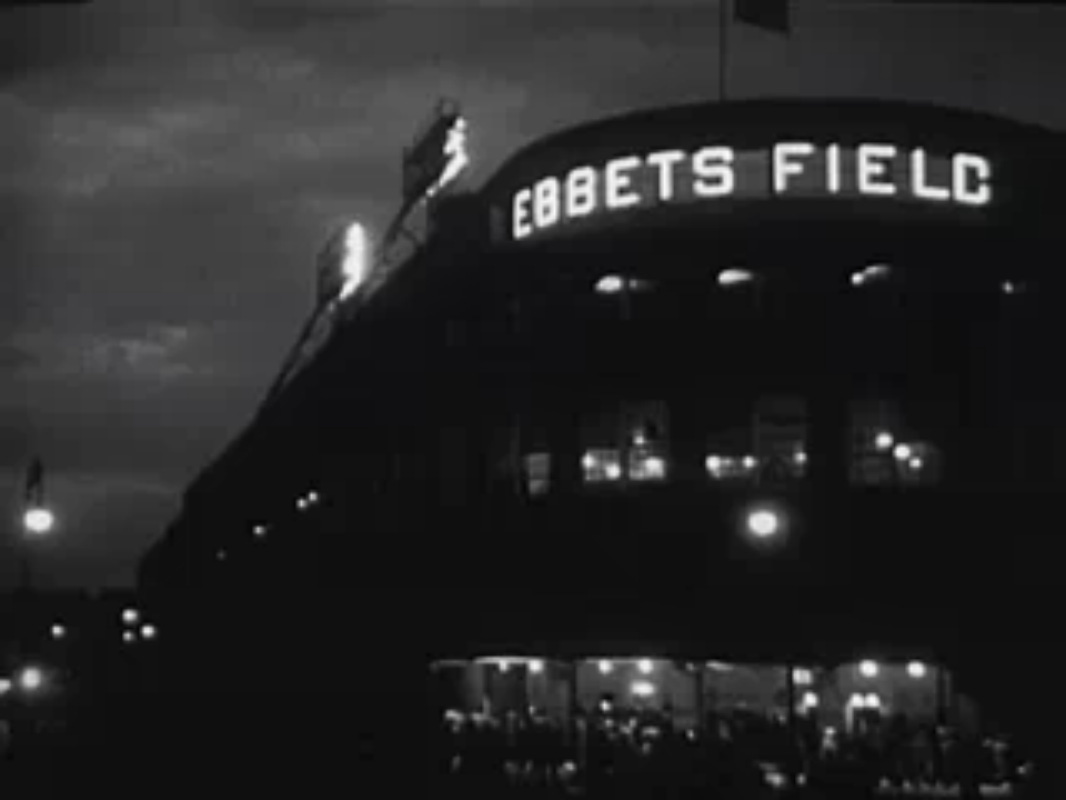
The Yankees won that game, 6-5 and took the second one 4-2. But when the series shifted to Ebbets Field for three games, the Dodgers stunned the Yankees by sweeping all three in Brooklyn, averaging seven runs a game behind future Hall-of-Fame hitters such as Duke Snider, Roy Campanella, and Gil Hodges.
So the teams returned to the Bronx for the final two games, where Whitey Ford held the Dodgers to one run as the Yankees won Game 6 to set up set up the finale at Yankee Stadium on Oct. 4.
The Dodgers had used six different starters to that point, and their ace that year, Don Newcombe, could have started Game 7. But Newcombe, who went 20-5 in the regular season, had won just two games since July 31. And the Yankees had pounded him for six runs in 5 2/3 innings in a Game 1 loss.
So manager Walter Alston turned to 23-year-old Johnny Podres to pitch the series finale. He had thrown a complete-game victory back in Game 3, giving up just three runs (two earned). The Yankees went with veteran pitcher Tommy Byrne, who held the Dodgers to two runs in a complete-game victory in Game 2.
If Brooklyn fans were looking for a sign from the baseball gods that this would be different, one came in the bottom of the third inning, when a ground ball by Yankees hitter Gil McDougald bounced off baserunner Phil Rizzuto in a rare fluke play. By rule, Rizzuto was out and the inning was over.
Brooklyn struck quickly after that: Campanella doubled and came home on a Hodges single to give the Dodgers a 1-0 lead in the top of the fourth. They made it 2-0 in the sixth inning when Pee Wee Reese led off with a single, moved up to third two batters later, and scored on a Hodges sacrifice fly.
The Yankees threatened again in the bottom of the sixth, when Billy Martin led off with a walk, and McDougald legged out a bunt single. That brought up Yogi Berra, one of New York’s best hitters, who laced a ball down the left field line. Left fielder Sandy Amoros raced more than 100 feet for a sensational, fully extended catch that robbed Berra of an extra-base hit. Amoros quickly fired the ball back to shortstop Reese, who relayed to first base to double McDougald off for a rally-killing double-play – Brooklyn’s 12th of the series.
Ironically, Amoros was not highly regarded as a fielder. In its story the next day, the New York Daily News said the signature fielding play of the series was made by “an outfielder who was held lightly as a prospective regular in the spring because of his shabby fielding and throwing.”
Podres worked around a couple of singles in the eighth inning and took the ninth with a 2-0 lead. He later said he relied on his changeup early in the game before shifting to his fastball over the last five innings “with the ball flashing from sunlight into shadow” – back when World Series games were always played in the afternoon.
With two outs in the bottom of the ninth, the Yankees’ Elston Howard hit a groundball to Reese, “the 38- year-old captain of the Flock,” as the New York Times described him. “Ever since 1941 had the Little Colonel from Kentucky been fighting these Yankees,” the paper observed. “Five times had he been forced to accept the loser’s share. Many a heart in the vast arena doubtless skipped a beat as Pee Wee scooped up the ball and fired it to first. It was a bit low and wide. But Hodges reached out and grabbed it inches off the ground. Gil would have stretched halfway across the Bronx for that one.”
Many in the split crowd of more than 62,000 went wild, some rushing the field to join the Dodgers’ celebration on the pitcher’s mound. Although an injury prevented Robinson from playing, the back of his broad-shouldered jersey, with uniform No. 42 so recognizable today, can be seen prominently in the Dodgers’ scrum.
In finally turning the tables on the Yankees, the Dodgers also made history as the first team to come back from a 2-0 series deficit. Podres, who finished with a 2-0 record and a 1.00 ERA, was named series MVP.
“They won’t make Oct. 4 a red-letter day in Brooklyn,” the Daily News wrote. “They’ll print it in letters of gold from now on because it’s only the greatest date in the history of the batter borough – the day those darling Dodgers finally won the World Series.” The front page of the paper screamed, “WHO’S A BUM!”
Across the borough of Brooklyn, people danced in the streets and rang bells to celebrate the elusive championship.
Alas, the next year, things reverted to normal, as the Yankees beat the Dodgers, embarrassing Brooklyn on its home field, 9-0, in Game 7. And of course, the year after that, the Dodgers broke the hearts of millions of fans (including 16-year-old Bernie Sanders) when they announced they were moving to Los Angeles.
“The Dodgers did win the Series in 1955, but only after pain was permanently implanted in our psyches,” wrote George Vescey, who grew up a Brooklyn Dodgers fan, in a 2017 New York Times sports column. “This is how life is. Suffering. Injustice.”
Frederic J. Frommer, a writer and sports and politics historian, has written for the Washington Post, the New York Times, the Atlantic, History.com and other national publications. A former Associated Press reporter, Frommer is the author of several books, including “You Gotta Have Heart: Washington Baseball from Walter Johnson to the 2019 World Series Champion Nationals.” Follow him on X.
At the tender age of 11, I gave up on the Dodgers and baseball in general after they left Brooklyn. That was MY team - the only team. I had a beloved ball autographed by the greats - Newcombe, Pee Wee, Hodges, Campenella... and I have no idea where it is now. Didn't care. The world had been revealed to me. Loyalty, the magic of the game, professional sports suddenly meant nothing. I wasn't heartbroken. I was abandoned, and the world became a place where dollars and cents were all that mattered. Phooey.
Long ago, when I was 8 or 9, I used to listen to the Brooklyn Dodgers on the radio, under the covers, when I was supposed to be asleep.
In 1955 I was in grade 6. The school PA system carried Game 7 - during the school day!
I stayed a Dodger fan through the move, although I was heartbroken. Even after I moved to Toronto (in 1976) I was still a fan … I remember the Kirk Gibson homer in 1988.
But these days, I admit, I bleed BLUE JAYS blue. I hope all you Dodger fans out there will join me on Tuesday evening to help the Jays beat the hated pin-stripers 😉.