

By Frederic J. Frommer
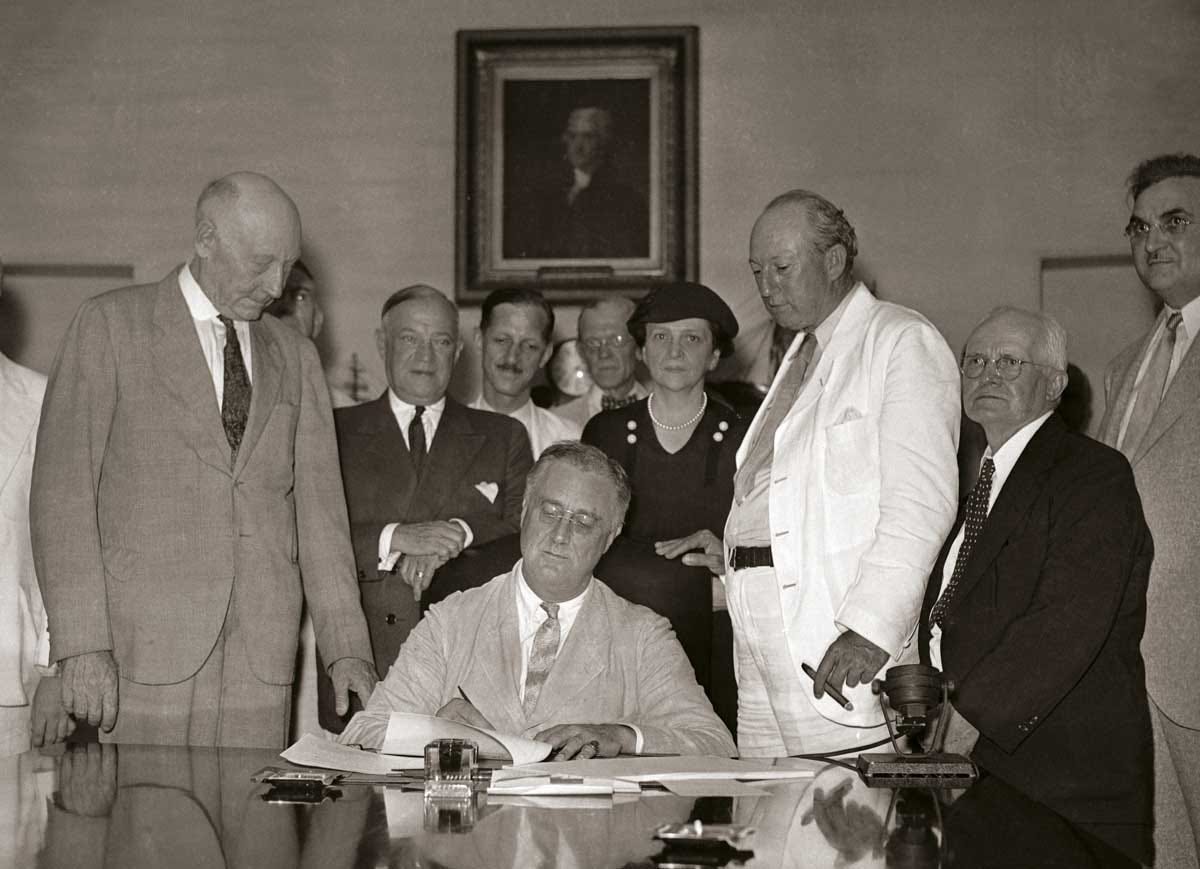
Ninety years ago this Thursday, President Franklin D. Roosevelt signed the Social Security Act, forever changing the relationship between Americans and their government by providing a guaranteed income for seniors and aid to the unemployed and disabled.
“Today a hope of many years' standing is in large part fulfilled,” FDR said at a bill-signing ceremony on Aug. 14, 1935. “The civilization of the past hundred years, with its startling industrial changes, has tended more and more to make life insecure. Young people have come to wonder what would be their lot when they came to old age. The man with a job has wondered how long the job would last.”
Social Security, FDR argued, would provide at least some measure of protection for Americans.
“We can never insure 100 percent of the population against 100 percent of the hazards and vicissitudes of life, but we have tried to frame a law which will give some measure of protection to the average citizen and to his family against the loss of a job and against poverty-ridden old age,” he said.
The president added:
This law, too, represents a cornerstone in a structure which is being built but is by no means complete, a structure intended to lessen the force of possible future depressions, to act as a protection to future administrations of the government against the necessity of going deeply into debt to furnish relief to the needy, a law to flatten out the peaks and valleys of deflation and of inflation – in other words, a law that will take care of human needs and at the same time provide for the United States an economic structure of vastly greater soundness.
Even if Congress hadn’t passed a single piece of legislation beyond the Social Security Act, Roosevelt said, “the session would be regarded as historic for all time.”
The new program offered a lifeline for countless elderly Americans at the height of the Great Depression, when nearly half of the country’s seniors couldn’t support themselves, the FDR Library observed: “Millions lived in poverty. Most had no access to private pension plans and the limited state-run programs that existed had paltry benefits and stringent age and residence requirements.”
Passage of the Social Security Act also laid the foundation for future government programs such as Medicare and Medicaid 30 years later.
Roosevelt signed the bill in his third year in office, after Democrats had made huge gains in the 1934 midterm elections.
“The Seventy-fourth Congress, swept into office on an enormous wave of support for the New Deal, was more than ready to follow Roosevelt's lead,” wrote Jean Edward Smith in his biography of Roosevelt, “FDR,” referring to the 1935-1936 session of Congress. “First on the president's agenda was a comprehensive social insurance program that would provide unemployment compensation and old-age and survivor benefits, as well as aid for dependent children and the handicapped.”
Roosevelt named Labor Secretary Frances Perkins to chair a special cabinet committee to draft the bill.
“Keep it simple," the president told her. "So simple that everybody will understand it.”
A key element of Social Security was to keep it self-funding, through payroll taxes.
"It is almost dishonest to build up an accumulated deficit for the Congress of the United States to meet in 1980,” FDR said, imagining a world 45 years in the future, which happens to be 45 years in our past. “We can't do that. We can't sell the United States short in 1980 any more than in 1935.”
Roosevelt later explained how the payroll taxes would help ensure Social Security’s long-term viability.
“Those taxes were never a matter of economics,” he said, according to Smith’s biography. “They are politics all the way through. We put those payroll contributions there so as to give the contributors a legal, moral, and political right to collect their pensions and their unemployment benefits. With those taxes in there, no damn politician can ever scrap my Social Security program.”
But today, the trust fund that runs Social Security is projected to run out of money in 2033, absent action by Congress before then, because the program’s outlays exceed the amount of money generated by payroll taxes.
Some businessmen opposed the creation of Social Security back in ‘35. General Motors president Alfred Sloan expressed a back-in-my-day resistance to a program he predicted would turn Americans into loafers.
“With unemployment insurance no one will work; with old age and survivor benefits no one will save; the result will be moral decay and financial bankruptcy,” he harumphed.
On the Hill, Sen. A. Harry Moore, a New Jersey Democrat, complained that Social Security “would take all the romance out of life. We might as well take a child from the nursery, give him a nurse, and protect him from every experience life affords.”
Still, with FDR’s popularity soaring and people despondent about their future prospects, both houses of Congress passed the bill with overwhelming majorities—372-33 in the House, and 77-6 in the Senate.
In her book, “The Roosevelt I Knew,” Perkins wrote that, among all his New Deal accomplishments FDR took special pride in creating Social Security. “He … he took greater satisfaction from it than from anything else he achieved on the domestic front,” she recalled.
The creation of Social Security “marked a watershed in American history,” FDR biographer Smith wrote. “The responsibility of the nation toward its citizens was redefined.”
Frederic J. Frommer, a writer and sports and politics historian, has written for the Washington Post, the New York Times, the Atlantic, History.com and other national publications. A former Associated Press reporter, Frommer is the author of several books, including “You Gotta Have Heart: Washington Baseball from Walter Johnson to the 2019 World Series Champion Nationals." Follow him on X.
FDR was a man for the times, both for dealing with the Depression and, later, WWII. And he represented a party that was in touch with the average person, which is not the case now. For the Democratic Party of today to rebuild its credibility, it will have to connect with average Americans and listen to what they have to say.
First we had a watershed moment that created a program to assist people to live comfortably once retired from the labor market. It was a great country that offered this level of compassion.
Now we have a cesspool where the rule of thumb is soon to be (if it isn't already) "you're on your own", which will apply to many of our fellow residents. It's no longer that great a country for them.