

By Carron J. Phillips
Last week was a wild one.
Amid a national columnist’s misguided attempt to link Caitlin Clark to Emmett Till, and the president of the United States suggesting that LeBron James is a racist, Colin Kaepernick received an award from the American Civil Liberties Union (ACLU) for his contributions to society.
Chances are, that last part didn’t make it to your newsfeed.
Kaepernick, who once symbolized and catalyzed America’s “racial reawakening,” has been largely forgotten. That’s just how far away 2016 feels.
“When we look back at this moment, and the next generation is talking about the work that we did, let’s make sure they don’t say we recognized injustice,” the former San Francisco 49ers quarterback said in his acceptance speech for receiving the Ralph Ellison Award for Defenders of Civil Rights and Civil Liberties in the Arts, Business, Science and Sports. “Let them say we refused to normalize it. Let them not say that we admired courage, let them say that we actively practiced it. Let them not say that we inherited history, let them say we changed the direction of it.”
The evening marked one of Kaepernick’s rare public appearances in recent years — he typically stays out of the spotlight. In his speech, he addressed the urgency of the moments we’re living in, with our civil liberties, humanity, and education under constant attack. “The consequences of these decisions are going to be the reality that the future generations inherit,” he explained.
Outside of the countless ways that President Trump has found a way to intrude on the sports world during both of his terms in office, it has become almost impossible to ignore how his policies and governing style have negatively affected Americans from all walks of life. Not even the socioeconomic and celebrity status that often comes with being an athlete provide the needed protection to go unscathed from this administration’s malice. And because of what we saw the sports world accomplish in the aftermath of Kaepernick’s sacrifice and the new heights reached in the summer of 2020, the inaction and apathy that have replaced that progress add to the disappointment of the moment.
The sports world hasn’t just lost the plot in terms of how social issues and athletics intersect; it has worked against its own self-interests from the press box to the locker room — and Caitlin Clark serves as a perfect case study.
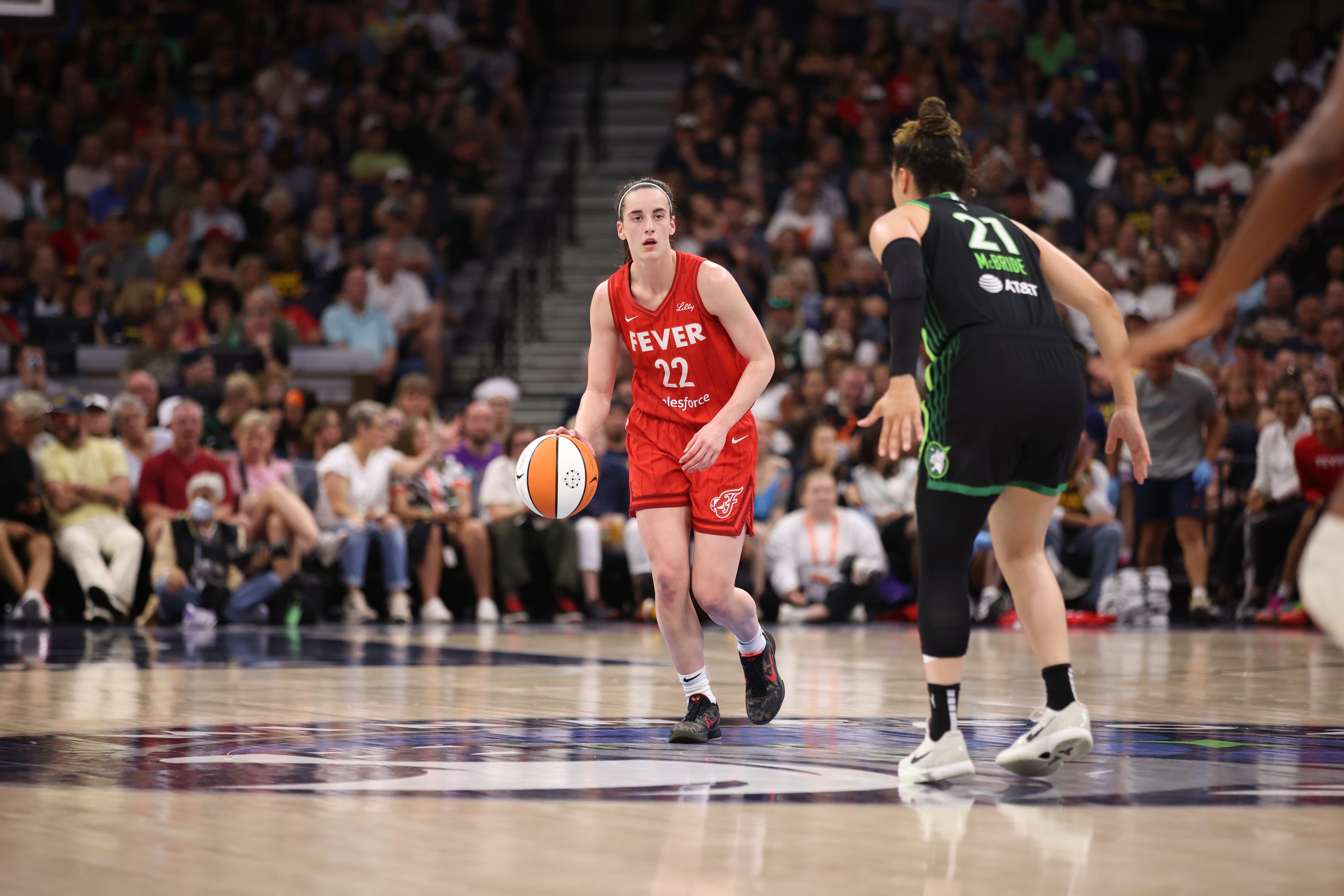
During the WNBA’s All-Star Weekend, the Indiana Fever star sat down with ESPN’s Malika Andrews for a rare interview — and addressed the noise around her and called out the media. “I think there’s just a false characterization of who I am sometimes,” she declared. “And I get it, as a reporter or as a blogger, you can write an opinion piece, and that’s your job and whatever. But at the same time, you don’t know me. We’ve never had a conversation. I get people have a job to do. But at the same time, don’t make accusations about my character and who I am when you don’t know me.”
The issue with Clark’s comments and the way she has gone about things since her stardom in her collegiate days at Iowa is that her popularity has little to do with her talent. Clark, a Midwestern straight white woman who plays a game dominated by Black women, many of whom are queer, has been unfairly hijacked by The Right as a prop to attack the women who serve as the foundation and faces of the WNBA. Critiques of Clark’s role in this situation are fair. Her arrival in the mainstream shepherded in a new level of racism that has been inescapable — and she refuses to publicly rebuke it. Some of her fanbase is the catalyst for these antics. If an athlete with Clark’s fame rarely discusses the principles that define his or her character, others fill in the blanks — even if they’re unqualified to do so.
“I sincerely regret that my lack of appropriate context is overshadowing important conversation and the action that needs to be taken by the WNBA to address is directly — for the benefit of ALL players,” USA Today Sports Columnist Nancy Armour said in her recent apology posted to social media. For some idiotic reason, Armour attempted to connect Clark’s on-court flopping to the dangers historically posed by white women against Black people by mentioning Till her opinion piece. Christine Brennan, another USA Today Sports columnist, has been Clark’s fiercest advocate, leading sports commentator Sarah Spain to publicly chastise her for her “dereliction of duties as a journalist” because of her slanted and obtuse coverage. And to make matters even worse, another journalist absurdly suggested that a brief meeting between players and former President Barack Obama could serve as a “needed shift” to solve all of the WNBA’s challenges.
If this were 2016, the coverage of Clark would be much more nuanced, perhaps resembling the elevated and thoughtful reporting and commentary when Minnesota Lynx players protested the killings of unarmed Black men by police or when Kaepernick was deemed a patriot for his stance. And if we were still in 2020, Clark would not be more newsworthy than players in her league making political history in a senatorial election in Georgia. Nor would she be the subject of more commentary than the Milwaukee Bucks boycotting a playoff game because of police brutality, which — back then — brought the sports world to a standstill.
Outgoing ESPN Executive Vice President Dave Roberts discussed the need for balance on a recent podcast, explaining that it’s “not reality” to separate politics and sports. “I was always unafraid to challenge within the organization that especially nothing drove me crazier than, ‘Well, you know, we don’t mix politics with sports, and covering issues like that is crossing the boundary of politics into sports.”
At some point, however, the outspokenness faded, the raised fists came down, and the kneeling stopped. This shift signaled that athletes, as a group, had moved away from using their voices and platforms for social change. When the actions of these players no longer compelled the media to critically engage with the pressing social issues affecting all citizens, the bar was unfortunately and sadly lowered — to hell.
Carron J. Phillips is an award-winning journalist who writes on race, culture, social issues, politics, and sports. He hails from Saginaw, Michigan, and is a graduate of Morehouse College and Syracuse University. Follow his personal Substack to keep up with more of his work.
Yes, I had read about Colin Kaepernick and Bruce Springsteen receiving awards from the ACLU.
As far as I have been concerned since 2016, Colin is a true hero for standing up (in this case kneeling) for his principles at the very high cost of sacrificing a promising career with possibly many millions of $ in rewards. It truly takes someone with a strong ethical and moral upbringing to take such a stand.
Bruce Springsteen? Well, nothing further needs to be said. He has always done the right thing.
Disagree with some of this. Caitlin Clark is just a basketball player. True, it would be nice if she'd make some elegant, powerful statement about racism. But that is evidently not her skill set. So leave her alone.
More important, probably, are the activities of her teammate, Sophie Cunningham, who appears to be courting the MAGA faction. It's too bad, really. Sophie seems clever and fun. But in the long run, j don't think Magaloid Princess is a winning look.