

By Frederic J. Frommer
On The Bob Newhart Show, a popular 1970s CBS sitcom, the storylines often centered around the humorous interactions of psychologist Bob Hartley, played by comedian Bob Newhart, and his friends and co-workers. But in an episode 50 years ago, the writers decided to take on a weightier subject: How would Bob’s therapy group react to a gay member?
At first, not very kindly.
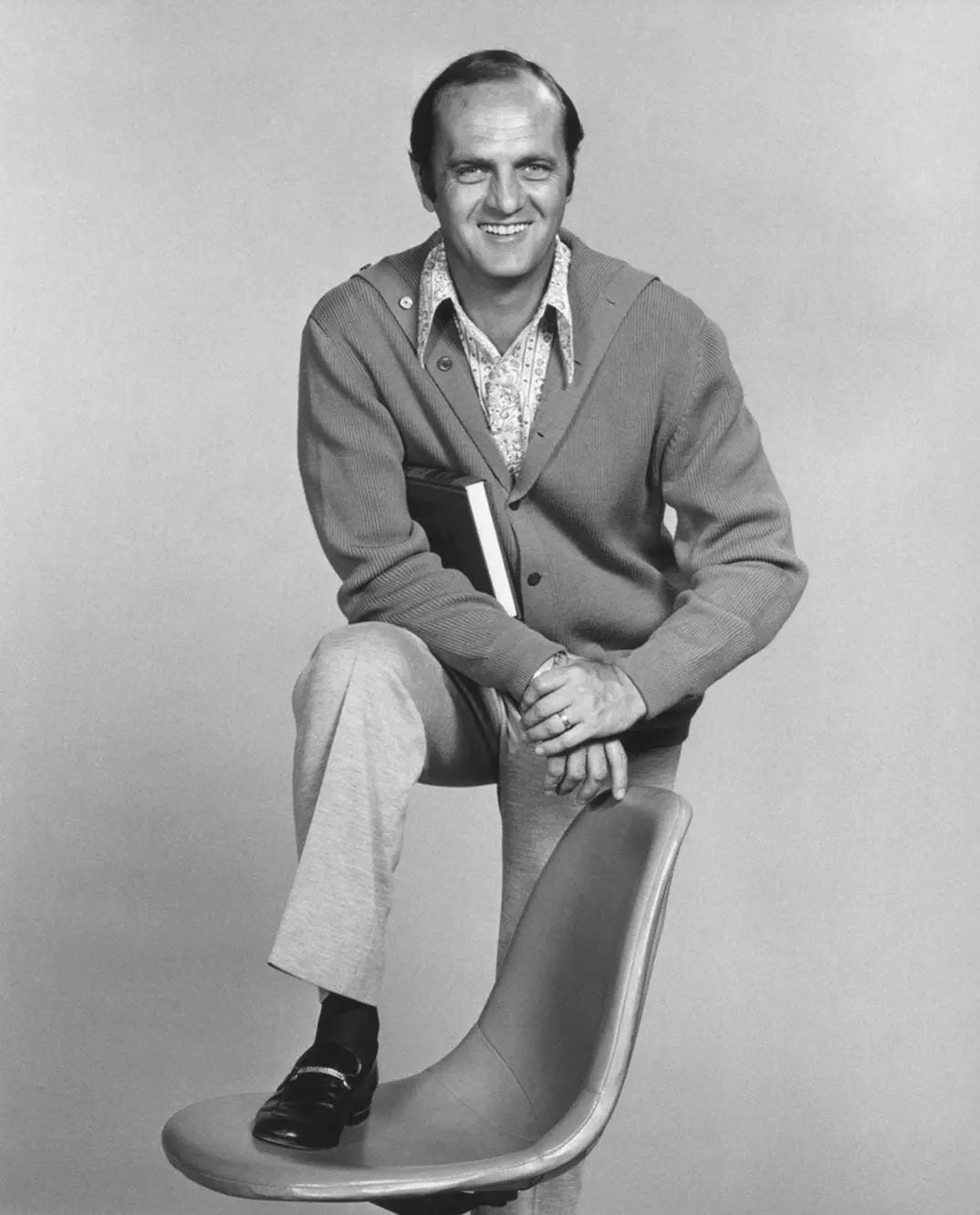
The episode, which originally aired on Oct. 8, 1976, and was called “Some Of My Best Friends Are…”, starts off with Bob’s usual Chicago therapy group running out of topics to discuss. They are bored with the usual ones: Michelle Nardo’s struggles to lose weight, Emil Peterson flunking shop in high school. So they agree that the group could use some new blood, and the next session features a new member, Craig Plager, played by Howard Hesseman, who went on to fame as the stoner DJ Dr. Johnny Fever on WKRP in Cincinnati.
The other members ask Plager to get the conversation rolling, so he tells them about troubles at home: “We fight all the time and it looks like we may split up.”
Hartley counsels Plager that if he cares about the relationship, he shouldn’t be so willing to get out of it.
“Me?” Plager replies. “I’m not the one who wants to give it up. It’s him.”
“Well, then talk to him,” Hartley says, followed by a pregnant pause and loud laughter from the studio audience. “Uh, him?”
“Yes, him,” Plager responds matter-of-factly.
“Wait a minute,” interjects the group’s resident jerk, Elliot Carlin (Jack Riley). “This guy’s gay.”
When one of the other group members, kindly elderly Lillian Bakerman (Florida Friebus) asks Plager if he knows her nephew Kenny, Plager says he doesn’t, explaining, “There are thousands of homosexuals in Chicago.”
“Oh boy,” Carlin says, and gets up to leave.
“Where are you going, Mr. Carlin?” Hartley asks.
“New York,” Carlin replies.
Soon, two other group members follow him out the door.
What’s remarkable about the episode is not the ugly homophobia of the group, but how Newhart’s character stands up for the ostracized newcomer. After the other group members leave, he meets with Plager one-on-one and apologizes.
“I didn’t know that they were going to react that way,” Hartley says.
“I could have told you they would,” Plager replies. “They’re not ready for me.”
Still, it’s clear that as tolerant as Hartley is, he’s also a bit uncomfortable.
“Well, I mean it’s really their problem, if they can’t handle the fact that you’re, uh …” and starts to stammer.
“Gay?” Plager says.
“Right.”
At his apartment that night, a sensitized Hartley uncharacteristically loses his patience with his oddball neighbor Howard Borden, a kind of precursor to Kramer from Seinfeld. Borden, portrayed by Bill Daily (of Major Healey fame from I Dream of Jeannie) mocks Hartley for wearing a “sissy shirt,” as part of a glee club tuxedo he’s wearing to a college reunion.
“I bet your club is full of guys in sissy shirts like that,” Borden adds.
“What are you trying to say, Howard?” Hartley asks.
“Oh, nothing. If the blouse fits, wear it. Do you have a matching bag?”
“You know, sometimes, Howard, you’re a real jerk,” Hartley scolds him.
After regaining his composure, Hartley explains:
“Howard, all I’m trying to say is we’re going to have to change our attitude a little bit. It’s just that kind of dark ages thinking that have kept homosexuals in closets all these years.”
This is remarkably progressive dialogue for a TV sitcom in the mid-‘70s, when many most states had anti-sodomy laws on the books. Only three years earlier, in December 1973, did the American Psychiatric Association remove homosexuality from its list of mental illnesses.
At the next group therapy session, as Plager and Hartley wait for the other group members, Plager seems despondent.
“The group is not going to show,” he predicts. “I mean let’s face it, I’m an outcast, a friendless man without a country.… For the first time, I feel sad to be gay.”
“Mr. Plager, I know things are rough right now, but we’re going to see this thing through. You’re not going to be alone. I’m going to be with you all the way,” Hartley says, putting his hand on the man’s shoulder.
At this point, the other members come in, and Carlin announces, “Let’s not beat around the bush. We had a meeting and we voted the gay guy out.”
“I don’t think that’s your decision to make,” Hartley replies firmly.
“That’s right, it’s mine,” Plager says. “So long, Dr. Hartley.”
“No, no. If anyone’s leaving, it’s not going to be you,” Bob says, then tells the other members, “I’m really ashamed of you. I never realized how narrow-minded you are. Just go and take your
narrow-mindedness somewhere else. Mr. Plager and I have a session here.”
And he tells them that they are free to return next week, but that Plager will be there.
In the laws of sitcom physics, the other members quickly realize they are wrong and apologize.
“I’m so ashamed,” says Peterson, played by John Fiedler, whose high-pitched tone would be known to millions as the voice of Piglet, the best friend of Winnie-the-Pooh.
“I offer you my hand in friendship,” says Bakerman, and Plager takes it.
But when Plager extends his hand to Carlin, he recoils.
“I’ll just say I’m sorry,” Carlin says, as the audience laughs.
(You can stream the episode today on Amazon Prime.)
Writing in Decider a few years ago, Brett White marveled at the show’s message of tolerance.
“In the span of one episode, Dr. Bob Hartley pushed through whatever unease he had about homosexuality and instinctively did the right thing,” White wrote. “He stood up for his gay patient, at the risk of his friendship with Howard and the bigoted demands of his regular patients. He was the kind of ally that we hope our friends and family will be to us after we come out to them. He flinched, but he never wavered.”
Newhart, an actor known for his own sense of decency, certainly lived up to that reputation through his TV alter-ego in this groundbreaking episode.
Frederic J. Frommer, a sports and politics historian who has written for the Washington Post, the New York Times, the Atlantic and other national publications, is working on a book on ‘70s baseball.
They just don't make 'em like that anymore. I do miss quiet humor.
One of my favorite shows from that era. It always made me laugh. The episode where Bob has his whole group over for Thanksgiving dinner while Emily is away, is absolutely hysterical.