



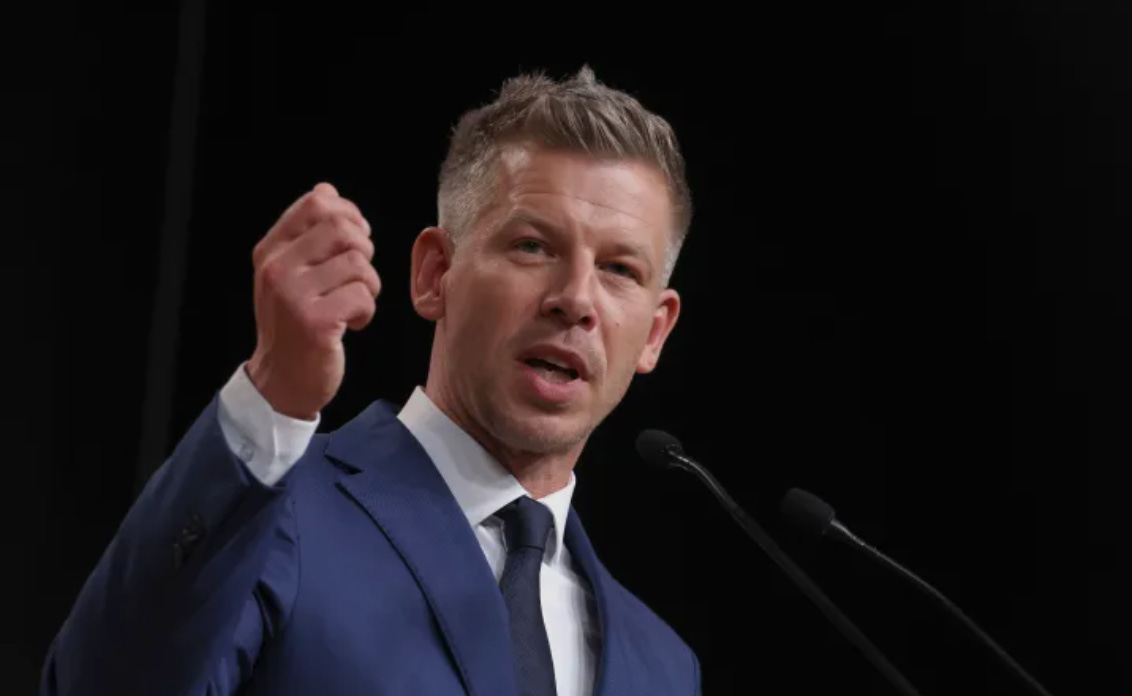
Viktor Orbán’s defeat is a stunning setback for the far-right. No, Péter Magyar is not a political liberal or a progressive. He is a former member of Orbán’s own Fidesz Party. He’s a conservative whose new party, Tisza, won a supermajority in the Hungarian parliament by focusing on practical issues, including the Orbán regime’s rampant corruption and failing economic policies. Some analysts have cited these kitchen table issues, with Orbán and his cronies enriching themselves even as the average Hungarian struggled to get by, as a reason to dismiss or downplay the ideological significance of Magyar’s sudden rise. But make no mistake: Magyar is not a lite version of Orbán. His brand of conservatism is far different from Orbán’s reactionary politics. Indeed, Hungary’s new prime minister has clearly distanced himself from the extremism and conspiracism that fuels authoritarianism across Europe and the United States.
During his first post-election press conference, Magyar was asked about the rise of far-right extremism in European politics. “Hungary has been seen as a laboratory of far-right policies,” a journalist said, pointing out that rightwing firebrands from across the European continent, such as France’s Marine Le Pen and the Netherlands’ Geert Wilders, had traveled to Hungary for ideological affirmation. The journalist wanted to know how Magyar would approach such extremism.
“We know that these players are important allies of Viktor Orbán,” Magyar responded. “They work together. They are supporting each other.” Mainstream politicians know the “extremities are rising,” Magyar said, but they cannot use “band-aids” to address the crisis. Instead, he advised politicians to confront the underlying issues driving widespread anxiety — namely, migration and a deteriorating labor market — head on, as extremist politicians have capitalized on them for their own purposes.
To be clear, Magyar’s stated policies on immigration are not all that different from Orbán’s. He has prioritized border security and strict limits on immigration. He also said that European leaders had “mismanaged the migration crisis” — a reference to the influx of migrants flowing from the Middle East and elsewhere into Europe beginning in the early 2010s.
However, there is a clear dividing line between Magyar and Orbán. Throughout his time as prime minister, Orbán repeatedly pushed the white nationalist “great replacement theory,” a once-fringe racist belief that European elites are seeking to replace the white, Christian citizens of their countries with immigrants of color. As we’ve written previously, the great replacement theory is one of the most dangerous conspiracy beliefs, which gained far-right virality in the internet era and led to a string of deadly shootings against Brown and Black populations. Orbán used this same paranoia to justify his authoritarian rule, portraying himself as a guardian against the European Union’s (EU) supposed great replacers in Brussels, as well as a bulwark against the alleged dangers of “race mixing.”
Magyar has not followed Orbán down this more extreme racist path. While Magyar rejects the EU’s migration quotas, and his rejection has undertones of racism, he has struck a conciliatory tone, arguing that Hungary’s integration with other European countries will lead to economic benefits for his country’s citizens. This is a far cry from Orbán’s “great replacement” paranoia, which portrayed the EU as the villain seeking to destroy Hungary by bringing in hordes of the “other” to threaten the livelihoods of native Hungarians.
During the press conference on Monday, Magyar vowed to cut off the Hungarian government’s financial support for far-right ideological projects, which Orbán mixed with his own political agenda. “The state is not going to finance CPAC [Conservative Political Action Conference] events, or Mathias Corvinus Collegium institutions,” he said. “I think this was a criminal offense…party financing mixed up with government expenditures,” Magyar claimed. He added that “future authorities will have to examine or investigate” the issue.
The Mathias Corvinus Collegium (MCC) is an institute backed by Orbán that is known for pushing a pro-Russian and pro-MAGA agenda. Vice President J.D. Vance, who has also promoted the racist “great replacement theory,” spoke at an MCC-hosted event while campaigning for Orbán just days before the election. Vance not only praised the MCC as a guardian of Western civilization, but also extolled Orbán’s funding of it — the same government funding that Magyar quickly repudiated as “criminal.”
The U.S.-based Conservative Political Action Conference (CPAC) has served as a networking event and ideological node for the far-right. During a CPAC event in 2024, for instance, Jack Posobiec, a rightwing provocateur, called for ending democracy. That same event was pro-January 6, as were subsequent CPAC conferences, with the rioters and extremists who attacked the U.S. Capitol portrayed as heroes and martyrs.
President Trump has been a frequent keynote speaker at CPAC conferences inside the United States since 2017. Orbán is also a CPAC darling, both at events inside America and at conferences hosted by his regime in Budapest. Far-right extremism, which heavily features white nationalism, is often front and center at the Hungarian events. Weeks ago, during the CPAC Hungary 2026 event, Dutch political commentator Eva Vlaardingerbroek promoted the great replacement theory. “What do you call the deliberate and systemic destruction in whole or in part of a national, ethnic, racial or religious group?” she asked. She then answered her own question, accusing European leaders of committing white “genocide” — a white supremacist trope that is central to the Trump regime’s agenda and propaganda.
Magyar’s repudiation of Orbán’s hate-filled politics is not just a matter of fighting corruption. During the same press conference on Monday, a reporter asked him about his approach to abortion and LGBTQ rights. Orbán’s regime had tightened abortion restrictions, making it more difficult for women to receive care. Orbán tried and failed to ban LGBTQ events, including the annual Budapest Pride parade.
On abortion, Magyar said that “this issue is settled” — as it is legal under Hungarian law up to 12 weeks. As for LGBTQ events, Magyar was unequivocal: “I said clearly last year several times, freedom of assembly, everyone has the right, full stop.”
Such statements make it clear that Magyar is no Viktor Orbán. Nor is he Donald Trump. He is not channeling hatred for his own political purposes. And while it is still early, the country’s response is a hopeful sign for its future. The people of Hungary rejected the repression and corruption of their leader, just like people in the United States are rejecting the same autocratic traits here.
Trump and Vance threw their political weight behind Orbán’s re-election. It’s easy to see why: Orbán has been one of their most important political and cultural allies in Europe. Indeed, they have viewed Orbán’s Hungary as a model for America. Like Orbán, they have sought to harness anxiety over immigration, a desire to restrict women’s reproductive rights, bigotry against the LGBTQ community, antisemitism, and racist sentiment for their own authoritarian purposes. This hate-filled agenda may not have been what cost Orbán his rule after 16 years. But it wasn’t enough to keep him in power either.
“I think I am different to Victor Orbán in everything,” Magyar explained to reporters after his win. “Sometimes I hear about these fears that we are similar in many things. No, I don’t think so.” Indeed, Magyar made that clear during his first appearance on state-controlled television, vowing to shutter Orbán’s propaganda organs.
It’s now up to Magyar and his supporters to deliver on a conservatism that isn’t rooted in hate and avoids the siren call of corruption. Just don’t expect him to be invited to speak at an American CPAC event or get a visit from Trump anytime soon.
Tom Joscelyn is a senior advisor for Democracy Defenders.
Susan Corke is the executive director of Democracy Defenders Action.


Let's hope that what has occurred in Hungary is a prescient warning to those Republicans who think that they can steal and dismantle our democracy. What exists in our hearts and minds -- our love of freedom, with justice and opportunity equally extended, under the rule of law -- is a spirit that cannot be extinguished by greed and corrupt dealings. Such a malignant disregard for others as we have been experiencing only ignites our sense of what is right, and determination to defeat those whose sense of entitlement runs counter to who we are as a people and nation.
A principled, competent, pro-democracy right wing political movement would be one of the best things to happen to the world. Not because I agree with a lot of their economic and social policies, but we all benefit when political parties provide accountability by policing each other and compete on their ability to make lives better for people in their country rather than trying to game the system for partisan advantage and insulate themselves from accountability.
In Oregon, our standing in the nation has declined dramatically over decades now. We've had near one party control (Democratic) for close to two decades, but that has led to stagnation and a refusal to address problems that would require disrupting the political status quo. If we had the Republicans of the 1970s and 80s as a competing force (they actually governed responsibly, with Republicans like Vic Atiyeh raising taxes in during recessions to ensure critical government services were maintained) they could challenge Democrats by saying "here are educational reforms in states like Mississippi that brought about dramatic improvements in educational attainment" and force change. Instead, we have MAGA who hate public education and for whom "reform" means sabotage and hollowing out public schools. So between well intentioned but under performing policies vs outright destruction, we have to go with the former. And it sucks.