

By Maya Cook
“Maya, you better call your family. Altadena is burning.”
In the early hours of January 8th, 2025, my boyfriend shook me awake with a plea I never expected to hear.
The Eaton Fire raged across fourteen thousand acres of land in my hometown of Altadena, California, taking nineteen lives and almost ten thousand structures with it. I watched this devastation unfold for hours, overwhelmed with anxiety as I waited to hear from my evacuated family.
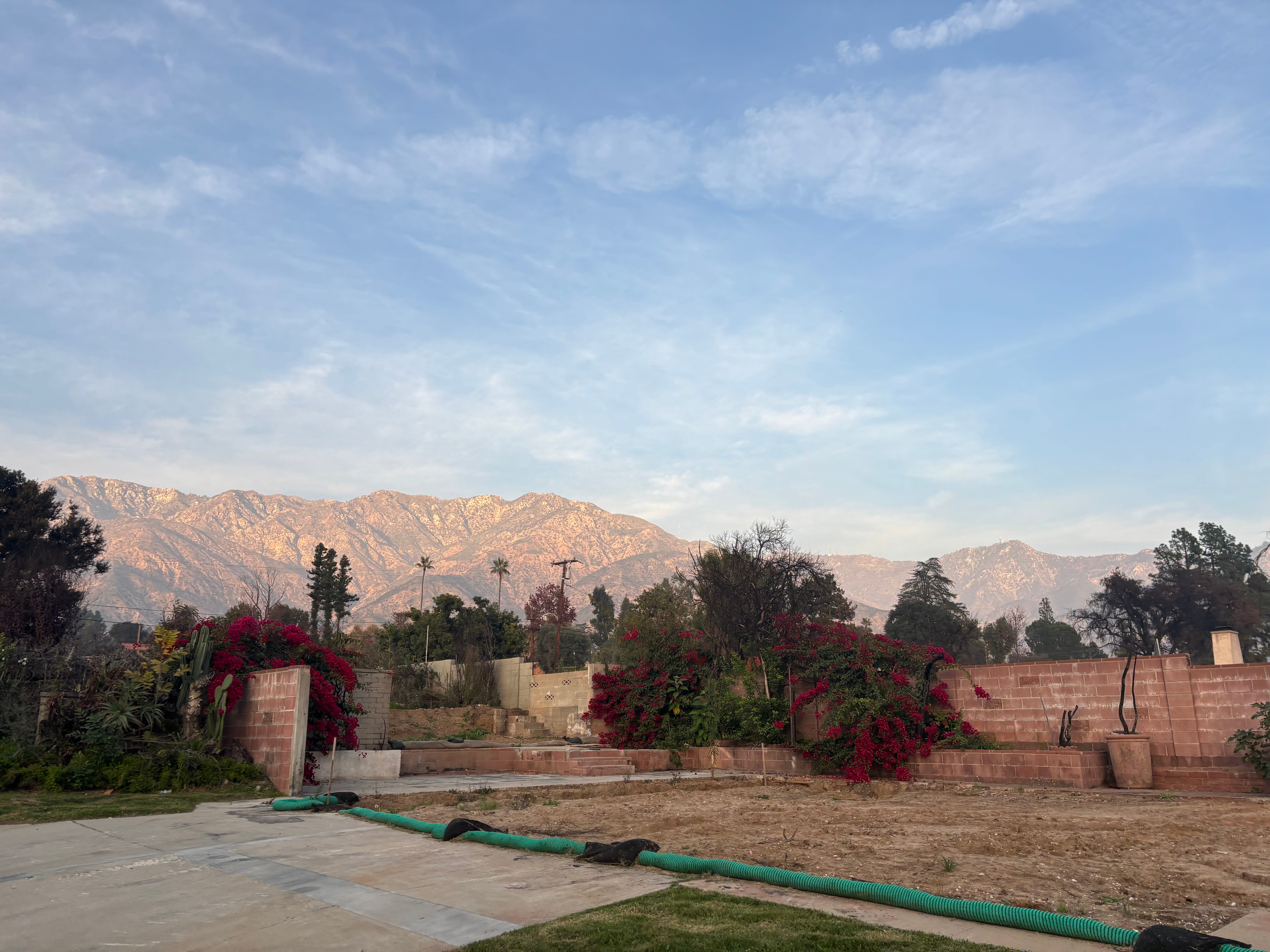
I flew to L.A. as soon as I could. Miraculously, our house was still standing. Inside, ash coating our floors and windowsills was the only reminder of the fire. But outside those walls, entire blocks were razed. My elementary school burned to the ground. Mellanie, my family friend, lost her home of nearly 30 years. “Nothing prepares you for leaving your house one night and never coming back,” she told me.
We Altadenians liked to boast about our charming, unincorporated pocket of Los Angeles, tucked away in the foothills of the mountains. Some Angelenos had still never heard of it when it went up in flames.
“Black people always knew about it,” Mellanie said. Once home to influential figures like Sidney Poitier and Octavia Butler, western Altadena houses one of the first middle-class communities in L.A. to include Black homeowners. Mellanie herself is a lifetime resident of the area. When she was looking to buy a home in 1997, Altadena was the obvious choice. “It was my stomping ground as a child, and I wanted to raise my two interracial children in a place that was a little more integrated.”
In the 1930s, western Altadena was designated as a “declining” zone by the U.S. Home Owners’ Loan Corporation. This designation led to lower housing prices that persisted after redlining practices were outlawed, allowing many Black families to purchase homes in the area despite systemic barriers. By the 1970s, the homeownership rate for Black families in Altadena was at 70%, nearly double the rate for Los Angeles County overall.
Since the fire, Altadena has been hailed in the media as a haven for middle-class people of color. But behind the new publicity is a history of inequality that has been reproduced, by bad luck and systemic factors alike, in the unequal devastation and aftermath of the Eaton Fire.
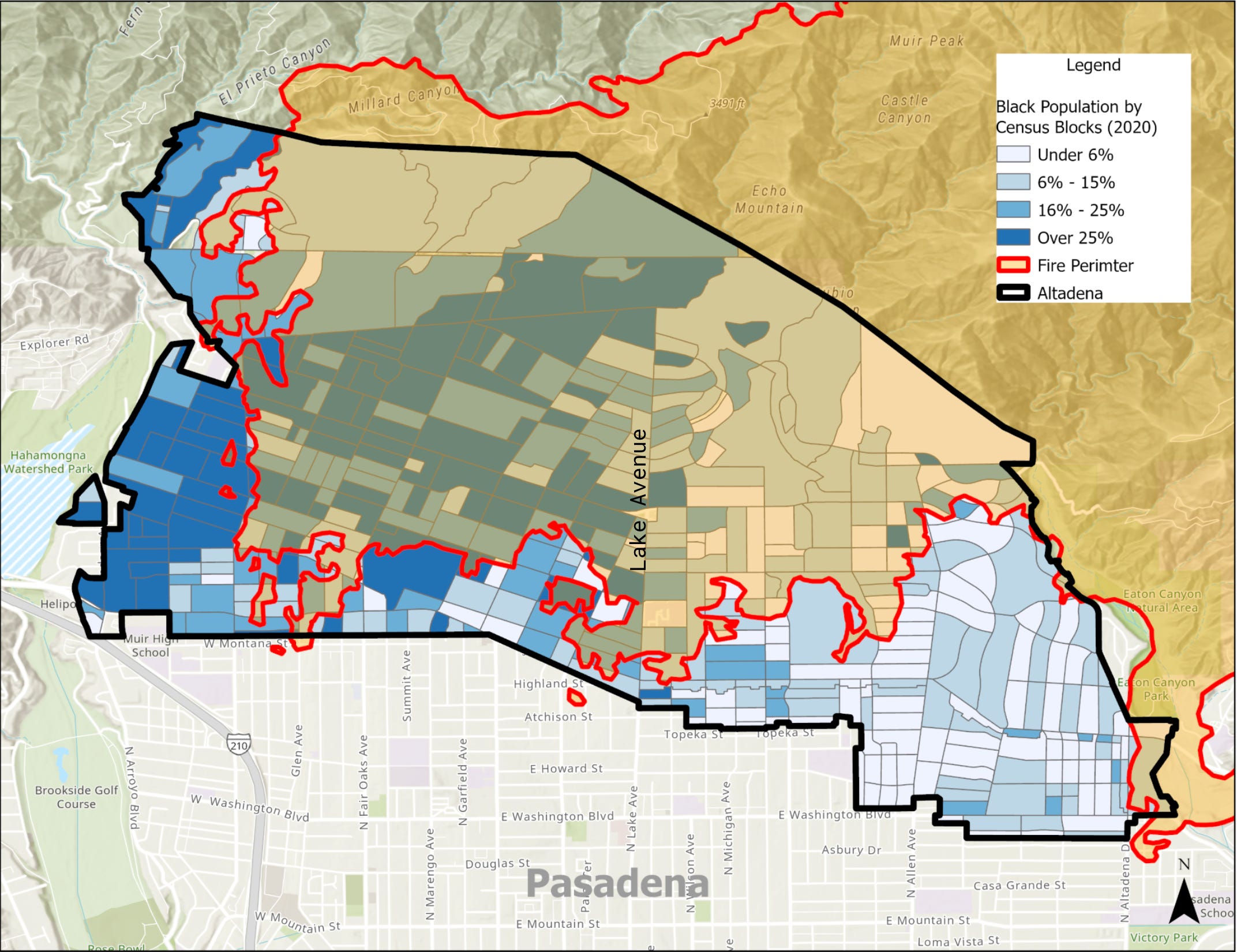
Echoing the historic redlining, there is a distinct line in the sand (down central Lake Avenue) that persists to this day, east of which Altadena becomes notably whiter and wealthier. Though the fire started in the east, wind patterns caused the fire to tear through western Altadena unabated. Yet residents of the area were not issued evacuation orders until 3am, nearly ten hours after orders were given for the east. And because of the fire raging in the Palisades, firefighting resources across Altadena were limited. In the end, 18 of the 19 individuals who perished in the Eaton Fire were from western Altadena. 48% of Black households were destroyed compared to 37% for non-Black households. The impact was disproportionate.
As we begin to rebuild, we celebrate it as an act of optimism and hope. But we also know it is an act of choice. Choice about what is preserved, what is replaced, and who is included.
It is now one year later, and a few houses are starting to go up. When I walk through the streets, I no longer see the gruesome remnants of homes and belongings. What I see now is mostly empty lots and possibility. When Mellanie began to rebuild her own home, she said to me, “I feel extremely blessed, but I’m also so scared.”
There is a lot of fear about who will be forced out of the new Altadena. Black homeownership was declining even before the fires due to rising home prices. This effect will only be intensified as developers buy up land and families lose the ability to pass on generational wealth via home assets. Some families who have been here for generations lost multiple homes across their family unit; Mellanie’s sister’s house burned down as well. Some Black families, who paid off their home loans generations ago, were uninsured when the fires hit. While most well-insured Altadenians have plans to rebuild, it is the underinsured who will likely be unable to return. This will inevitably include many of the people who made Altadena what it was.
History has shown us that when natural disasters hit, Black and brown people endure the worst of it. Altadena is no exception.
Despite the grief, the hope is palpable. On January 4th, 2026, Altadena came together in remembrance for the inaugural “Altadena Forever” run. Even in the pouring rain, thousands showed up to run through the burn zone in a much-needed reminder that Altadena is more than the sum of its structures. The community is still here even when the physical place is not.
We have all suffered the same loss. Our collective memory of what it once was will hold together the community as it is. And if for nothing else, for that we will be stronger. It is now incumbent upon those of us who remain to rebuild Altadena in a way that honors the ones who can’t come back—all those people who have made it worth saving.
Maya Cook is a Legal Program Associate at Democracy Defenders. She is a native Californian and earned her BA in Political Science from UC Berkeley.
I would like to enlist your help in gaining traction for a proposal which just might solve our immigration problem?
Plz help by reading this 3 minute read. If you think it worth it spread the word via friends, neighbors + local, state & national representatives. At 91 I do not do Facebook, Tweet, TikTok nor chat on Reddit, Instagram, etc. daily chores take most of my energy
Edits, criticism & catchy titles all welcome. I have no need for any recognition as the author. TIA
It was written as a proposal to rebuild fire devastated California towns, thus the 1st paragraph may need to be deleted?
Any fire requires a spark, fuel & oxygen. We for the most part can influence only one, tho Smokey Bear expended much treasure trying to control another which ironically has led to an abundance of tinder. Wise forest management can remedy this problem, and at a cost certainly less than the present toll for fighting fires + rebuilding + State subsidy of insurance. AND surely at less human cost in lives & stress.
One solution which needs serious discussion is a revival of a program like the Civilian Conservation Corps that was successful during the Great Depression by putting to work millions of unemployed men, but now fire survivors &/or immigrants, from artists to cooks to lumberjacks, could build & rebuild throughout the USA.
A blueprint for America --
Instead of billions for ICE, a wall, Deportation Camps and soldiers stringing razor wire, let's develop an immigration policy to benefit millions: both present asylum seekers and past immigrants as well as folk who have lost everything to fire, flood or other natural disasters.
A program like the Civilian Conservation Corps may be the key to accomplish this! In the 1930s the CCC helped 3 million young men, their families and local communities survive the Great Depression. A present day example would be helping towns devastated by wildfires to rebuild with the help of a local CCC camp staffed by local folk with skills and trades, perhaps even some DACA-ites which could open a path for them to citizenship.
What if asylum seekers were granted respite in return for enrolling for at least 6 months in a CCC project while they awaited their “day in court”? If needed, the military could provide setup assistance & security for these camps. Financing could be a joint venture of Federal, State and local government.
Experience gained could be applied nationwide helping after natural disasters, supplying workers to reduce fires by implementing needed forest management practices and in
rebuilding the nation’s infrastructure.
America is at its greatest when it extends helping hands in grass root community action.
What better way to bring people together? For are we not all immigrants?
For more information concerning CCC please see –
John A. Salmond, The Civilian Conservation Corps CCC 1933–1942: a New Deal case study (1967)
Robert Allen Ermentrout, "Forgotten Men: The Civilian Conservation Corps," (1982)
Fechner, Robert, Director (1938). Pamphlet: Objectives and Results of the Civilian
Conservation Corps Program. Washington, D.C: Civilian Conservation Corps
Conservation Corps CCC
1933–1942: a New Deal case study (1967)
Conservation Corps Program. Washington, D.C: Civilian Conservation Corps
Oh the situation in East Altadena can't possibly be that bad. Why only recently Dictator Trump Said White People were Being ‘Very Badly Treated’. His comments reveal his administration’s racial politics, which rest on the belief that white people have become the real victims of discrimination in America. Hopefully East Altadena has vast oil deposits.....