


Yesterday, I wrote that the Trump administration this year turned “national security” into a catch-all justification for aiming powers built for foreign threats inward—treating fear as policy and spectacle as a substitute for standards. There is an outward-facing companion to that story that stretches beyond our borders. The current U.S. posture—impulsive, performative, and indifferent to institutional restraint—has taught foreign allies and adversaries alike to treat American reliability as conditional and U.S. volatility as the baseline.
These nations are no longer waiting for Washington to steady itself; they are building their strategies on the assumption that it might never.
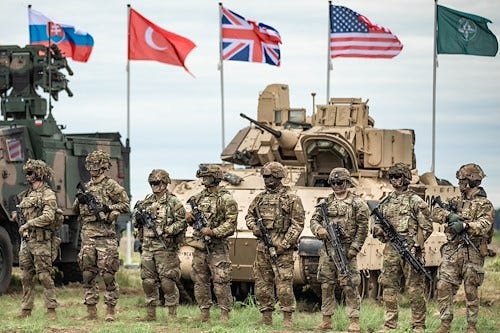
World leaders did not start 2025 facing a mystery. They lived through the Trump first term—and then watched him promising a sharper version of the same approach if elected again. Still, many foreign governments began the year telling themselves the task was still to limit the damage, absorb the theatrics, and keep the machinery of cooperation running.
But, as the months unfolded, each new policy or episode didn’t merely confirm what they already knew about President Donald Trump; it forced a harder conclusion: This wasn’t a rough patch to ride out until the next U.S. election. It was a shift in what the United States is willing to do with its power—treating commitments as adjustable, rules as optional, and leverage as something to use even on friends.
The first wake-up call came in February in Munich. Vice President JD Vance used a conference built for alliance reassurance to chastise European leaders that the chief danger was “from within”—censorship, cancelled elections, and mass migration—rather than Russia or China. He recast solidarity as contingent—a message sharpened two weeks later in the infamous Oval Office meeting with Ukrainian President Volodymyr Zelensky. The gauntlet had been laid: U.S. support for allies was conditional, and withdrawal was always on the table.
April made the new normal of volatility real. On April 2, Trump announced “Liberation Day” tariffs and rewrote the trade rules in one stroke—quickly, broadly, and with swagger, less like negotiation than a show of power. Allies and adversaries drew the same conclusion: If Washington can upend the economic relationship overnight, no one should assume security commitments live in a separate, protected box.
Ukraine was where that conclusion stopped being abstract. In the spring, the administration paused intelligence sharing and security assistance then lifted the pause after Kyiv backed a U.S.-supported ceasefire framework. Later came fresh interruptions and reversals—on weapons flows and on what the United States would share with close partners about the talks. Even when moves were walked back, the lesson held: Support could tighten or loosen quickly, and allies should plan accordingly.
Finally came the National Security Strategy this month. If there was any doubt that the United States was narrowing its focus and treating commitments more like deals, the NSS put it in plain English: The Western Hemisphere comes first and everything else comes after. For the rest of the world, that’s when the argument ended. This wasn’t just another Trump moment; it was the administration putting its worldview on paper—and telling allies and rivals to treat U.S. unpredictability as the new baseline.
By the end of 2025, most capitals have stopped treating Washington as a partner to be “managed” and started treating it as a risk to be engineered around. Allies and rivals have stopped waiting for the “old America” to return and started making structural changes to protect themselves—changes in economic partnerships, defense planning, trade routes, and information sharing that won’t snap back just because the occupant of the Oval Office changes.
Europe’s hedge has been two-track: keep the United States close enough to deter Russia while building the capacity to withstand sudden pauses or policy shifts from Washington. Rearmament is the visible part—budgets, joint procurement, munitions and air defense. The quieter part is resilience against single points of U.S. political failure, especially in areas such as intelligence collection and analysis. With China, Europe has stepped into the cage with the tiger: resisting Beijing’s leverage while keeping China in play as a diversification hedge against U.S. pressure.
Canada has set a goal of doubling non-U.S. exports over the next decade, is steering policy and capital toward more domestic production and infrastructure, and is using its Indo-Pacific strategy to widen trade and supply chains with partners including India, Japan, South Korea, and ASEAN—while leaning harder into Europe where it can.
In the Indo-Pacific, allies have made a similar pragmatic adjustment—a scramble to “minimize abandonment” and preserve the security upside of U.S. power while reducing exposure to U.S. economic pressure and policy whiplash.
China watched these recalculations and moved to profit from them, understanding that TACO is not just a witty acronym because Trump’s threats are often followed by delay or retreat when markets and domestic realities bite. Beijing has held firm where it could, waited when it should, and used America’s lurching approach to make itself look like a steadier partner by comparison—not kinder, just more predictable. It pushed exporters to reroute and repackage supply chains through third countries. In parallel, China continues its military buildup and a steady squeeze on Taiwan and the South China Sea. China does not need to peel allies away outright; it only needs to deepen the world’s habit of hedging.
The pattern repeats across the world and domains—trade, technology, sanctions, basing, intelligence, even the basic choreography of summit diplomacy—and it points in the same direction. The question is not whether the United States still has power—it plainly does—but whether others can trust how that power will be used.
By the time the Oval Office is redecorated on Jan. 21, 2029, the world will not be waiting for Washington to “come back” in the old sense. But that does not mean the United States becomes irrelevant, or that allies stop needing it; it means the baseline has shifted. A new administration will be able to rebuild and renegotiate—but it will be doing so in a world that is more cautious, more conditional, and less forgiving.
That is the outward-facing lesson of 2025: America remains strong but is increasingly treated as the variable everyone else must manage. The White House will find trust more tarnished, influence less automatic, and bargaining power more contested—sometimes competing, in certain rooms, with an alternative promise of predictability offered by Beijing.
And much of it started in 2025.
Brian O’Neill, a retired senior executive from the CIA and National Counterterrorism Center, is an instructor on strategic intelligence at Georgia Tech. His Safehouse Briefing Substack looks at what’s ahead in global security, geopolitics, and national strategy.

NO ONE! I repeat, no one in America wants a “war” with Venezuela!
Only Trump, Hegseth and a few in the military.
It’s crazy to finally finish 24 years of unending war and just jump into another one because Trump doesn’t like his chances at the midterms!
Trump regime is leading from a position of weakness. None of our European allies and Canada see us from a position of strength anymore. Until we have some real leadership and leaders who respect our allies and our position in the world it will never improve.