


“America, U.S.A.: How Race Shadows the Nation’s Anniversaries” by Eddie S. Glaude Jr. is the Princeton professor’s attempt to trace the moments when the United States has marked its founding — and who has been left out of these commemorations. Each chapter begins with a fragment of sheet music from composer Joel Thompson, forming a work written for the book.
Glaude spoke with Abraham Kenmore shortly before the book published on May 26. The following is excerpted from that conversation with edits for length and clarity. Quotations from other authors are left as spoken and may not be exact.
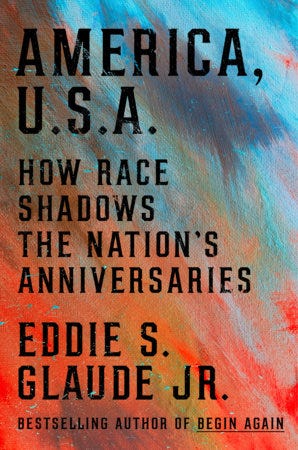
Throughout the book, you’re quoting [James] Baldwin, you’re quoting Frederick Douglass, you’re quoting Walt Whitman, President [Gerald] Ford — all these people who’ve been thinking about and writing about this issue of race in America, Blackness in America. When you were approaching this book, what did you feel like hadn’t been said that you wanted to say?
I think at the heart of it was a curiosity, a kind of sense that there’s a haunting at the heart of the American project, that there’s something that cycles repeatedly — and it happens at these moments when we have to tell the story of our founding, tell the story of ourselves.
Here we are in 2026, and we’re grappling with the gutting of the Voting Rights Act, we’re grappling with the racism of Trumpism, white nationalism, white Christian nationalism, however you want to describe it, and it’s happening in the 250th year of the country. And my gut was telling me this is a repetition of sorts, this is a rhyming, to use Twain’s language, of sorts.
I’m not Jill Lepore, I didn’t want to write a 250-year history of the country, so I thought, well, let’s look at these milestone anniversaries. And when you think about it, 1876 is the beginning of the collapse of Reconstruction, 1926 it’s the decade of the Klan, 1976 a deep sense of skepticism coming out of Watergate, Vietnam, Black Power and the like. And each of these moments when the country has to tell a story of itself the vexed issue of race, of its divided soul, is in full view.
Your first line is, “I do not love America, and never have, especially now,” and the last word of the book is “blues,” right? I feel like a lot of times when I’m reading books, there’s this impulse to — even if you go into a dark place — to end on a note of hope. I’m not saying that this book doesn’t have hope, but why did you want to have so much of that sense of blues throughout? What made you steer away from reaching to end on a high note?
I think that’s part of the American fantasy, it’s one of the reasons why we can’t grow up. Everything has to end in resolution, we’re always already on the road to a more perfect union, you want to end in that space.
Even though I disagree with, a little bit, Robert Bellah, the sociologist who gave us the notion of American civil religion — when you read his 1975 book, “The Broken Covenant,” or you read Robert Penn Warren’s book on the legacy of the Civil War, both of them are saying that we need to have a more tragic sense of the country, right? That we have to attend to our losses and our failures and our evils, and I use that possessive on purpose. And to attend to that, to recognize it, acknowledges what I take to be the blue note at the heart of the country. You know that blues scale is predicated upon the most unstable chords you can imagine, right?
I was hoping that you’d speak a little bit about the role of music in this book and why you chose to weave this composition through it.
In so many ways, it’s an homage to W.E.B. DuBois, his classic book, “The Souls of Black Folk.” At the beginning of each chapter in “The Souls” is a bar of music from the slave spirituals, and then a line of prose from the Western canon. For him, it’s kind of showing the doubleness of the country.
And because I say, well, Du Bois is right, and his description of Black folk as experiencing a kind of double consciousness — that we see ourselves through the eyes of those who despise us — but the country itself, I argue, is experiencing that what we experience as double consciousness, the divided soul of the country.
So I asked the award-winning classical composer Joel Thompson to compose a composition in response to the argument, because I didn’t want the duality — slave spiritual or blues and western prose. No, I wanted it to be in one body, I wanted it to be me, us. Joel came back with this amazing piano concerto called “And Blue.”
Throughout this book you use the image of freedom dreaming. I wonder if you’d talk a little bit about where you see people dreaming of freedom or doing that freedom dreaming in this moment?
Yeah, so you know, freedom dreaming is really important. Freedom seeking is really important in the book. And freedom dreaming is, and freedom seeking is, of course, contrasted with freedom snatching.
A horrific story of Moses Gordon crystallizes that for you, that is a slave who was freed during the revolution in 1776, re-enslaved two years later because of a statute passed by the colony of North Carolina, escapes to Philly, lives a life for 10 years, and then is captured because of the Fugitive Slave Clause in the Constitution. And as he was incarcerated to be extradited to North Carolina, he commits suicide.
We’ve always freedom dreamed is the point in that long-winded preface. Freedom dreaming today is — we can see it in spaces that are fighting against ICE and spaces that are fighting for full citizenship, as we fight the battle around the gutting of the Voting Rights Act. There are those who are fighting for working people.
Now, I think our task, at least my task as a writer, is to give them space to dream even more expansively. To not just simply tinker around the edges, but to imagine the country shorn of those commitments that keep it mired in the muck, you know?
If you’re handing someone a book this year, one book that you should read on the 250th anniversary of the Declaration, what book are you handing folks?
On the 250th? I should say this, this book is the third in a trilogy. [James] Baldwin has been a through line, so much so that the second volume was about him — or not really about him, but he was walking with me as I was trying to understand Americanism at the dawning of the Trump years.
So I would give them the collected nonfiction of James Baldwin, and say start from the beginning and make your way all the way to the end and track his voice. Feel how it coarsens, not just simply because the cancer is eating it up, but what does he mean when he says on his deathbed “sometimes I feel like — I felt like a broken motor saying the same thing over and over again.” What does it mean when he says that about Ronald Reagan?
I would give people the portal to a vast literature that demands that America grows up. So I would give them Baldwin.
When I read your first line, I thought, of course, of “Notes of a Native Son,” “I love America more than any other country in the world, and exactly for that reason, I insist upon the right to criticize it perpetually.” But as you write about Baldwin evolving, he kind of moves away from that — and you aren’t really in that space either.
That first sentence is operating on three registers. One is just a visceral register of the wounding. Another is a riff on Hannah Arendt. She is very skeptical of loves of people and nations and the like. And then there’s this, this, this Baldwinian riff — and unlike Baldwin, you know, my love is located closer to the ground. When it comes to the country, that’s just an abstraction for me, and it’s an abstraction that’s dangerous.
And so what I want to do is to bring it from the abstraction to the ground, and what is clear, I hope, is that my love of this place — not the abstraction of this place — is rooted in the people, and that love includes us all, not just the people that matter to me. This is that beautiful formulation from Ralph Ellison, that “democracy at its best is a form of disinterested love,” that I care for your well-being, even though I do not know you. And I want that sensibility to be rampant in our lives.

Our Indivisible chapter has started a book club, with this book as our first pick. I'm appreciating all of the references to, and quotes from, Baldwin and Frederick Douglass, two of our most brilliant thinkers, and eloquent speakers, on the issue of race in America. And I'm struck by the parallels between what was happening in both 1876 as well as 1926 with what we're experiencing today. History definitely does rhyme.
I am a bit tired about race, as if we are more than one race. We are people, one race; the human race that does horrible things to each other.