


Whether it was wise for six senators and representatives to make a video reminding soldiers that they should not obey illegal orders is the kind of question that democratic procedures are designed to decide. Elections provide voters with the opportunity to weigh in on that question.
Whether what they did was legal goes to the heart of how representative democracy works. Representative democracy cannot work well if the executive uses its prosecutorial power to punish legislators for what they say in the course of their legislative activities.
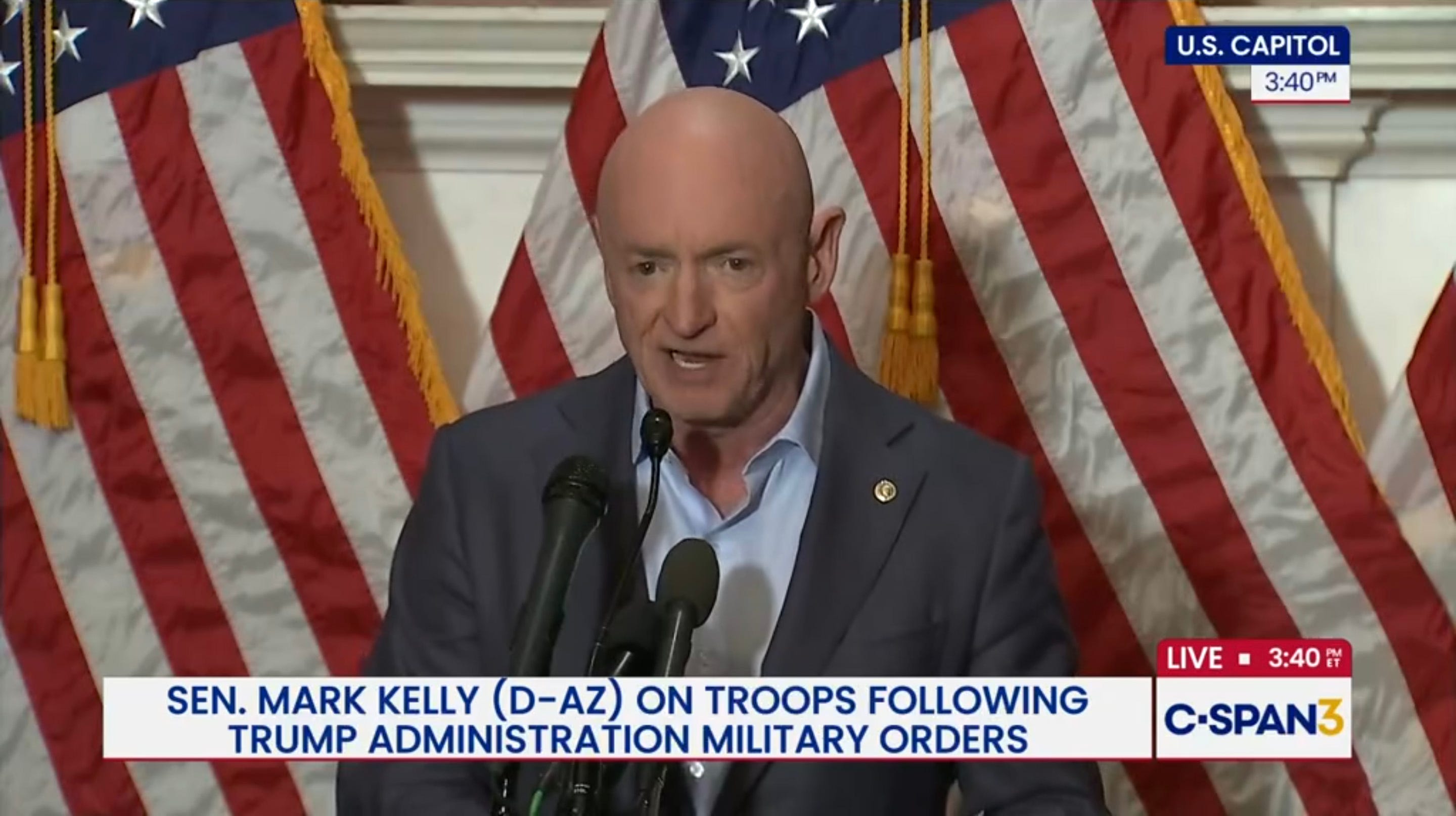
That is why the president’s threat to prosecute Sens. Mark Kelly and Elissa Slotkin and Reps. Jason Crow, Chris Deluzio, Maggie Goodlander, and Chrissy Houlahan for “sedition,” the FBI’s plan to launch an inquiry, and the Pentagon’s threat to court martial Kelly, a retired military officer, are so troubling. They threaten to undermine legislative independence.
We all have a stake in the fate of Kelly and his colleagues. We all should speak out against the administration’s latest effort to intimidate and silence those it regards as its political enemies.
Recall what Sen. Lisa Murkowski (R-Alaska) said in April about her colleagues and life under the Trump administration: “We are all afraid. It’s quite a statement. But we are in a time and a place where I certainly have not been here before. And I’ll tell ya, I’m oftentimes very anxious myself about using my voice, because retaliation is real. And that’s not right.”
Legislators who are afraid to speak out cannot do their jobs. They cannot keep their focus on doing what is best for the country and hold the executive accountable for its actions.
The people who wrote the Constitution were aware of this. To protect legislators, they included Article I the speech or debate clause.
“The Senators and Representatives shall … in all Cases, except Treason, Felony and Breach of the Peace, be privileged from Arrest during their Attendance at the Session of their respective Houses, and in going to and returning from the same; and for any Speech or Debate in either House, they shall not be questioned in any other Place.”
In 1880, in its first consideration of the speech or debate clause, the Supreme Court said that a member of Congress may be “prosecuted under a criminal statute provided that the Government’s case does not rely on legislative acts or the motivation for legislative acts…. (T)he Speech or Debate Clause prohibits inquiry only into those things generally said or done in the House or the Senate in the performance of official duties and into the motivation for those acts.”
Sixty years ago, the court explained that the speech or debate clause was a reaction to “a long struggle for parliamentary supremacy” in Great Britain.” Tudor and Stuart monarchs “utilized the criminal and civil law to suppress and intimidate critical legislators.”
Those monarchs wanted to “imprison members of Commons on charges of seditious libel … [t]he law of seditious libel was interpreted with the utmost harshness against those whose political or religious tenets were distasteful to the government.” Sound familiar?
So important was protecting “the independence and integrity of the legislature” from such abuses that “The Speech or Debate Clause of the Constitution was approved at the Constitutional Convention without discussion and without opposition.”
James Wilson, who was a delegate to the Constitutional Convention, later called the provision “indispensably necessary to the discharge of the publick [sic] trust.” It was necessary, he argued, for Members of Congress to be “clothed with the fullest liberty of speech so as to be protected from the resentment of every one, however powerful, to whom the exercise of that liberty may occasion offense.”
In Federalist 48, James Madison described the speech or debate clause as an essential element of the separation of powers. The Supreme Court agrees.
In 1972, it observed that “It does not undermine the validity of the Framers’ concern for the independence of the Legislative Branch to acknowledge that our history does not reflect a catalogue of abuses at the hands of the Executive that gave rise to the privilege in England.” When they wrote those lines, the justices did not foresee the rise of Donald Trump.
Even so, the court has interpreted the speech or debate clause “to include not only ‘words spoken in debate,’ but anything ‘generally done in a session of the House by one of its members in relation to the business before it.’” It has held that “The claim of an unworthy purpose does not destroy the privilege.... The holding of this Court… that it was not consonant with our scheme of government for a court to inquire into the motives of legislators, has remained unquestioned.”
Though the protections provided by the speech or debate clause are not unlimited, the court applies them to all matters which the Constitution “places within the jurisdiction of either House.” The regulation of the military is surely one of those matters.
But you would never know that from what Trump and Secretary of Defense Pete Hegseth have said about the video made by Kelly and his colleagues. How can it be a crime or an offense under the Uniform Code of Military Justice for legislators to remind soldiers of their obligation to obey the law?
Such Orwellian logic beggars the imagination.
However, that didn’t stop the Pentagon from announcing the court martial investigation of Kelly. Hegseth called the video made “by the ‘Seditious Six’ … despicable, reckless, and false. Encouraging our warriors to ignore the orders of their Commanders,” he continued, “undermines every aspect of ‘good order and discipline.’”
Of course, that is not what the video does.
Undeterred by that fact, Hegseth claimed, “Their foolish screed sows doubt and confusion — which only puts our warriors in danger…Five of the six individuals in that video do not fall under @DeptofWar jurisdiction (one is CIA and four are former military but not ‘retired’, so they are no longer subject to UCMJ). However, Mark Kelly (retired Navy Commander) is still subject to UCMJ—and he knows that.”
Not surprisingly, Hegseth ignored the speech or debate clause. He argued that Kelly’s statements and actions “were addressed directly to all troops while explicitly using his rank and service affiliation—lending the appearance of authority to his words. Kelly’s conduct brings discredit upon the armed forces and will be addressed appropriately.”
What should be addressed appropriately is Hegseth’s amateurish effort to turn the department he leads into a tool in Trump’s retribution campaign. If Congress were doing its job, it would investigate that effort.
Even Republicans, including Rep. Don Bacon of Nebraska, see Hegseth’s threat for what it is: “Amateur hour once again at the Department of Dense.” Bacon added, “I thought the video by six Dems was unnecessary and foolish. But the threats of sedition charges and courts martial in response are also crazy. Let’s show some common sense and restraint.”
Protecting against such craziness is precisely what the speech or debate clause does. The Tudor and Stewart kings and queens might approve of the efforts by the secretary of Defense and the president to bully legislators, but they have no place in a system of representative government.
Austin Sarat is the William Nelson Cromwell Professor of Jurisprudence and Political Science at Amherst College.

While true as far as it goes, this column entirely misses the essential points of the video, which are 1) that service members count on veterans in Congress for guidance, and 2) that these congresspersons and senators have the same first amendment right to free speech that all Americans enjoy. We’re in the real world, here, not some fantasy ivory tower. Geez — wise?? It is critical AND legal. What a cheap shallow ‘analysis’ you have offered. I’m guessing you have never served, so until you do, STFU.
Lawyers: Are there grounds for a class action suit (brought by say, Democracy Defenders), on behalf of Sen. Mark Kelly and the other legislators who stuck their necks out to remind us of the Constitution, and who are now facing retribution?