

By Frederic J. Frommer
In recent years, baseball has placed an increased premium on home runs—perhaps perfectly epitomized by the National League’s 7-6 All-Star Game victory last week decided on a home run competition “swing-off.”
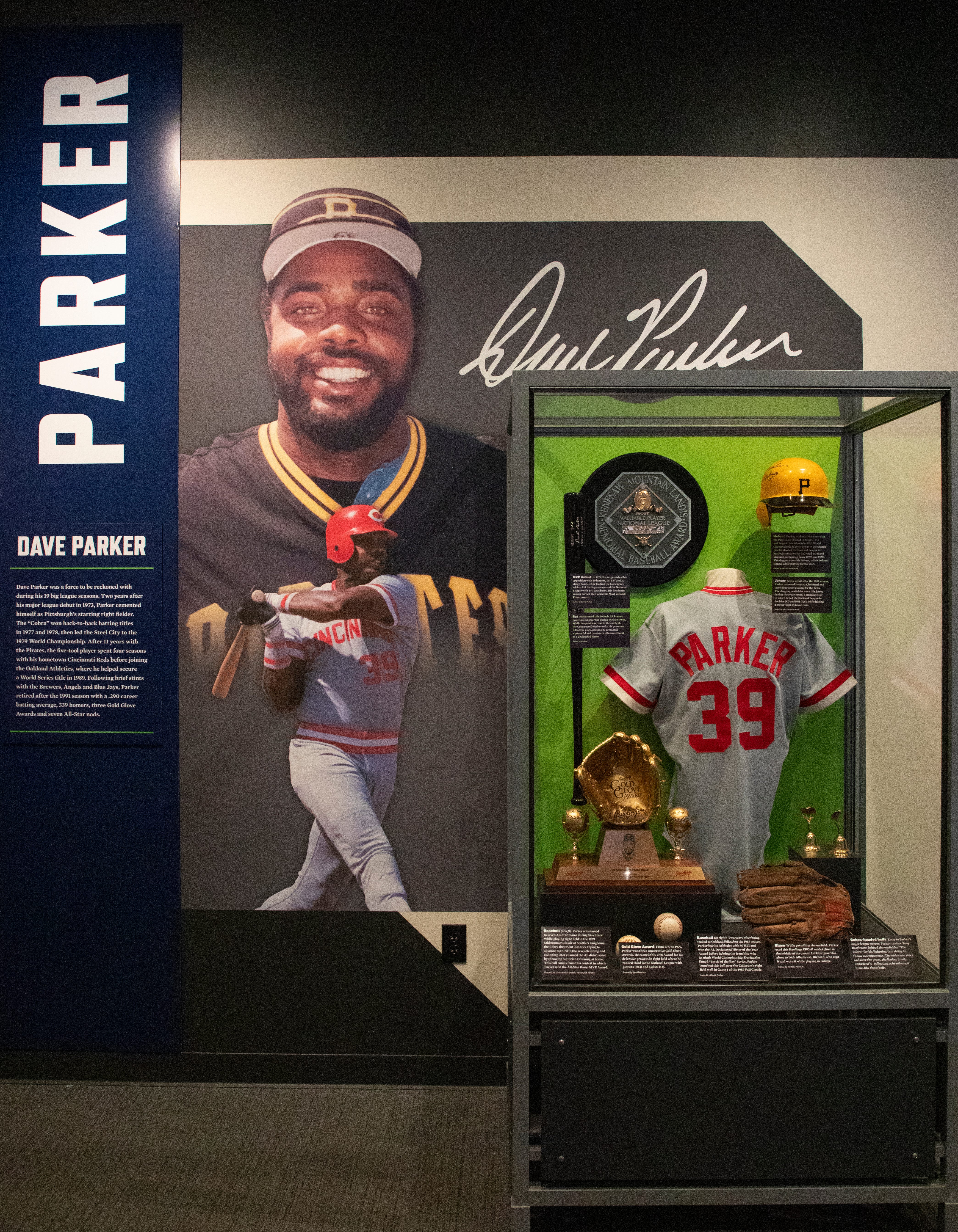
But in another 7-6 NL victory 46 years ago, it was a pair of missile throws from Pittsburgh Pirates right fielder Dave Parker that earned the top accolades. Baseball rarely rewards defense with a Most Valuable Player award, but his throws were so gravity-defying and so clutch that it was hard to make the case for anyone else at MLB’s 50th All-Star Game in 1979, held in Seattle’s Kingdome.
This weekend, Parker will be inducted into the Baseball Hall of Fame, just a month after his death at age 74.
At the 1979 All-Star Game, Parker started in right field and batted second, between a pair of Los Angeles Dodgers—Davey Lopes and Stave Garvey. Parker, 28, was already known for his cannon, but that was just one element of his game. Nicknamed “the Cobra,” he was also an outstanding hitter, having won the two previous NL batting titles, eclipsing .330 both years. He was coming off an MVP season in ’78, when he hit 30 homers and 12 triples, stole 20 bases, drove in 117 runs, and led the league with a .585 slugging percentage. Parker also won his second consecutive Gold Glove award.
By the seventh inning of the ’79 Midsummer Classic, with the AL ahead 6-5, Parker was still in the game after most of his fellow starters had been subbed out. (In fact, he would be just one of two NL starters who played the entire game, along with San Diego Padres outfielder Dave Winfield.)
Leading off the bottom of the frame, Boston Red Sox slugger Jim Rice, the reigning AL MVP, hit a high pop fly to right field, but Parker lost it in the lights. The ball landed in fair territory, then took a superball bounce off the artificial turf over Parker’s head. He chased it down in foul territory with his back to the infield, twirled around, and made a perfect one-hop throw to Los Angeles Dodgers third baseman Ron Cey to cut down Rice, stretching for a triple.
Just three months earlier, Parker and Rice, two of the game’s great superstars, had posed together, back-to-back, on the cover of Sports Illustrated, the 6-foot-5-inch Parker towering over the 6-foot-2-inch Rice, under the headline, “WHO’S BEST?” Parker’s throw seemed to provide the answer at baseball’s biggest summer showcase.
“Well, let me tell you, Dave Parker was better,” Rice told The Athletic recently. “He just was. He was better.”
But Parker’s seventh-inning throw turned out to just be a warmup.
After Lee Mazzilli of the New York Mets led off the top of the eighth with a home run to tie the game, the AL threatened to take the lead in the bottom half of the inning, with a man on second and two outs. Graig Nettles of the New York Yankees singled to right, and the baserunner, Brian Downing of the California Angels, rounded third and broke for home for the potential go-ahead run. But Parker uncorked a perfect, no-bounce laser to nab him at the plate.
On the TV broadcast, announcer Joe Garagiola was effusive—but he gave catcher Montreal Expos catcher Gary Carter all the credit.
“What a tag by Carter! A tremendous play by Carter! Oh baby, what a play.”
True, Carter did an excellent job of blocking the plate as he caught the ball and made the tag. But Garagiola—perhaps because he had been a catcher—was missing the big story here.
Luckily, his partner, Tony Kubek, quickly recognized the oversight, telling viewers: “And what a throw by Dave Parker, who continues to show why some people consider him the greatest player in the game,” adding, “No hitting the cutoff man in this situation.…”
After the tag, Parker’s NL teammates poured excitedly out of the dugout, a collage of powder blue, mustard orange and other colors that helped define 1970s baseball uniforms, and congratulated Parker as he came off the field.
The NL took the lead in the top of the ninth inning, when Yankees pitcher Ron Guidry, who had won the Cy Young Award the previous year, walked Mazzilli with the bases loaded. Chicago Cubs reliever Bruce Sutter retired the side in the bottom of the ninth to ice the game.
After that final out, Parker recalled in his autobiography, “Cobra,” he got a hug from the San Diego Chicken in the dugout. Then his Pirates manager Chuck Tanner, a coach on the NL squad, embraced him. “Where are you going?” Tanner asked. “You won it.”
“I got MVP?”
Tanner nodded and grinned.
Parker wrote this meant more than his back-to-back batting titles:
“I carried that thing through the dugout, up the stairs to the clubhouse, out the stadium, back through the doors of the Olympic Hotel. It sat beside me on the hotel bar while I cooled out with some of the fellas. I might’ve even bought it a drink. I stared at the trophy before I fell asleep. I carried it through Sea-Tac Airport like a damn Cabbage Patch doll.”
When he got home, Parker put it on his mantelpiece.
Then it was time to focus on the second half. The Pirates were in fourth place, but Parker and veteran first baseman Willie Stargell helped turn the season around—with some musical inspiration from Sister Sledge’s disco hit “We Are Family,” which became the team’s theme song. The Pirates won the World Series that year. It remains the last one in franchise history, nearly a half-century later.
Parker didn’t win Hall of Fame enshrinement until last December, when the Hall of Fame Classic Baseball Era Committee voted him in, years after he was first eligible.
“I loved throwing out runners,” Parker told reporters after winning induction, adding, “And if they kept running, I would hit them in the back of the head with the ball.”
Frederic J. Frommer, a writer and sports and politics historian, has written for the Washington Post, the New York Times, the Atlantic, History.com and other national publications. A former Associated Press reporter, Frommer is the author of several books, including “You Gotta Have Heart: Washington Baseball from Walter Johnson to the 2019 World Series Champion Nationals." Follow him on X.
This was a great article. I needed to hear something good that’s happening and the HOF induction on Sunday will be amazing.
I am just sorry that Parker will not be there to see it. But at least he knew he made it.