


Donald Trump was not playing five-dimensional chess when he attacked Pope Leo for being “weak on crime” or when he posted a picture portraying himself as Jesus (subsequently taken down). Assuming a clever strategy behind objectively demented conduct is the equivalent of sane washing, that is, straining to attribute rational motives to someone behaving irrationally. Trump is deeply unwell, becoming more so as he experiences serial failures and finds his bully routine no longer works (on Iran, Europe, or the Pope).
As Peter Baker of the New York Times acknowledged (more please!), the buzz about Trump’s mental stability has heated up of late:
A series of disjointed, hard-to-follow and sometimes-profane statements capped by his “a whole civilization will die tonight” threat to wipe Iran off the map last week and his head-spinning attack on the “WEAK on Crime, and terrible for Foreign Policy” pope on Sunday night have left many with the impression of a deranged autocrat mad with power.
Mr. Trump seems even less restrained and more incoherent at times. He uses more profanity, speaks longer and regularly makes comments rooted in fantasy rather than fact.
Pope Leo responded as one would expect of a religious leader. On Monday, Pope Leo said, “The message of the church, the message of the gospel — blessed are the peacemakers. I do not look at my role as being political.” He continued: “I don’t want to get into a debate with him. I don’t think the message of the gospel is meant to be abused in the way that some people are doing.” Legacy media’s insistence on treating this like a game (the two are “feuding”!) reveals their own superficiality, lack of insight into Pope Leo, and aversion to taking Trump’s mental defects seriously.
Nevertheless, Pope Leo is as much a problem for Trump as Pope John Paul II was for communist Poland. When a native son (Leo of America, John Paul II of Poland) expresses affection for and understanding of his countrymen in their native language during a time of the oppressive rule, the Pope can form an emotional bond that rises above politics. His message of faith, peace, and love reaches far beyond Catholic churches and compels people to focus on matters and values more profound and compelling than partisanship. A Pope in tune with his flock who promotes a values-based worldview can illuminate an autocrat’s smallness, meanness, and desperation.
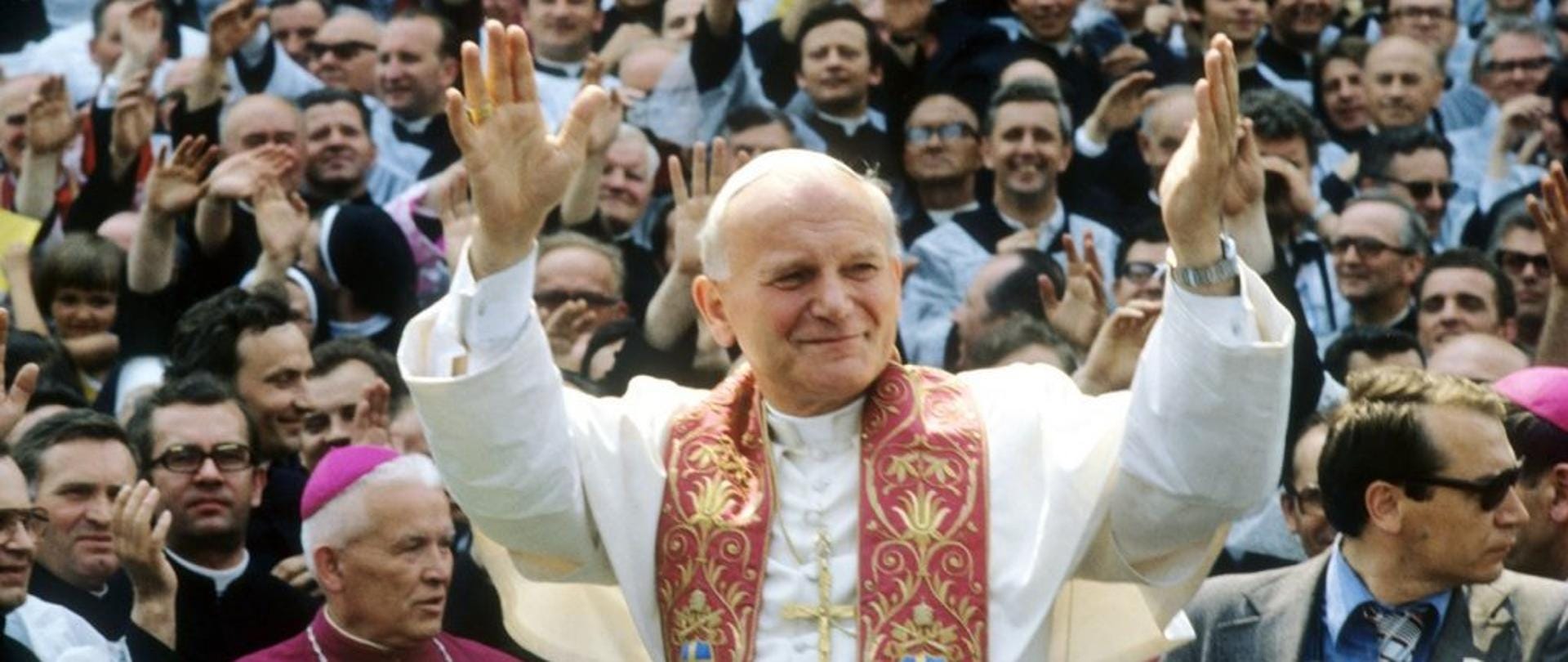
As Catholics recall nearly fifty years later, Pope John Paul II’s visit to Poland in June 1979 helped ignite a movement that would upend the communist regime. The Pope’s visit attracted 11 million people (of a total 36M at the time) and “helped many Poles understand that they were not alone in their rejection of the regime.” Put differently, John Paul II helped Poles reconnect with their historic, religious, and patriotic roots, helping them to recognize communism as a foreign, transitory, and corrosive force. A year later, Solidarity formed in the Lenin Shipyards in Gdansk to spearhead the anti-communist political movement.
The Polish example reminds us that autocrats resort to bullying, violence, and fear because they cannot obtain people’s affection. Through personal experience with a despotic regime, regular people (whether in Poland in the 1980s or Hungary and the U.S. today) eventually recognize the regime as exploitive, corrupt, and cruel.
Once unleashed, these forces can level tyrants who previously cultivated the aura of invincibility. Historian Anne Applebaum writes:
Orbán’s loss brings to an end the assumption of inevitability that has pervaded the MAGA movement, as well as the belief—also present in Russian President Vladimir Putin’s rhetoric—that illiberal parties are somehow destined not just to win but to hold power forever, because they have the support of the “real” people. As it turns out, history doesn’t work like that. “Real” people grow tired of their rulers. Old ideas become stale. Younger people question orthodoxy. Illiberalism leads to corruption. And if Orbán can lose, then his Russian and American admirers can lose too.
Popular movements grounded in stirring positive emotions such as patriotism, love, and faith accelerate the demise of secular autocrats who appear small, desperate, and superficial in comparison to religious figures. When despots insult the faithful, matters go from bad to worse.
The now-infamous Trump-as-Jesus image triggered an instantaneous blowback from many in his white Christian base, compelling him to take it down and confirming this was not some genius strategy. He wouldn’t, however, apologize to the Vatican, showing where Catholics stand in the MAGA hierarchy. (Only the most willing dupes bought his lame excuse that he thought the image portrayed him as a doctor.) Rightwing commentators decried Trump’s image as “blasphemy”, while regular Truth Social users also condemned Trump’s sacrilegious image.
The White House assumes angered Christians will soon forget the latest outrage, but at least for a moment, some MAGA Republicans (especially Catholics) can recognize Trump is an unhinged narcissist exploiting their religious beliefs. Perhaps rightwing Christians will become permanently disaffected from Trump or stay home in November or even disengage from politics entirely.
The democracy movement is not a religious community, although faith motivates many in their opposition to ICE, racism, and neglect of the poor. Nevertheless, the pro-democracy movement can and should stay grounded in positive ideals — patriotism, decency, fairness, and empathy. Whether those values emanate from religious faith or humanistic values, once people rediscover a sense of obligation to something higher than themselves, they are more likely to lose fear of the regime, forge a community with other inspired democracy defenders, challenge authority, and view vulgar, crazed leaders as weak and transitory figures.
Democracy advocates should unabashedly denounce Trump in moral terms. Launching a war of choice and threatening genocide is evil. Taking away healthcare and food from the poor to enrich billionaires is wrong. Deporting grandmothers and children is cruel.
When the argument becomes right vs. wrong rather than right vs. left, an amoral, corrupt autocrat is cooked. A wide coalition that can unite around simple propositions (e.g., freedom, decency, fairness, peace, truth) can bring down a communist Polish regime, a fascist Hungarian autocrat, or a mad king who rages at the Pope.
The party of Trump is the party of Autocracy, Oligarchy and Corruption. And will lie, cheat and steal to whatever degree necessary to achieve those ends. Say no to racism, homophobia, misogyny. Vote Blue.
Will the mainstream (legacy) media ever come around? From a health perspective, still talking about Biden but mostly ignoring Trump.