


Even as we prepare to celebrate the 250th anniversary of the American Declaration of Independence, the persistent MAGA narrative coming from the White House is not pride but decline. For all the chest-thumping about American greatness, the most powerful component of President Donald Trump’s four-word mantra has always been that last word: “Again.” From his 2016 “American carnage” inaugural address to his planting a previously toppled statue of Christopher Columbus on the grounds of the White House, Trump’s appeals to patriotism are rooted in blood-and-soil nostalgia and resentment.
In this administration, the promotion of white supremacy is simply an axiom. Just last week, as the Supreme Court approved Trump’s racist removal of Temporary Protected Status for Haitians and Syrians, Trump is welcoming white South African refugees with gift bags containing a PragerU children’s book on so-called reverse racism and white genocide in their country of origin and a document produced by Trump’s short-lived “1776 Commission” that defends America’s founding on slavery.

But the MAGA movement’s true cultural power — and the element that gives its racism moral cover — comes from its embrace of Christian nationalism. Trump tells his white Christian base that he is going to “bring back the churchgoer.” JD Vance’s language is more polished, but his appeals to “western civilization” and “Christian values” (made while campaigning for authoritarian leaders like Viktor Orbán) ultimately make the same claim—that both our past and our future lie in the reclaiming of our European Christian origins. That was certainly the vibe at the recent “Rededicate250” event, which I attended, on the National Mall. A cross between a white evangelical tent revival and a Trump rally, this publicly funded nine-hour extravaganza, which attracted a nearly all-white crowd, featured calls for the salvation of both individuals and the nation, not just through God but through “our Lord and Savior Jesus Christ.”
The stark declension narrative, of course, serves a would-be authoritarian well. At our 250th anniversary, the story line goes, we are facing an unprecedented state of emergency. Only the anointed leader can save us from the looming abyss below and the swarthy barbarians within.
To be sure, Trump and his white Christian nationalist followers will make much of the founders’ general references to God in the Declaration of Independence (Nature’s God, Creator, Supreme Judge of the world, divine Providence). But they always ignore an inconvenient fact: When these same founders translated those appeals into a governing document, they intentionally created a Constitution that omitted references to God, secured religious liberty for all, and ensured that there would be no government-established religion or religious test for public office.
In a 1790 letter written to the leaders of the Touro Synagogue in Newport, Rhode Island, shortly after the ratification of the Constitution, none other than George Washington clarified that these constitutional rights were “natural rights” and available equally to all:
It is now no more that toleration is spoken of, as if it was by the indulgence of one class of people, that another enjoyed the exercise of their inherent natural rights. For happily the Government of the United States, which gives to bigotry no sanction, to persecution no assistance requires only that they who live under its protection should demean themselves as good citizens.
Moreover, it should not be lost on us that we have lived through one catastrophic episode in the American experiment in which God was placed explicitly into a founding governing document. That was the Constitution for the Confederate States of America, which invoked “the favor and guidance of Almighty God” to justify white supremacy and the enslavement of African Americans.
Importantly, the Christian nationalist founding myth also begins with a fundamental falsehood: that the American colonies were all comprised of churchgoing Christians in 1776. The best estimates we have, however, indicate that at our nation’s founding, only about 10 percent of the population were official members of a congregation, and including more loosely affiliated people only brings the number of religious adherents to 17 percent (see The Churching of America, 1776-2005 by Roger Finke and Rodney Stark).
Even after population growth and the church-assisted westward occupation of Indigenous lands by the mid-19th century, religious adherence rates in the U.S. states were only about one in three by 1850. The United States did not become a majority religiously affiliated nation until our 150th anniversary.
Even after the much-discussed recent decline, modern levels of religious affiliation — approximately seven in ten Americans today — are roughly twice those of the first century of our nation’s existence. Despite the breathless warnings, America today is a far more religiously engaged nation than we were at our founding and through our first 150 years.
Since our bicentennial celebration in 1976, there have been signs of stability and religious growth. The proportion of Latino Catholics and other Catholics of color have tripled, nearing parity with white Catholics (10 percent vs. 12 percent). Latino and AAPI Protestants have grown from being populations that were rarely measured to comprising 6 percent of the population, and Black Protestants have remained steady (7 percent today). And the proportion of Americans who identify with non-Christian religions has doubled and now stands at 7 percent.
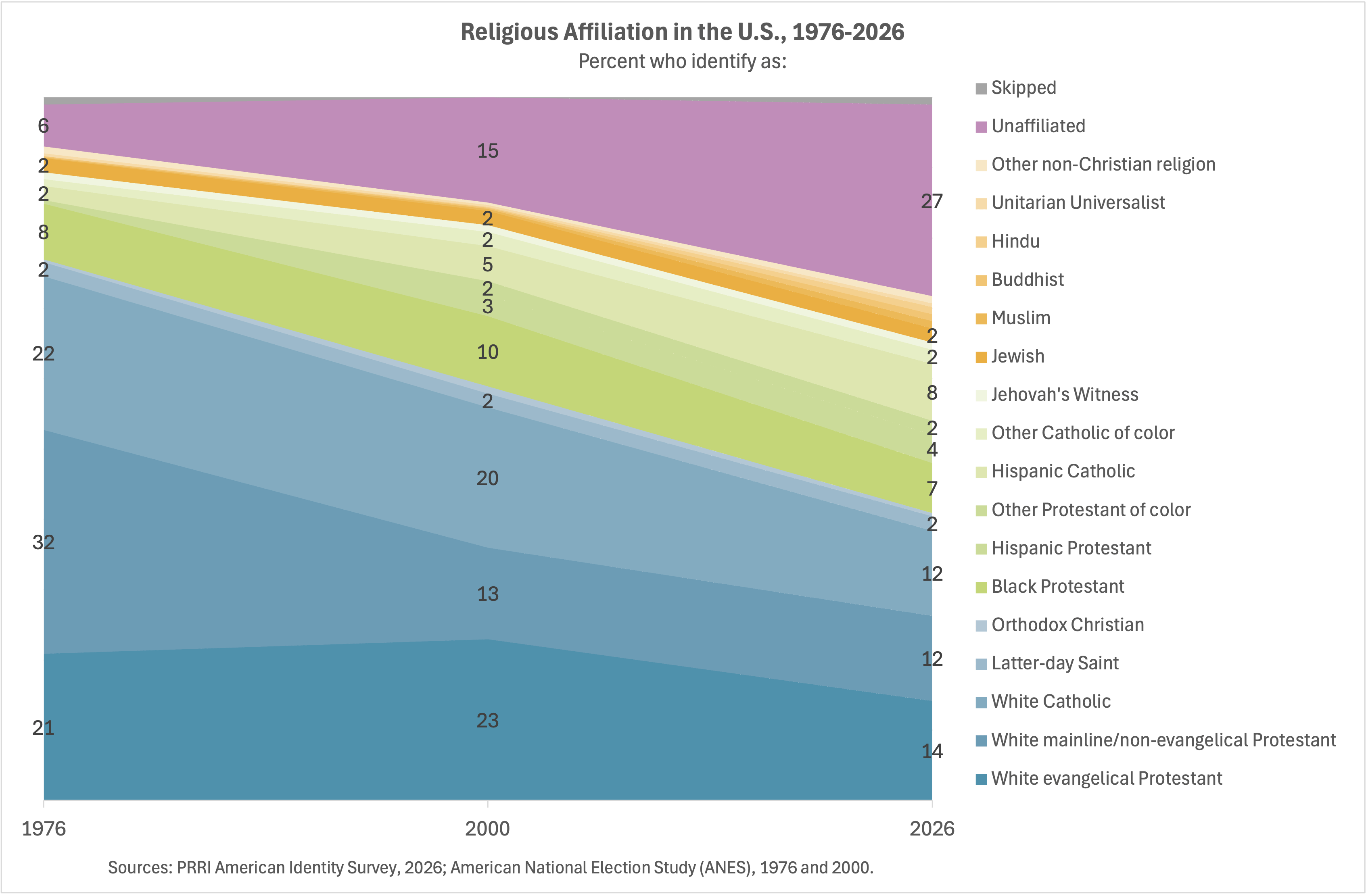
As the chart above illustrates, the shifts in the religious landscape over the past half century can only be described as a simple narrative of decline if the focus is narrowed to white Christianity. In 1976, roughly eight in ten (81 percent) Americans identified as white and identified with a Christian denomination, twice the percentage (40 percent) who identify as white and Christian today (American National Election Study, 1976; PRRI Census of American Religion, 2025). This decline has been experienced by all three major white Christian denominational families: white evangelical Protestants (21 percent to 14 percent); white non-evangelical Protestants (32 percent to 12 percent); and white Catholics (22 percent to 12 percent).
And that simple fact gives the game away. The MAGA appeals to bring back the churchgoer, restore western civilization, or rededicate the nation to God are attempting to hijack the diverse religious tradition they claim to be reviving. As I argue in my forthcoming book, Backslide, the God conjured by MAGA is not the compassionate creator of an expansive universe but a vengeful tribal deity tailor-made for a white Christian ethno-religious state. In Trump’s brooding imagination, our collective task in 2026 is not to celebrate the pluralistic nation we have organically become — one that has flourished precisely because of the non-establishment protections in our Constitution — but to forcefully restore a white Christian nation we have allegedly lost.
There is some good news, however, at this moment of national self-reflection. Though the MAGA movement seems determined to resurrect a mythical white Christian America, far more of us are united in rejecting that worldview and seeing Trump as a fundamental threat to American democracy. PRRI’s most recent survey finds that two thirds of Americans embrace religious pluralism and repudiate the Christian nationalist worldview. And nearly six in ten (59 percent) Americans, including 65 percent of independents, now agree that “President Trump is a dangerous dictator whose power should be limited before he destroys American democracy.”
It is sobering, however, that a sizable portion of our fellow citizens may be willing to quietly, continually submit to the injustices and assaults on democracy being meted out by a tyrant like Trump as long as they are not directly impacted. As we celebrate the 250th anniversary of our democracy, the critical question is whether we can galvanize our diverse majority into a political force while there is still time to save it.
Robert P. Jones is the founder and president of PRRI. He also writes the Redeeming Democracy Substack newsletter and is the author of the forthcoming book, BACKSLIDE: Reclaiming a Faith and a Nation after the Christian Turn Against Democracy.

Bravo, Robby! (If I may use the name you call yourself). I’m glad to see that two-thirds of our country reject the white “Christian” patriarchal supremacy they’re trying to suffocate us with!
“As I argue in my forthcoming book, Backslide, the God conjured by MAGA is not the compassionate creator of an expansive universe but a vengeful tribal deity tailor-made for a white Christian ethno-religious state.”
Thank you for making this distinction. I believe it is this sort of thing that gets lost in the messaging by the MAGA right.