


This weekend, as Bad Bunny prepared to take the stage at the Super Bowl, a photo of the star began to circulate on social media. Taken in 2016, it showed Bad Bunny — a.k.a. Benito Antonio Martinez Ocasio — bagging groceries at Econo, a supermarket in his hometown of Vega Baja, Puerto Rico. At the time, he was a cash-strapped college student who had just begun sharing his music on Soundcloud.
Within a few years, Bad Bunny was one of the fastest-rising stars in pop music, collaborating with big names like Drake and Cardi B. Now, just a decade removed from his days behind the register at Econo, Bad Bunny is the most-streamed recording artist in the world. Earlier this month, he won album of the year at the Grammys, a historic first for a Spanish-language recording. A week later, he headlined what is likely to be the most-watched Super Bowl halftime performance of all time, an exuberant celebration of Latin culture across the Americas.
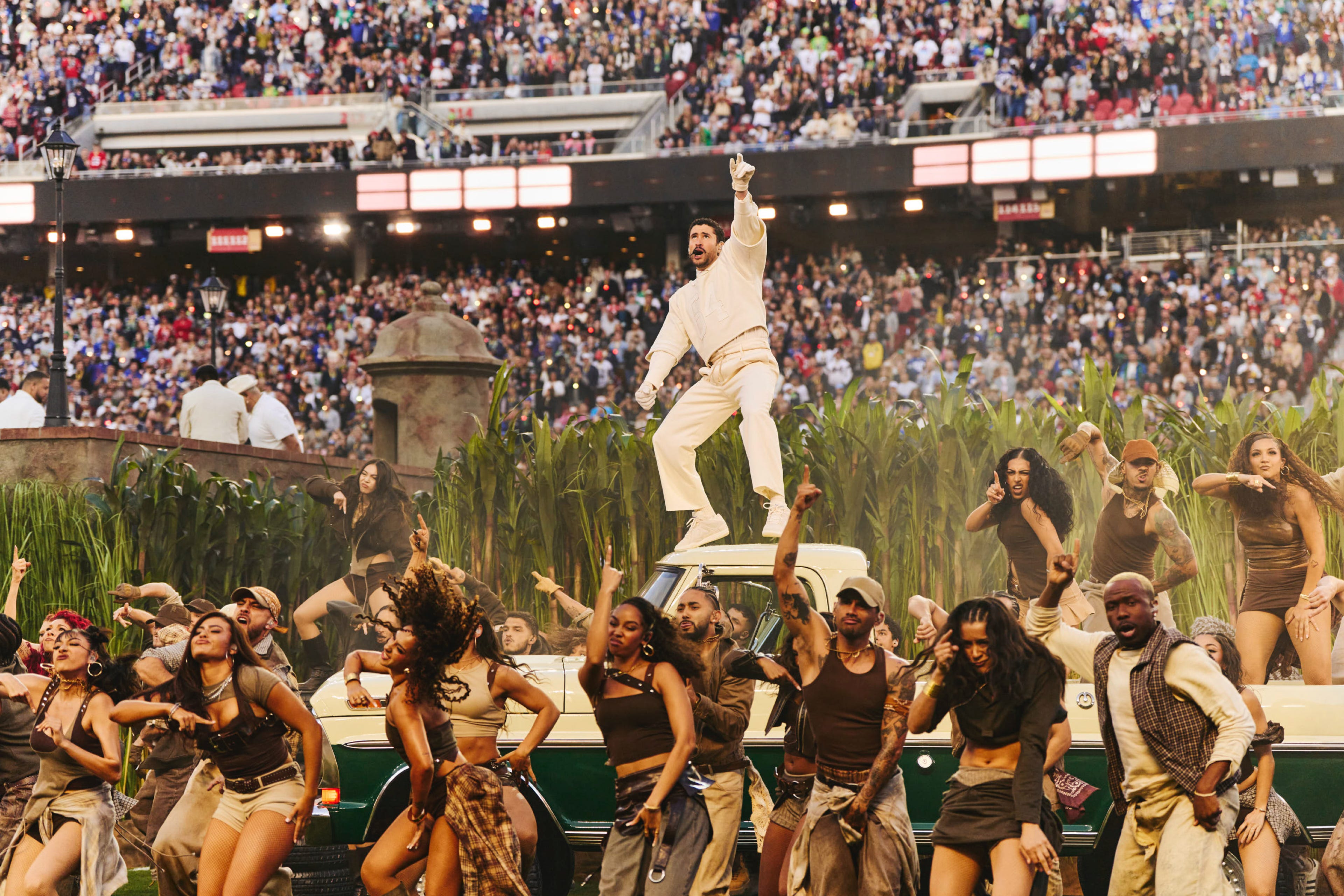
Featuring surprise performances by Lady Gaga and Ricky Martin, the 13-minute set was both innovative — hundreds of extras disguised as plants transformed the football field into a sugar cane plantation — and inspiring; a paean to the people being vilified by the current occupant of the White House.
Bad Bunny’s dazzling show boasted all the usual halftime pyrotechnics but was also laden with cultural significance. He walked through rows of sugar cane, a backbone of the economy since slavery, past vendors selling piraguas, fresh coconuts, and tacos — a tribute to the entrepreneurial hustle of island life.
At one point, he sang “El Apagón” (“The Blackout”) from the top of a utility pole, an unmistakable reference to the power outages that have long plagued Puerto Rico, particularly since Hurricane Maria in 2017. He concluded his set with a message of international unity, calling out dozens of countries across North America, South America, and the Caribbean, while clutching a football that read “Together we are America.” High above the stadium, a Jumbotron displayed a similarly unobjectionable message: “The only thing more powerful than hate is love.”
The performance was a joyful, even wholesome, celebration of ostensibly American values like hard work and family, complete with an actual wedding, use of the phrase “God bless America,” and a flag-waving finale. The only offensive thing about it was its proximity to a boring game interspersed with ads for AI chatbots, gambling sites, and weight-loss medication.
Naturally, Donald Trump hated it, taking to Truth Social to denounce the set as “an affront to the Greatness of America,” and “a ‘slap in the face’ to our Country.”
Nothing could be further from the truth. Replace the rows of sugar cane with some corn, swap the taco stand for a guy making burgers on a grill, and you have pretty much every country music video ever made.
And even though dim-witted racists question his national identity, Bad Bunny is the embodiment of the American dream. In a business full of pre-packaged stars — or “industry plants,” as the kids like to say — he is the real deal, someone who made it big, thanks to a singular combination of talent, charisma, cultural savvy, and hard work.
In a less stupid timeline, one can imagine conservatives embracing Bad Bunny as a role model, as someone whose rise proves that meritocracy exists. The eldest son of a truck driver and a schoolteacher, he grew up in a small, working-class city an hour from San Juan. He paid his way through college. In the early years of his fame, he spent up to eight hours a day working with a tutor to learn English, not to assimilate or erase his heritage (he still performs in Spanish), but so he could be extra-charming in talk show appearances and do some acting when he feels like it. (Vital skills for any top-tier celebrity.)
To someone like Trump, who failed upward to the highest office in the land, Bad Bunny is an “affront” because he actually earned his success. Despite the president’s grumbling, Bad Bunny was an obvious choice to headline the Super Bowl, not because of “DEI” or because the NFL has “gone woke” — if only! — but because he is one of the most popular recording artists on the planet, period.
The same can’t be said of the performers at Turning Point USA’s much-hyped alternative halftime show, where the only qualifications seemed to be 1. being white, 2. supporting Trump, and 3. singing — or in Kid Rock’s case, lip-synching — in English. The special, pre-recorded on a bunker-like soundstage somewhere in Atlanta, was everything that Bad Bunny’s show was not: joyless, sloppy, dull, exclusionary.
Nor can it be said of the first lady, who is currently “starring” in an Amazon-funded “documentary.” In its second weekend of release, Melania plummeted 67% at the box office. The movie, with a price tag of $75 million, has brought in less than a fifth of that and is guaranteed to lose vast sums of money. Any other film that fared so badly would be considered an unqualified flop, yet Amazon is desperately trying to cast the numbers in a positive light.
Bad Bunny’s transcendent performance will hardly require such frantic PR spin: according to preliminary estimates, some 135 million people tuned in to enjoy “Benito Bowl.” On YouTube, the show has racked up 58 million views in a few days, a number that will surely continue to climb.
One moment in particular is likely to get replayed for years to come. Arguably the emotional highlight of the performance came when Bad Bunny handed his Grammy to a little boy watching his acceptance speech on TV. (It was not Liam Ramos, as rumored on social media, but a different five-year-old boy, though the resemblance hardly seems like an accident.) Just as Bad Bunny used the Super Bowl stage to propose a more expansive idea of what it means to be “American,” he also depicted a more inclusive version of the American dream, one that’s open to kids in Puerto Rico and beyond.
The exchange with the little boy captured just why Bad Bunny’s ascent is so inspiring, especially to young people who may feel targeted because of their skin color or the language they speak. The implicit message? If Bad Bunny made it, so can they.
Meredith Blake is the culture columnist for The Contrarian
My age is truly showing, but the kind of music Bad Bunny put on is not my kind of cup of tea. I am an unabashed classic rock fan.
BUT, I absolutely did love the show Bad Bunny put on, it was great and truly showed a compassionate story. AND...... what I love even more is the fact that it pissed the orange dumpster and all his mob members off.
Thank you. As I saw this, I immediately thought it was a smack in the face to Donald Trump and his people (Miller especially), their white vision of America. Theirs apparently is a white Christian US plus what else can be grabbed of the lands south, never mind the people as we have for over a hundred years. Heather Cox Richardson tells it well in her letter today https://heathercoxrichardson.substack.com/p/february-9-2026?
And they were joyfully dancing about the message, not afraid.
The Donald was actually watching Bad Bunny's celebratory show and not his own failed counter show. He said it was a smack in the face to the country, as if he is the country. He is not. Again, it was about him. Actually it was about a lot more.