


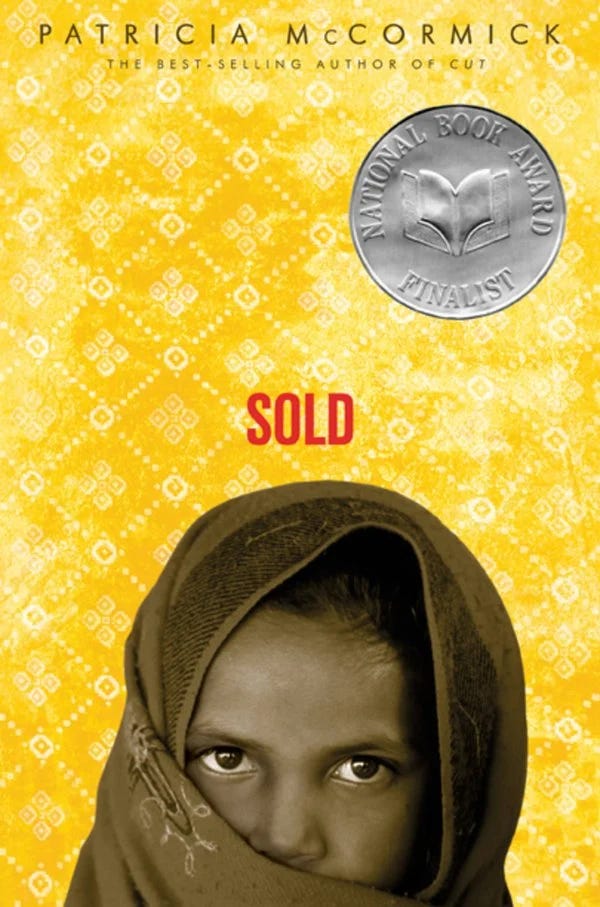
In 2006, Patricia McCormick published a young adult novel called Sold, which followed Lakshmi, a thirteen-year-old girl from a remote village in Nepal who is trafficked into sexual slavery in India.
The author, who was trained as an investigative reporter, spent months interviewing women and girls in the red-light districts of Kathmandu and Calcutta before writing the book. Told from Lakshmi’s perspective, Sold conveys the trauma of her experiences using language accessible to adolescents. Widely praised by critics, Sold became a National Book Award finalist and was made into a film, executive produced by Emma Thompson.
“I wrote it because I wanted to be part of the solution to the issue of trafficking, and I am proud to say that public awareness about child trafficking and the exploitation of children has really changed radically in the past 20 years,” said McCormick in an interview Monday. “And I think the book is part of that.”
This week, Sold earned a less welcome distinction: it was the most banned book of the 2025-26 school year, according to PEN America’s annual report. This year, there were nearly 12,000 book bans in American public schools, the highest tally since PEN began tracking these statistics in 2021, with the vast majority coming from two states: Texas and Florida.
Stephen King was the most-banned author, but Sold was the most-banned individual title, with 25 prohibitions nationwide. The book has been targeted by conservative activist groups like Moms for Liberty, which gave Sold its most severe content rating for including references to “explicit aberrant sexual activities.”
“I feel really confused, because it’s a book about child trafficking, which is an issue that people on the right end of the political spectrum tend to care a lot about,” said McCormick. “Here’s a book that explores how that can happen, and can help make kids a little more aware of the world as it is… So I am really quite mystified as to why this book is banned.”
Although Sold has been on library shelves for two decades, McCormick said it has only come under attack in the last four or five years — often getting labeled as “obscene,” “indecent,” or “pornographic” by activists who confuse a fictional portrayal with endorsement.
“People who view that as pornography are themselves sexualizing young girls,” said McCormick, who has written about her own experiences as a survivor of sexual abuse.
“It certainly wasn’t pornography to the women in the brothels who I interviewed, who shared their stories in the hopes of making sure this doesn’t happen to somebody else.”
Typically, activists will isolate a single passage “and read it out of context at the school board meeting,” said McCormick. Given that Sold was about trafficking, she believes it was essential to include scenes of sexual assault. But she also did so tactfully, avoiding the use of graphic language and focusing instead on Lakshmi’s “confusion and bewilderment and physical pain” in these moments.
More than half of the books banned this year were aimed at young adult readers, and 80 percent were works of fiction, like Sold.
Several other books on PEN’s list also explore sexual violence. This year’s second most-banned book is Speak by Laurie Halse Anderson, a YA novel about a high school student who gets raped by an older boy at a party — and then shunned by her peers.
"It's so hard to understand why a book that educates people about sexual exploitation would be banned," McCormick said. "I think people are trying to police young adult minds."
No. 4 on the list is Margaret Atwood’s dystopian classic, The Handmaid’s Tale, set in a world where fertile women are systematically raped and treated as reproductive chattel — a perennial target for conservatives.
Particularly in light of the alleged rape at Cornell currently dominating the news, McCormick believes that “any book that can bring this conversation about consent and respectful sexual relationships into the classroom is helpful.”
Over the years, McCormick has heard from numerous young readers who were moved by Sold, which “has really been a lifeline for a lot of kids — girls and boys,” she said. “Kids will come up to me and say, ‘There’s something going on in my home, and I didn’t really have the language for it until I read the book.’ Or they’ll feel so much empathy for a thirteen-year-old girl from Nepal in a way that they might not be able to feel for their own circumstances.”
This may be what conservative activists fear more than sexual violence: young people, especially young women, who are informed about ideas like consent and bodily autonomy, and are empathetic to others.
“I think that a lot of book-banners find the idea of kids having their intellectual independence frightening and threatening, and find the idea of kids making their own choices about what they want to read frightening,” McCormick said.
In their report, which you can read in full here, PEN America identified other alarming trends, including using AI to select books for removal, and the first-time banning of classic titles, including Jane Eyre.
What is not new is that librarians are on the frontlines of the fight, and are in many ways more vulnerable than authors like McCormick. She says she has heard from librarians who’ve been doxxed or called “groomers” for refusing to take Sold off the shelves, as well as those who refuse to carry the book because they don’t want to jeopardize their jobs.
McCormick suggests people support librarians and teachers by reading a banned book.
“It’s a private act of resistance,” she said.
Meredith Blake is the culture columnist for The Contrarian