


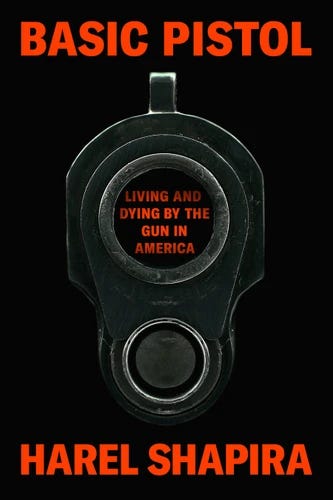
To write “Basic Pistol: Living and Dying by the Gun in America,” sociologist Harel Shapira took dozens of firearms classes — interviewing fellow students and teachers alike. Shapira, an associate professor at the University of Texas at Austin, spoke with Abraham Kenmore shortly before the book was published. The following is excerpted from that conversation with edits for length and clarity.
What was the moment you decided to write this book?
I’m gonna answer in multiple moments. The first moment is that I grew up in a family that didn’t own guns, but immigrated to America. I moved to the States when I was six years old from Israel to upstate New York. My parents were into the project of assimilating into America, whether that meant baseball or lacrosse or whatever it may be. But American gun culture was something that we didn’t touch; we don’t assimilate into that. My parents thought of civilians owning guns, whether for hunting or self-defense, as just utterly anathema to civilized democratic life.
The moment when I think we can start to talk about imagining writing a book about guns happens when I’m in graduate school. I was in graduate school at Columbia University, but I was spending time in Southern Arizona with a militia group. If I really had to signal one moment, it would be the moment when I first formed relationships with gun owners in the course of doing this research for my dissertation. I just felt such an enormous gap between myself and them, and I wanted to make sense of that gap at a very foundational level.
You describe how as you do more and more advanced training, there’s this sort of narrowing of options [for gun owners] — anything can be a threat. Do you see that attitude show up elsewhere in American culture outside of these small groups who are really, really into training tactical training with firearms?
What is happening in firearm schools is at once specific to firearm schools and also a symptom of broader themes in America. [There is] the broader embrace of individual-level responsibility for matters of safety, for matters of your own economic well-being, for your family, right? The narrowing of vision can take many forms.
[Also] I think what is useful to think about, whether we think about American gun culture or any culture, is what the most emblematic identity of that culture looks like. I would rather us not think about it as a numbers game — am I describing a majority of American gun culture or a majority of America? — as much as the most idealized version of the American gun owner. Here’s the person who does train a lot, here’s the person who follows the rules, follows the law, and this is what they look like.
Most of this book takes place around one particular gun school in Texas. But you also traveled around, you’ve interviewed a whole lot of people. What did the conversations look like when you were talking to liberal or leftist gun owners? You know, Social Rifles of America, John Brown Gun Club, or Black and Brown gun owners, LGBTQ gun owners, what did those conversations look like?
One similarity is the embrace of what we talked about, which is the logic of, you cannot rely on the state to protect you, and you certainly cannot rely on the police.
Another similarity is learning to feel not just that you need a gun, but learning to embrace that identity as morally valued: that I am capable of protecting myself, and/or I am capable of standing up to various threats.
And this comes back to a key difference [between groups]. When it came to described the reasons that people carry guns, people who were not white, not men, there was a heightened sense in which one of the dangers they felt was about their identity. Fears of sexual assault from women. The white men I talked to weren’t afraid of being sexually assaulted — they expressed a much greater concern for, implicitly and explicitly, what they described as Black and Brown men in cities.
[Another] of the main differences is fear of violence from the state, right? In other words, the idea of, I need to protect myself from law enforcement. This was particularly pronounced with Black gun owners that I met.
I do want to say, a lot of times when I have these conversations with people, especially more on the left, progressive, and they say, “I want to learn to get a gun to protect myself from the government, from totalitarianism,” I say, “just walk me through that. What does that look like?” And it becomes very vague. It’s like, “I don’t know.”
But [then] it very quickly slipped into — they also carry a gun because they’re worried about Black and Brown men that they might encounter in the cities. Even people on the left very often articulated fears that actually had a lot more overlap with the concerns that I saw expressed from your more conservative, predominantly white, predominantly male gun owners.
As you were researching the book, did you do interviews before and after 2020?
Yes.
Were the concerns framed differently after 2020, whether that was lockdowns or some of the BLM protests, than prior to it, and the backlash there too of the protests?
Yes and no. You know what instructors always told me after the pandemic started? I heard this time and time again. They said to me, “Guess what? I was right. The world has proven me right. Everyone said I was paranoid. Everyone said you don’t need to own a gun. And look, I’ve been proven right.”
Certainly during COVID, there was a heightened concern with social collapse, social disorder, right? Which is why we saw so many first-time gun owners who were more diverse politically, but also demographically, than former gun owners. But I think it also points to a continuation rather than a rupture of what was before. By which I mean the continuing trend of normalizing the idea that guns are a tool to solve our insecurities — whether those insecurities come from the state because you’re a queer person who lives in Texas, or they come from your racist fears.
Do you think that there are times or places where this kind of training has helped people increase their safety?
I think that the way safety is thought about and taught at these schools, both for the people who embrace this mindset and embrace carrying a gun, I think it actually increases their sense of vulnerability. Safety needs to be understood not as an objective condition. [We need] to think about how subjectively do people experience what it means to be safe in America, and how these schools teach people to experience what it means to be safe. And from what I saw, not only do I think—do they not make people feel safer, but also the way they teach people to think that they’re safe puts other people in the line of fire.
You say this is about how guns help us understand America. Something I’ve really been enjoying asking authors is what is a book, particularly in this 250th anniversary of the Declaration of Independence, what’s a book that helps you understand America a little bit better, or maybe this relationship between guns and America?
The book I’m thinking about is very different than my book. It’s called Privilege: The Making of an Adolescent Elite at St. Paul’s School. It’s written by a sociologist at Princeton University and also a professor of American Studies at Princeton, Shamus Kahn. It focuses on an elite boarding school.
And one of the most remarkable things that I remember from this story isn’t just the inequality in the amount of privilege that these people have, but the way that certain people navigate the world differently than others. He shows part of what it means to be elite isn’t just money; it’s that sense of ease around authority, and the sense, and this is kind of where I wanted to lead us to, that “America is yours. It is yours. This is your place. Feel comfortable here.” And I think that feeling of comfort is very powerful, right?
I talked about insecurity, and he shows us here’s this community of people who feel comfortable in America and entitled to America and what it is, and so many people have the exact opposite feeling. There’s something quite powerful about being exposed to and understanding a population that sees that America is theirs. It’s theirs for the taking. It’s theirs for the making.
