


As you read this, I am abroad to celebrate my youngest son’s wedding — a true delight! (Tomorrow will be my last post until May 12.) Before leaving, however, and especially given the devastating Callais ruling handed down yesterday by the Supreme Court, I wanted to share a book that deeply impressed me, both because it illuminates the divide between enablers and resisters during the age of MAGA autocracy and because it helps universalize our experience in combating tyranny.
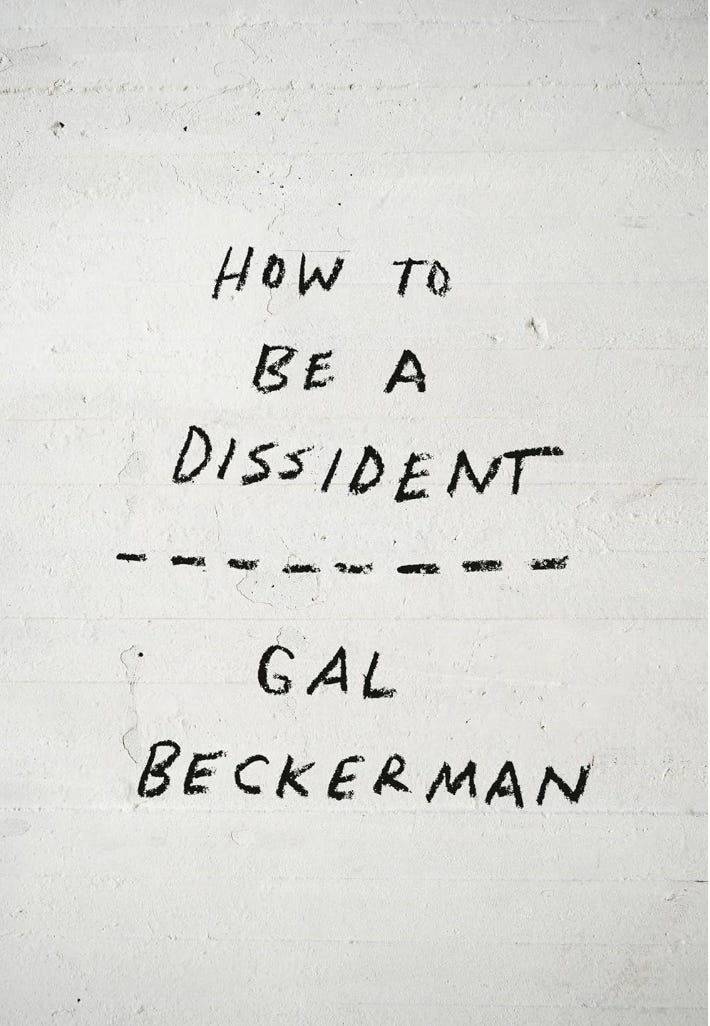
Gal Beckerman’s How To Be a Dissident is not a guide for how to resist authoritarianism. Rather, Beckerman explores the mindset of dissidents. The volume is less than 200 pages but densely packed with fascinating accounts of global dissidents over thousands of years, from Aleksandr Solzhenitsyn to Baruch Spinoza to Diogenes to Henry David Thoreau (and many whose names will not be familiar).
To be a dissident (literally to “sit apart” from the Latin) is not, Beckerman says, a “political stance” or the equivalent of “being outspoken” (especially in countries where free speech is largely protected). Rather:
It is something much more profound. Being a dissident means trying to close the distance between what you believe and how you act. It means understanding the conditions that allow you to be yourself, and not accepting any violation of them. And it means doing all this when there are great risks involved. You feel you cannot do otherwise.
On one level, his accounts of dissidents’ experiences (e.g., exile, torture, death) are a testament to their remarkable courage. However, these are people who could not help but dissent. They could not live with themselves by simply going along with the status quo. It is who they are, a reminder that dissent is not “a distinct moment of action, not as a choice, but a way of being.”
Beckerman set out to explore why some people become dissidents. He identifies ten characteristics — e.g., willing to be alone, pessimism (yes! unbridled optimism can be a trap), dark humor, intense rationality, keen awareness — that characterize dissidents around the globe and over centuries. Beckerman takes us back to the ancient Greeks, drops us into 17th-century Amsterdam, then pulls us into contemporary China, Kenya, and Russia. With sharpened perspective, we can acknowledge that the Resistance in the United States is a comparatively mild form of dissent that does not require the unimaginable sacrifices Beckerman describes in totalitarian states.
Whether it is Czech dissident Milan Kundera or murdered Russian activist Alexei Navalny, dissidents are the ultimate nonconformists, repelled by demands to go along with the mob and utterly immune to the lure of outside validation and acceptance. Their experience as a dissident often begins as a “vague sense that what they are feeling puts them in conflict with what appears to be everyone else.”
I’m reminded of the protagonist Pavel Talankin in the Academy Award-winning documentary Mr. Nobody Against Putin. Talankin acknowledges he was a loner as a kid, an odd duck, happy to be in his own company. When the crushing conformity of Vladimir Putin’s propaganda/indoctrination comes to the school where he works (complete with false recitations extolling the Ukraine war, militarized displays, and nonstop propaganda), he watches with amazement as the entire town falls in line…except him. He simply cannot abide by the lies, the absurdity, and the Ukraine war killing machine. He rebels, he disrupts, and he surreptitiously documents the insanity around him. He has the quintessential dissident’s mindset.
Some of the characteristics of dissidents that Beckerman illuminates are counterintuitive, including pessimism. That is not “fatalism” as Beckerman explains. It is an outlook that recognizes circumstances are likely to get worse (e.g., climate change), but not necessarily. Think of it as a grim recognition of reality with a dash of hope.
These people resist the happy talk of the oppressive regime assuring us all is well, but also the false reassurances from those who refuse to confront the regime, insisting “it will all work out.” Both are recipes for passivity. Instead, Beckerman points to role models “who do their work because it matters now and not because of what it might achieve for them in the future.” You rebel and resist not because you are certain to prevail but because it is essential to do what you can. For those who ask themselves, “Does anything I do make a difference to the fate of democracy?” the pessimist with a modicum of hope answers: “We don’t know. We do what is right. We fight the good fight.”
One of Beckerman’s ten qualities is near and dear to the spirit of The Contrarian: dark humor, and the ability to laugh at and mock power. Humor “provides perspective,” Beckerman says, forcing us to step outside of and critique regime orthodoxy. It is “as much about defanging an oppressor as it is about making dissidents themselves feel a little less scared.”
It can be the ultimate weapon against “totalitarian kitsch” (the unquestioned reverence for regime rituals he describes as “syrupy uniformity”). Humor, he writes, “is like a knife that slices through the stage backdrop and gives us a look at what lies hidden behind it.” It can be jarring, crude, or even offensive (e.g., South Park), but making oppressors into the butt of jokes is no small thing. We have no better proof of ridicule’s power than Donald Trump’s wars against Jimmy Kimmel and Stephen Colbert.
Beckerman’s remarkable work at the juncture of philosophy, political science, and sociology is well worth your time. Those in the Trump-era Resistance will get a strong blast of humility; our protests generally entail little risk compared to those who have suffered in gulags, prisons, and torture rooms. (A modicum of effort to organize, speak out, and vote should not be too much to ask.)
If nothing else, Beckerman clarifies the divide between the toadies (who crave acceptance and conformity, exhibit humorless self-importance, and eschew critical thinking) and those who oppose the regime. If you want to be in the latter, because you cannot do otherwise, you will relish this book and take heart from dissidents’ examples. If you know people who could use a moral wake-up call, buy it for them.
Resistance is NOT futile!
Inspiring ideas and people, thank you. Congratulations on your son’s wedding!