


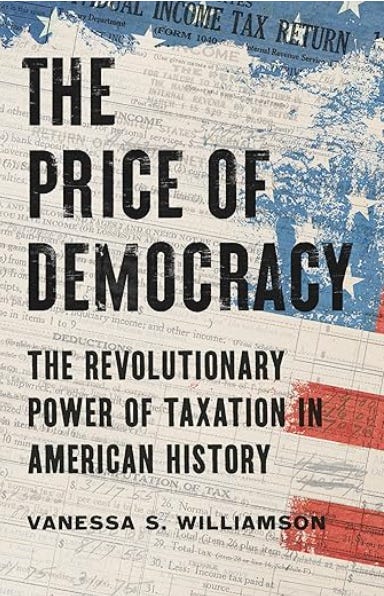
The opposition to taxation in America has usually come not from grassroots opposition but from anti-democratic economic elites, according to Vanessa S. Williamson’s The Price of Democracy: The Revolutionary Power of Taxation in American History. Williamson spoke with The Contrarian about her book. The following is excerpted from that conversation, with edits for length and clarity.
You’ve written about taxes extensively. What got you interested in the issue of taxation, and why this book on taxes and democracy at this moment?
The exact moment when I first realized that taxation was tapping into something much deeper than I had ever imagined was when I was doing work for my first book, which was on the Tea Party, and I was at a Tea Party rally. A woman came up onto the stage, and she was a gold star mother, she lost her son in Iraq, and she was talking about the sacrifices she had made. And then she segued seamlessly into her taxes, and I realized that the thing that she was talking about, when she was talking about the sacrifices she had made and how it had been unfair, had been about taxes.
It made me realize that taxation taps into really fundamental ideas about whether you think the government works for you. It taps into these really deep emotions, and I thought, I need to understand this.
As you were writing this book, who was your imagined reader?
I think it’s a book that will be helpful for people who are looking at our politics and trying to understand how we got here. And I think this story is a lot longer than people imagine, and there’s really something valuable in recognizing the ways that this echoes previous parts of our history. I hope that the book provides a little bit of a roadmap for people who are thinking about how we build a multiracial democracy.
In the introduction, you wrote “the most powerful forces resisting taxation in America have always been the country’s most anti democratic elements,” using a variety of tools, to “keep fiscal power in elite hands.” When you’re looking at the broad span of American history, what’s the archetypal example of that to you?
From the beginning, the people who fought to limit the power of the federal government to tax were slave owners. They did not trust even propertied white men, the only people then allowed to vote, to adequately protect the peculiar institution that was enriching them and enslaving a substantial part of the American population. So from the very beginning, the limitations on the federal power to tax were an attempt to protect the southern slave oligarchy.
But that same fear of taxation recurs throughout our history. It is part of the story of the Redeemers, the white supremacists who fought against multiracial governments of the Reconstruction. They organized themselves as taxpayers because for them, the idea that a multiracial democratic state government was deciding the tax rates—was deciding to make investments in public schools for both Black and white children—felt like tyranny. And there are more, we don’t just need to look at slavery and Jim Crow.
You write about in the early republic there is this idea of economic equality being tied to political liberty. And over and over again, elites say, “Well if we create too much democracy, they’re going to take our money away.” Do I read this book correctly, that in many cases they were right? That you’re arguing that, yes, in fact, if we have a more democratic system, there will be a kind of economic leveling, and that creates a stronger democracy?
Benjamin Franklin famously argued that Americans had a “happy mediocrity of condition.” I love the phrase, and there’s something to that, right? But at the same time, one thing that I think is a striking throughline in the stories that I tell is the real moderation of the demands of the masses. They’re not here to expropriate. They’re talking about higher marginal rates on people with enormous fortunes.
You see that in the reconstruction period, they preserve the poll tax, even though people a few years out of slavery could barely afford $1. But they wanted to keep the poll tax because they wanted everyone to chip in. They thought it would save the school system against those who were opposing the extension of public education to all children.
It’s certainly the case that, I think, you can have a society too economically unequal to function as a republic. I think that those fears that have existed since the founding of our country and before are real. But the idea that greater democracy would result in leveling or communism, there’s just there’s no evidence to back it up.
On the flip side, you document some cases where incredibly regressive taxes have been put in place—in the 60s, you write that some of them even taxed people into poverty. What moments in American history have allowed those kinds of ultra-regressive taxes to take hold?
The times when you see genuinely oppressive taxation are when you have a racialized minority excluded from political power. The taxes on free blacks in the antebellum period were intended to push people back into slavery—quite explicitly. The taxes put in place under Jim Crow were intended to be unpayable. But even more than oppressive taxation is fees and fines, and I think that’s something that’s very resonant with the kind of politics we have today.
If you look at the Jim Crow period, a substantial amount of state revenue came not from taxation, but from absolutely unpayable fees and fines that were applied for anything and everything. And what would happen, of course, is that black men who were the primary victims of this couldn’t pay, and so their sentences would be lengthened.
They were leased to corporations to do back-breaking, deadly labor. It was understood (and I still can’t believe this to this day), to be worse than slavery—because people didn’t live. The death rates in some states looked like the gulags’. So if we want to talk about how the state can be fiscally oppressive, there is a long history in the United States, and a lot of it comes in places where they weren’t taxing. There were tax caps all across the South where they were propping up their budgets with these extortionate levies on Black America.
You document pushback against taxes, both from both in trying to create these regressive tax systems, but also simply avoiding taxes when they are imposed. Did you notice any trends about when economic elites employed one tactic over the other?
Well, sometimes it’s easier. It’s quite difficult to disguise an enslaved population when the collector comes. But also it’s an ideological commitment—slaveholders did not want a representative of the state to come into their little domain where they were supposed to be a master without parallel.
That remains an issue. It’s not just about the money. Because how could it be? There’s never been a serious campaign for a tax system that would have made rich people not rich. But the idea that you are beholden, that you are merely a citizen among other citizens, is something that at certain levels of wealth many people find unacceptable.
Up through World War II, where you’re writing about people sending in taxes that they might not even owe, there is a kind of patriotic idea that “we have skin in the game.” And then the last part of the 20th century, there becomes a bipartisan consensus that taxes are bad. Do you see a path forward to creating a narrative around taxes as this kind of “contribution of a fair share to the country” again?
I think this is really an example where American leadership has failed the people, because if you look at survey questions, Americans still see tax paying as a patriotic duty. If you ask people, “is it every American’s civic duty to pay their fair share of taxes,” do you know what percentage agree? Over 90%.
This is consensus, right? I looked at one point for poll data that had a similar level of consensus, and you’ve got to ask things like, “is Elvis alive?” What’s changed is not what people believe about the importance of taxpaying. What has changed is the rhetoric of elites. And frankly, to me, it feels like cowardice at a certain point that you wouldn’t defend that government elected by the people can do good things. To me, that is an abdication of the most basic responsibilities of leaders in a democratically elected country.
There was a time when we believed that we were part of our democracy, that the government we elected belonged to us. It feels very distant to us now, but I don’t actually think that the basic idea that we chip into a government that we vote for and do our part—I don’t think that idea is foreign to Americans by and large. But it sure dropped out of our public rhetoric.
Vanessa S. Williamson’s The Price of Democracy: The Revolutionary Power of Taxation in American History was published on November 11, and is available at your closest independent bookstore.

Let's face it-- ever since Robin Hood duked it out with the Sheriff of Nottingham, nobody in their right mind has WANTED to pay taxes! We just want the benefits of having a will-funded safety net without having to pay for it.
Oliver Wendell Holmes put it best when he said:
Taxes are the price of civilization.
I am puzzled by this: "What has changed is the rhetoric of elites. And frankly, to me, it feels like cowardice at a certain point that you wouldn’t defend that government elected by the people can do good things." Are you saying that millionaires are avoiding taxes because they don't believe in government??