

By Roberto Valadéz
On October 25th, Brazil will decide whether its political future belongs to Lula or to the Bolsonaro movement that has reshaped the country’s right.
The election comes four years after Brazil survived an attempted coup following the 2022 presidential vote, making this a consequential test of the country’s democratic resilience. Whatever the outcome, its implications will reach far beyond Brazil, as the election unfolds amid a broader resurgence of conservative politics across Central and South America.
The contest is remarkably close. On October 4th, neither candidate secured the majority needed to win the presidency outright. Senator Flávio Bolsonaro, the eldest son of former president Jair Bolsonaro, won 47% of the vote, narrowly ahead of current President Luiz Inácio Lula da Silva’s 45%.
That the younger Bolsonaro is this competitive is itself significant. His father is imprisoned after being convicted over a plot to overturn the 2022 election and prevent Lula from taking office. Yet the political movement associated with him has not disappeared. It has adapted and consolidated support.
Four relatives of the imprisoned former president won congressional seats in October: Michelle Bolsonaro, Jair’s wife, and Carlos Bolsonaro, his second son, won seats in the Senate, while Jair Renan Bolsonaro, his youngest son, and Renato Bolsonaro, his brother, were elected to the Chamber of Deputies. That breadth of electoral success is more than a curiosity. It is evidence of the durable appeal of a certain kind of reactionary, strongman-centered populism.
Brazil is not alone in the region. Across Central and South America, voters have recently moved toward leaders on the political right who promise order and security. These countries — which include Argentina, Chile, Costa Rica, and El Salvador, among others — are politically and culturally distinct, and the nuances driving their rightward shifts vary. But beneath their differences lies a strikingly similar political strategy: the power of a savior narrative.
Public policy is complicated. Economic reform takes time. Institutional change requires negotiation. For voters struggling to pay rent or worrying about their children’s safety, the promise that a policy will eventually improve their lives can feel distant and abstract.
Right-wing and populist politicians have offered something immediate. They’ve made politics personal, casting themselves as champions of ordinary people willing to fight a corrupt establishment or an identifiable enemy on their behalf. They offer an archetypal cast of characters: the virtuous and the wicked, the victims and the villains. It is the political version of stories we learn as children. There is a threat and the promise that they, the hero, will stand between us and danger.
This David vs. Goliath myth-making can be compelling even when the underlying policy proposition is far more complicated — and even when a leader’s record does not support the heroic role he has assigned himself. That does not mean voters are irrational or uninformed. It means that human beings rarely experience politics as a policy white paper. We experience it through stories shared, emotions felt, and lived experience.
Across the Americas, many voters are confronting genuine insecurity, from economic uncertainty to crime, to weak public services and a sense that political institutions have failed them. An OECD survey found that 82% of Latin Americans report concerns about their financial situation, while crime and violence rank among the region’s most important concerns. Those conditions create fertile ground for politicians who can make people feel seen, identify someone to blame, and position themselves as the person willing to fight back. That is a powerful proposition. And it is not uniquely Latin American.
The U.S. has seen the same power of morally absolute political storytelling. Donald Trump has repeatedly converted complicated economic, cultural and geopolitical anxieties into narratives that resonate with his supporters: ordinary Americans versus elites, citizens versus immigrants, Christians versus Muslims. Trump’s second term is evidence of the enduring communicative power of these divisive and appalling narratives — and the policies they help shape.
The power of a political story is contingent not only on who gets to tell it, but who gets to hear it — something more contested than ever in the digital age. In Brazil, allegations that Meta restricted the reach of Lula’s content while its platforms recommended Flávio Bolsonaro’s accounts have prompted Brazil’s electoral court to order equal treatments of the candidates, underscoring how the platforms that distribute political narratives can shape the contest as much as the politicians who create them.
As like-minded governments have gained ground across the region, many have cultivated close relationships with Trump, which in turn plays into Trump’s own imperial strongman ambitions. His administration has revived an old idea for a new era: that the U.S. has a special right to shape political and security affairs across the Western Hemisphere. The Shield of the Americas, launched at a March summit in Miami, is an extension of this “Donroe Doctrine” vision, bringing together governments to cooperate with Washington on cartels, illegal migration, and what the administration describes as foreign interference.
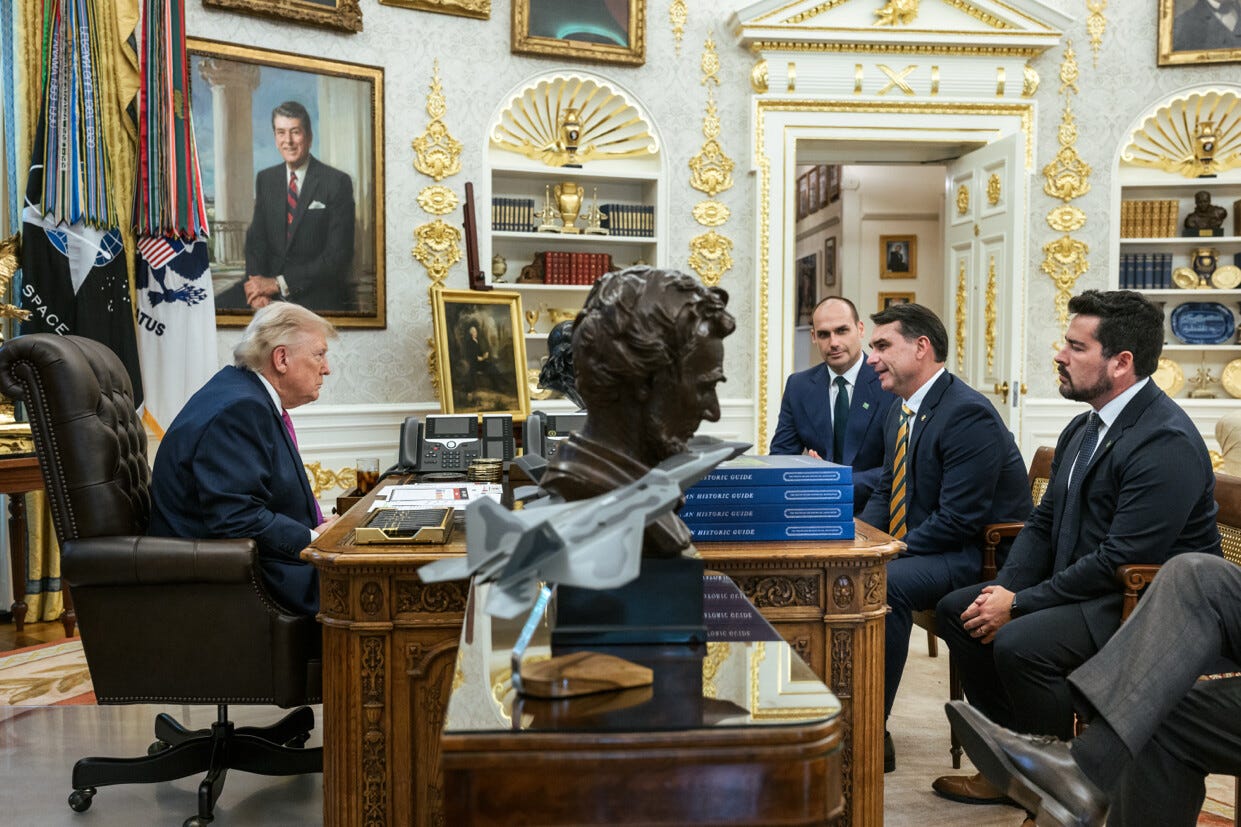
Brazil is the missing heavyweight in that emerging coalition. With roughly 213 million people, the largest economy in Latin America and nearly half of South America’s landmass, it is simply too consequential for Washington to ignore. A Bolsonaro victory would not automatically bring Brazil into the Shield of the Americas, but it would bring one of the hemisphere’s most consequential countries considerably closer to Trump’s political orbit — and give his vision for American influence in the region a powerful new anchor. Jair Bolsonaro has long been a political ally of Trump, and Flávio Bolsonaro has actively cultivated that relationship, including meeting with Trump during his current campaign.
None of this means that every conservative government will become authoritarian, or that voters who support right-wing candidates are rejecting democracy. They are, in fact, exercising it. The greater concern is what happens after a political strongman is elected — when the self-proclaimed champion of the people begins to portray courts, legislatures, journalists, or electoral institutions that constrain his power as enemies of the people.
That is the larger significance of Brazil’s election. The Bolsonaro movement has demonstrated that a political narrative can survive scandal, defeat and even the imprisonment of its founder when it continues to speak powerfully to voters’ fears and aspirations.
For those defending democratic institutions across the Americas, the answer cannot be to dismiss those voters or to rely on policy-wonk explanations alone. They must make the case for democracy in terms that people can feel and understand: telling the true story that security does not require surrendering freedom and that prosperity should not depend on a political savior.
Roberto Valadéz is the former director of communications and special initiatives for the United Nations Ambassador for Global Health, where he led high-stakes global campaigns, including the office’s work on COVID-19. As the founder of True You, he now equips underestimated C-suite leaders with the tools to level up their leadership and amplify their impact by harnessing their authenticity.