


Congress has once again driven the nation into a federal government shutdown. The ritual has become drearily predictable: angry finger pointing, bad-faith (or nonexistent) negotiations, market volatility, and federal workers now wondering when—not if—their next paycheck will come. At this point, such budget-related brinkmanship has become as much a part of the political calendar as the State of the Union. That should be remarkable. The idea that the world’s most powerful democracy would intentionally grind its own government to a halt would once have seemed absurd.
The trail of how we got here begins in the 1990s with Newt Gingrich, who engineered a similar shutdown in late 1995, when Bill Clinton was president. Gingrich left behind two legacies that continue to shape our politics. The first was structural: he centralized power in the Speaker’s office. The second was cultural: he normalized the politics of contempt.
In the early 1980s, as an obscure backbencher, Gingrich recognized that the newly installed C-SPAN cameras in the House chamber were always on—even when the chamber was empty. He would regularly deliver vitriolic monologues to rows of vacant chairs, denouncing Democrats as corrupt and un-American. The language that he perfected was later handed out in pamphlets to interested Republicans via his political action committee, GOPAC. Words like “disgrace,” “traitors,” “sick,” and “radical” emerged in the political lexicon. His fiery language was an antidote to what he felt was a Republican weakness—one that he had articulated years earlier, in 1978, at a meeting of the College Republicans in Atlanta: “One of the great problems we have in the Republican Party,” he told the aspiring politicos, “is that we don’t encourage you to be nasty.”
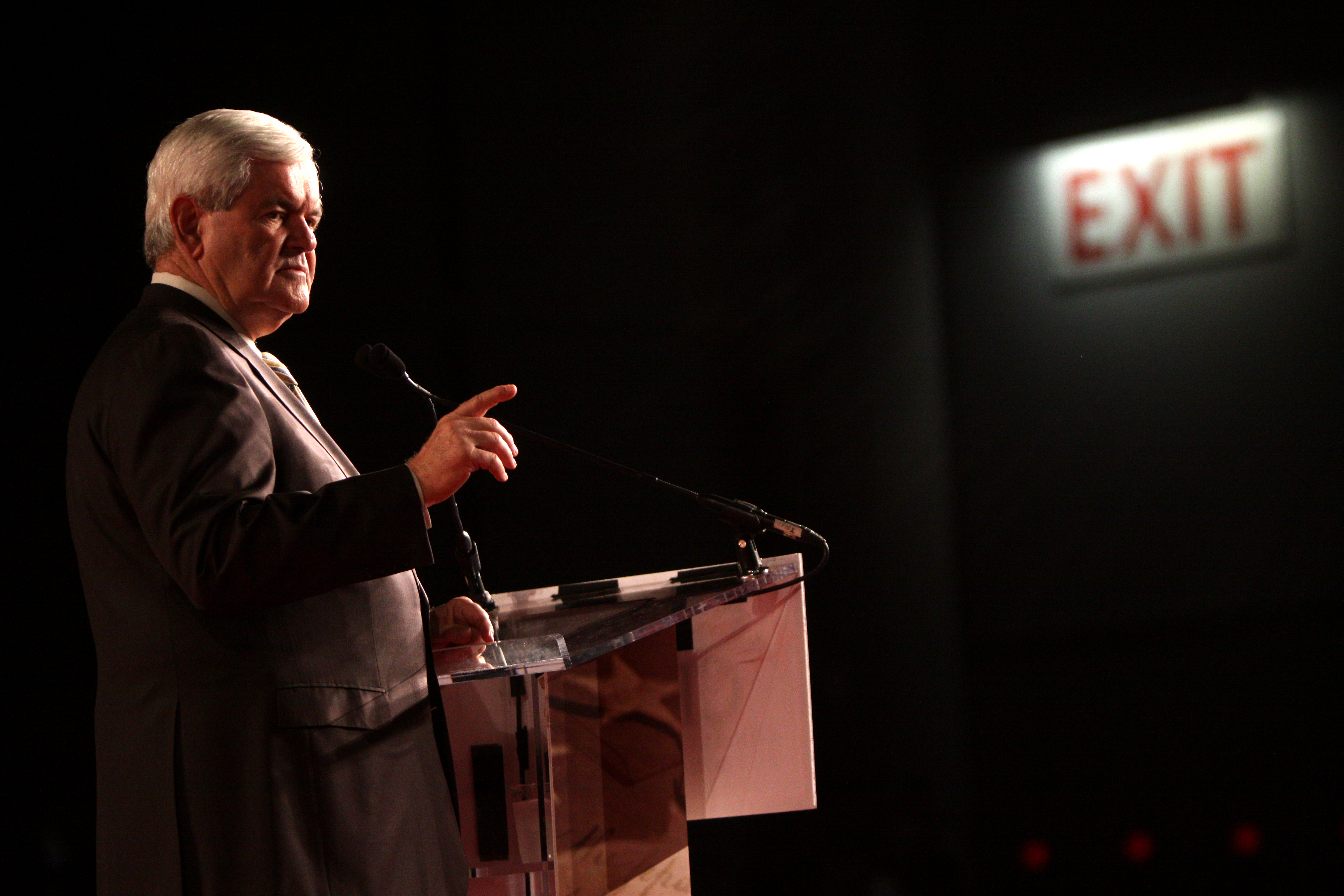
The old guard, led by Republican Bob Michel of Illinois, was appalled. Michel believed politics was adversarial but not existential, that strength came from coalition-building, not constant attack. But Gingrich’s louder, sharper, more theatrical approach proved far more effective in the cable-news age. By 1994, he and his “Contract with America” had rocketed Republicans to their first House majority in 40 years. Michel retired after that cycle, proclaiming that too many politicians were now “trashing the institution” of Congress for political gain.
As the newly-elected Speaker, Gingrich remade the House in his image. Authority was centralized in the Speaker’s office, committees were weakened, loyalty became paramount and bipartisan dealmaking withered. To all but a handful of Hill analysts, these changes seemed minor at the time. But their impact was profound. Take a simple one: Before Gingrich, House committee chairs were elected by the committee members. Post Gingrich, they were appointed by the Speaker’s office (pending rubber-stamp ratification by the full conference), always based on loyalty to the Speaker and the party, and often determined by fundraising prowess. The result was that the men and women who had the best relationships within the committees—and who often knew the most about the substance of the committee—were replaced overnight by party loyalists who were willing to do whatever the Speaker demanded of them.
Democrats decried Gingrich’s tactics, but eventually adopted many of them. Concentrated power, endless investigations, “messaging bills” (designed to frame the other side negatively but never to pass) became often-used tools. Rep. Nancy Pelosi’s style as Speaker might have been less bombastic than Gingrich’s, but she, too, often prioritized command-and-control strategies over bipartisan legislating. And so, the arms race has escalated for 30 years.
How much more escalation can we endure? In the wake of the murder of conservative activist Charlie Kirk—and the rise of politically-motivated violence in recent years—the need to turn the temperature down on national politics is not an abstraction but a matter of public safety. The U.S. Capitol police reported nearly 10,000 threat assessments against members of Congress in 2024.
For more than ten years, I have been working with members of both parties on Capitol Hill on various political reform bills. In private, most of them admit that they are sickened by the way Congress is run. And yet, very few have ever stuck their necks out to change it. Why? Because they do not want to buck their leadership. Because they worry about getting “primaried by the crazies.” Because “the other side isn’t going to quit, so why should we?”
Why do we continue to accept these excuses from the people we pay to govern the country on our behalf?
Structural democracy reforms can lower the cost of courage. Right now, members who challenge their party leadership or cross the aisle often face instant punishment: a primary challenger in a gerrymandered district, a loss of committee assignments, or a drying up of campaign fundraising. Redistricting, open primaries, ranked-choice voting, and campaign finance reforms would blunt those threats by rewarding broader appeal rather than rigid loyalty. Revamping House rules would empower rank-and-file lawmakers to bring widely supported ideas to the floor without fear of retribution.
We’ve already seen glimpses of how this can work. In Alaska, where ranked-choice voting was adopted, Sen. Lisa Murkowski can cross the aisle and still win reelection because she’s not at the mercy of a small slice of her party’s base. Reforms like these change the calculus: they make it politically survivable—and sometimes advantageous—for lawmakers to choose principle over partisanship.
Here’s what the vast majority of voters would prefer over shutdowns and bomb throwing: Genuine debates about the nation’s priorities; civility and respect among those we’re paying to represent us; budgets passed on time; and legislation, born of compromises, that solve real problems, from the housing crisis to immigration.
Gingrich may have opened the door to mafia-boss leadership and smash-mouth politics, but today’s lawmakers choose each day whether to walk through it. They can continue to bow to party leadership, and then spend most of their time raising money and performing for cable news and social media, as the government shuts down and problems fester. Or they can remember that they are public servants—elected and paid by the public to serve the public good, not to stoke more nation-crippling outrage.
Nick Penniman is the founder and CEO of Issue One, a leading bipartisan democracy reform nonprofit. A former newspaper and magazine editor and publisher, he’s the author of Nation on the Take: How Big Money Corrupts Our Democracy and What We Can Do About It.

Gingrich found it apt to weigh in on this shutdown in an op-ed that I refused to read this week. Instead of learning from his own grotesque mistakes and helping to reverse course, the bit I saw simply continued the tirade against half of American voters. How disrespectful, how un-American, how inhumane. And what a pig. If you can't do something positive as your country burns, throw yourself on the pyre, old man.
All too true, but no one will do anything about it until Democrats stand up together and GET LOUD.
And, of course, until billionaires will no longer be allowed to rule this country.