


It has become something of an online truism that everyone wants a village but nobody wants to actually be a villager. The science seems to back this up. Americans are lonelier than ever before. A poll from the American Psychological Association found that a third of us reported feeling lonely in the past week, with some academics warning of a growing loneliness epidemic. These numbers have only continued to climb since Covid, when many of our social activities were put on pause, never again to resume in quite the same way.
The increasing prevalence of work-from-home jobs means more of us are missing out on the minor social contacts of office life–for better or for worse. We don’t really take public transit as a nation, leaving us sitting in the solitary bubbles of our cars for an average of at least an hour per day. At home, more of us seem to be turning to technology for a sense of companionship in times of isolation—a trend that appears to be even stronger with Gen Z and Gen Alpha Americans. The younger we are, it appears, the lonelier we might feel.
A friend who teaches at an area college tells me that these statistics mesh with her experience. Many of her freshman students, who navigated some of the most formative years of their adolescences in a time when it was unsafe to be around friends, prefer to stay inside their dorm rooms scrolling, shunning the university’s party scene and even seeming reluctant to study publicly in the library or on the quad. This didn’t used to be the case. Although she hates assigning group work, now she makes a practice of it—many past students have told her that’s the only way they’ve been able to make new friends.
As a culture, lockdown drove us into the dubious embrace of the all-consuming internet, a habit that, as it turns out, is hard to break. Overly boundaried, therapized language has become part of the cultural lexicon, with people increasingly prioritizing protecting their peace over making space for the feelings and problems of the people around them. Another friend told me that she was recently shocked by a discussion of the book “The Rainbow Fish” at a party. The fish should have had better boundaries, the guests said, and kept his scales. The moral of this much-loved story seemed, to her, to be lost to contemporary readers.
So what’s the solution to all this social separation? One friend recently joined the Masons, becoming the youngest member of his local lodge. My husband hosts weekly jams in our garage, where friends drop by and play for hours. My New Year’s resolution this year was to invite friends over once a month—from a flower-arranging Galentines Day party to regular mother’s groups where other people with young children can work and sip coffee outside of the isolation of our toy-cluttered living rooms. Anything that gets you out of your head and into your neighborhood works.
Or, if all this sounds like entirely too much, you can always just make some granola.
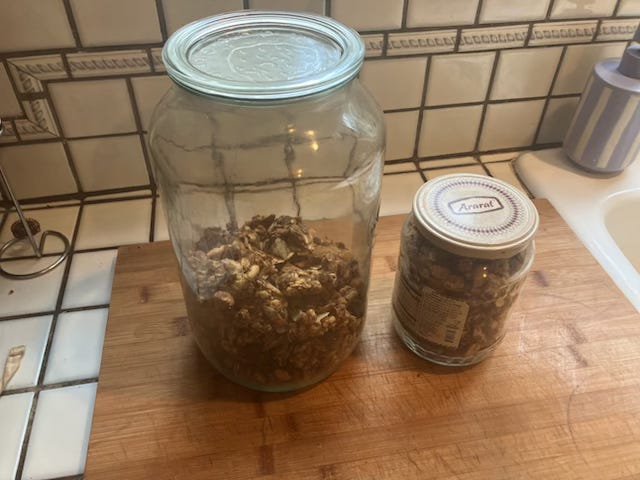
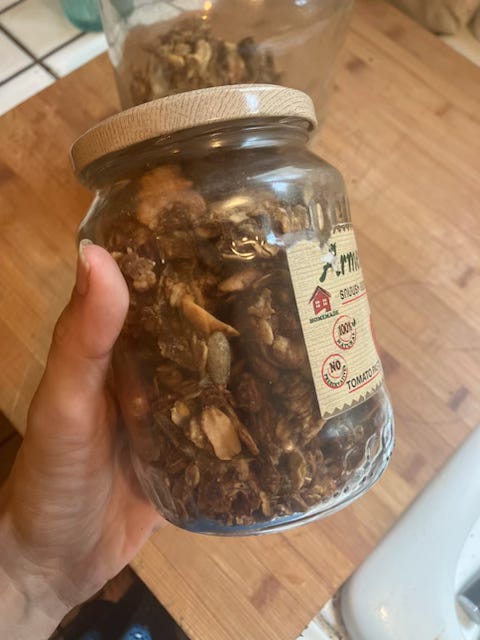
I started sharing granola with my neighbors as part of my resolution to be better about community building, and, to be honest, to have a solution for my irredeemable glass jar hoarding habit (the flower arranging party was also great for this, if you, too, are looking for a solution). Every time I make a big batch of granola for my family, I simply fill up an extra glass jar or two and spread the love. I’ve brought thank you jars to parties, dropped them off at neighbor’s houses, shared with the friend who invited my toddler and me to her house for a mental health break.
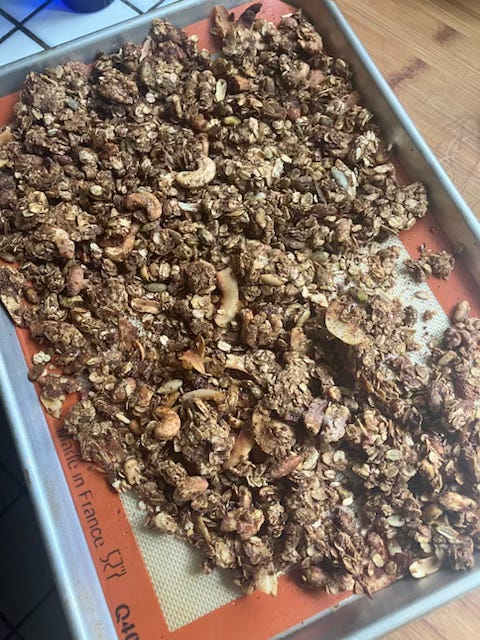
Granola is one of the ultimate bridge-building foods because it’s just so dang adaptable. Baking up a batch for a vegan pal? Use flax seeds instead of egg whites to help everything stick together. Sharing with a health-nut neighbor? Swap the vegetable oil for avocado or coconut, or go oil-free altogether. A good granola recipe can be modified to suit pretty much any personal or political palate, making it the perfect snack for building community and bridging divides.
As long as you have oats, you can make a pretty decent batch with whatever odds and ends happen to be lying around in your pantry. This is the perfect use for those ancient coconut flakes, the desiccated dried cranberries from last thanksgiving, the odds and ends from a million bags of half eaten nuts. Granola is delicious, forgiving, easy to make, and fun to share. The perfect food for spreading community—wherever you are lucky enough to find it.
Bridge-Building Granola
Ingredients:
2 cups rolled oats
1 cup nuts of choice—try to use a mix of large and small for the best texture, and maybe throw in some coconut flakes
¼ cup flax meal
½ cup coconut oil, butter, or ghee
¼ cup maple syrup or molasses
¼ cup brown sugar
2 tbsp of nut butter, like tahini (my favorite) or peanut butter
Splash of vanilla (optional)
1 tsp cinnamon
½ tsp ground ginger
¼ tsp cardamom
Pinch of black pepper
½ cup dried fruit of choice
Method:
Preheat the oven to 300 degrees fahrenheit
Mix together all your dry ingredients, combining the oats, nuts, and flax seed until well blended, then pour in your fat, sugars, nut butter, vanilla (if using), and spices.
Spread out evenly on two parchment paper-lined pans.
Bake for 20 minutes before giving everything a good stir. Slide back into the oven for another 20 to 30 minutes, stirring periodically. Once everything looks nice and toastyl, turn off your oven and let it come to room temperature, propping the door open with a wooden spoon if you’re worried about things burning.
While the granola cools, chop up your dried fruit if you’ve chosen something large like dates, figs, or apricots.
Mix the fruit into the granola and store in two jars—one for you, and one for a friend.
Emily Beyda’s writing has appeared in the Los Angeles Times, Built, Refinery29, Smartmouth, Fodors, the Thrillist, the Austin Chronicle, and more. Her novel, “The Body Double,” was published in 2021.

Ooh! I seem to have a growing population of those jars too!
Use them for everything from fave seasoning mixes, corralling buttons, vessels for flowers to leave on neighbors’ porches.
Thank you for proposing an additional use, granola!
Of course!
And thank you for your recipe as well.
Thank you for this recipe!