


“Oh, my darling, I can’t wait to return to Paris, / and to stroll with you arm in arm…. Let’s go back to the Bois de Boulogne again / Let’s have chicken and champagne for dinner again” — Pollo e Champagne
I’ve been thinking a lot lately about what the U.S. administration is doing to the food supply in the United States. As a food writer, someone who spends her professional life thinking about, writing about, cooking and baking, and (mostly) eating food, I’ve been watching this spectacle, for lack of a better word (and in an attempt to keep my language civil), from afar with growing horror and uncontrollable anger.
What this administration and its deranged and unqualified head of the Department of Health and Human Services are doing to the systems built specifically to keep our food safe is an avoidable tragedy, bordering, in my humble opinion, on domestic terrorism. When a population is afraid to eat for fear of being poisoned, contaminated, or sickened by the food they buy every day in their local supermarkets, when the systems designed to protect it are deliberately weakened or dismantled, what else do we call that?
Promises of “the biggest regulatory reduction in the history of our country” and boasts that “the never-ending growth of red tape in America has come to a sudden, screeching, and beautiful halt,” all wrapped in the enticing promise of a “powerful driver of economic freedom, lower prices, and consumer choice” — or, in other words, “removing pesky regulations” — lead supporters to believe that these “unnecessary, restrictive, and counterproductive” bureaucratic burdens were bothersome, unnecessary, and standing in the way of “freedom and prosperity.”
By putting someone in charge of food safety who trusts neither science nor medicine and surrounding him with people who, as a friend described it to me, think they’ve found a kind of magic nexus, we’ve fallen head over heels into a medieval belief system of superstition, pseudoscience, and snake oil. It’s no wonder that Americans are terrified to ingest a whole range of staple ingredients, from eggs and sugar to lettuce and beef — and blueberries, cinnamon, and applesauce, and baby formula, and….
Decades of food standards and regulations were put in place because lawmakers knew the government’s basic job is to protect its citizens from dangers they can’t control on their own. It’s really a no-brainer, if you ask me. Each medical and scientific advance allows us to guarantee our most basic daily need: eating with as few negative consequences as possible.
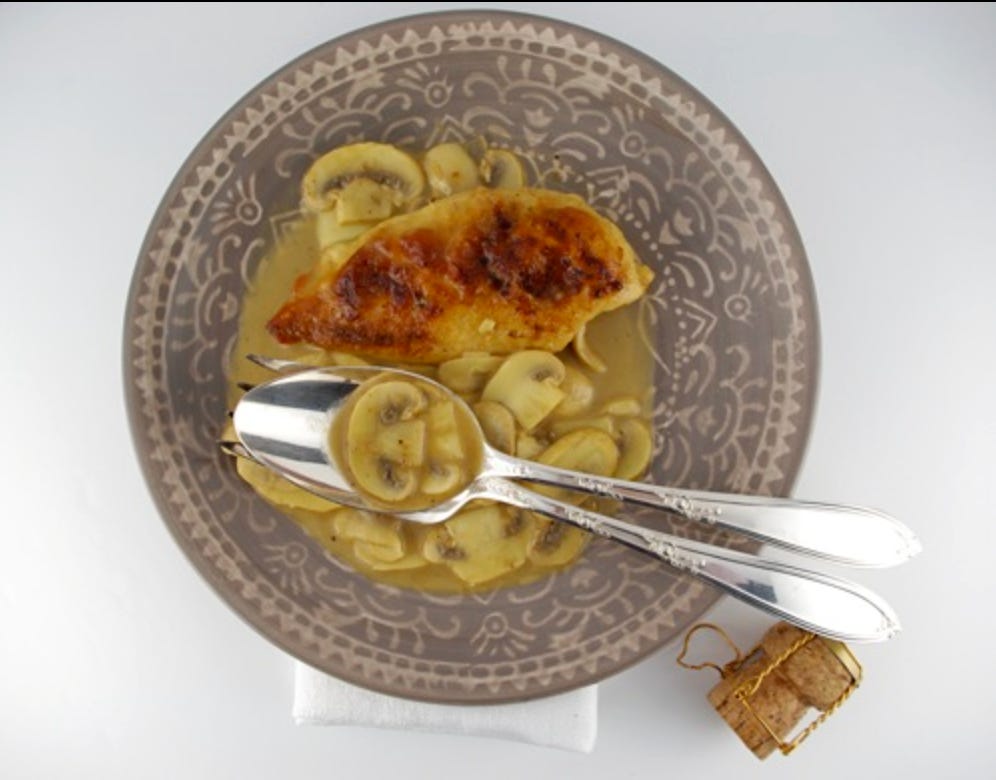
And while I’ve been pondering this whole unnecessary, potentially catastrophic train wreck, I was reminded of a surreal story my husband told me back in the 2000s, after we had returned from living in Milan, Italy, where he’d spent seven years running a small veterinary science publishing house. I had just purchased a lovely pear-shaped bottle of Cremant de Loire, our own local sparkling wine. I was participating in a monthly food blogging challenge, the theme being Champagne, and, when asked, I told him I decided to make Champagne chicken.
“Chicken and Champagne!” He perked up and asked “Did I ever tell you the story of Signore Ventola (the former owner of the little Italian publishing house) and Pollo e Champagne? This story is so wild but true and so Italian!”
“It was a catastrophe in the making,” he began. Throughout the 1950s chickens in Italy (and elsewhere in Europe, I should add), along with their farmyard friends, were pumped full of hormones, estrogen in particular, to plump them up, give them the voluptuous curves of a Botticelli Venus, endow them with the large breasts and meaty hips of a Fellini starlet, making them more attractive, I imagine, to all those mamme and nonne standing at butcher counters from Balzano down to Lecce, deciding on which cut of meat would make the best secondo, meat course, for their preziosi bambini and their cari sposi.
But sadly, as it turned out, it wasn’t only the chickens who were affected by the hormones. Swiss studies began linking estrogen-plumped meat to strange developments, namely children developing breasts (reaching puberty much too soon).* So, in true Italian style and ever protective of their bambini, as soon as the first whispers of this connection leaked out, followed by screaming headlines, Italy went, pun intended, “cold turkey.” The entire country just stopped eating chicken overnight. An entire country’s chicken producers panicked and, fearing tremendous financial losses, began running around like chickens without their heads! What to do to save the industry? They turned to the president of the Italian Association of Poultry Producers, Signore Ventola (who, some 30 or so years later, recounted this story to my husband), and desperately begged him to do something to stop the collapse of their industry.
So, the representatives of Italy’s Poultry Producers put their heads together and, in great flamboyant Italian style, came up with a brilliant idea that would, without a doubt, save the chicken market. They hopped into their Fiats and their Alfa Romeos and off they sped to Milan, where they commissioned a music producer to find a team of writers and musicians to write a song about — of course — chicken.
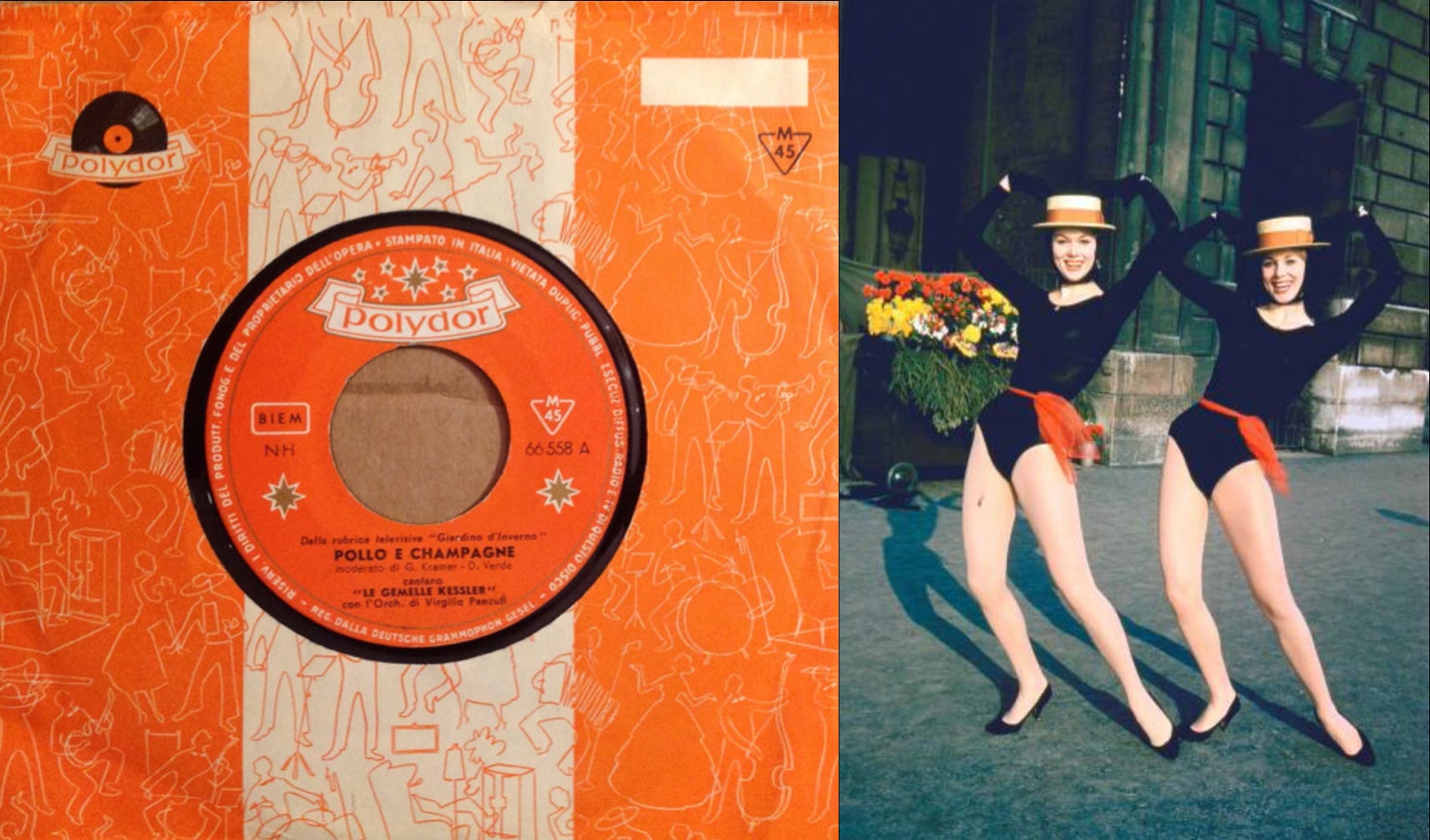
Well, as incredible as it seems, their plan worked. The producer at Edizione Kramer hired the team of Dino Verde and Bruno Canfora to write the words and music. He offered the song to The Kessler Twins, lovely, leggy German twin sisters, all dolled up in 60s Italian TV camp: black fishnet stockings, skimpy outfits, top hats and feathers, and turned all of those crazy scientific studies on their heads, outdoing the scientists themselves in true San Remo style. They soon had the entire country singing along to a catchy new song. Youth on their Vespas sped through the streets of Rome and Florence whistling the jazzy tune, while families throughout the country tuned in to watch — and hum along with — the new singing sensation, the Kessler Twins. Their new single, Pollo e Champagne (Chicken and Champagne), was a hit.
Chicken was the new sexy. Paired with Champagne and enjoyed in the glamorous city of Paris after a romantic stroll, arm in arm through the streets of the City of Light, to the très chic Bois de Boulogne, chicken became something desired rather than feared, something romantic to eat sitting in a sidewalk café while sipping bubbly, the nec plus ultra of Parisian elegance and chic sophistication. Gone was the terror of serving dangerous chemical-laden chicken to the family, and with one little swingy song, and two shapely blonds, chicken and champagne became all the rage. Chicken was back — both in style and on the plate.
“Oh, mon chéri / I can’t wait to go back to Paris / And walk arm in arm with you / Along the quiet, lamplit avenues… That evening, my heart / Burst like a champagne cork / After the chicken à la crème / I said this to you: / “Mon chéri, je t’aime”… Remember, c’est magnifique / That little spot in the Bois de Boulogne / Where you dine on chicken and champagne / And then you can dance cheek to cheek.”
This story won’t fix anything about the current situation, but it came to mind anyway. And sometimes, when things get this grim and feel a little hopeless, I just need to drink a little Crément de Loire and think of the absurdity — the strange and unlikely stories — of the world.
* As a result of these studies, Italy’s Law No. 4 of February 3, 1961, prohibited the use of estrogens and other hormones as growth stimulants in all meat intended for human consumption. Europe followed in 1981/1988.
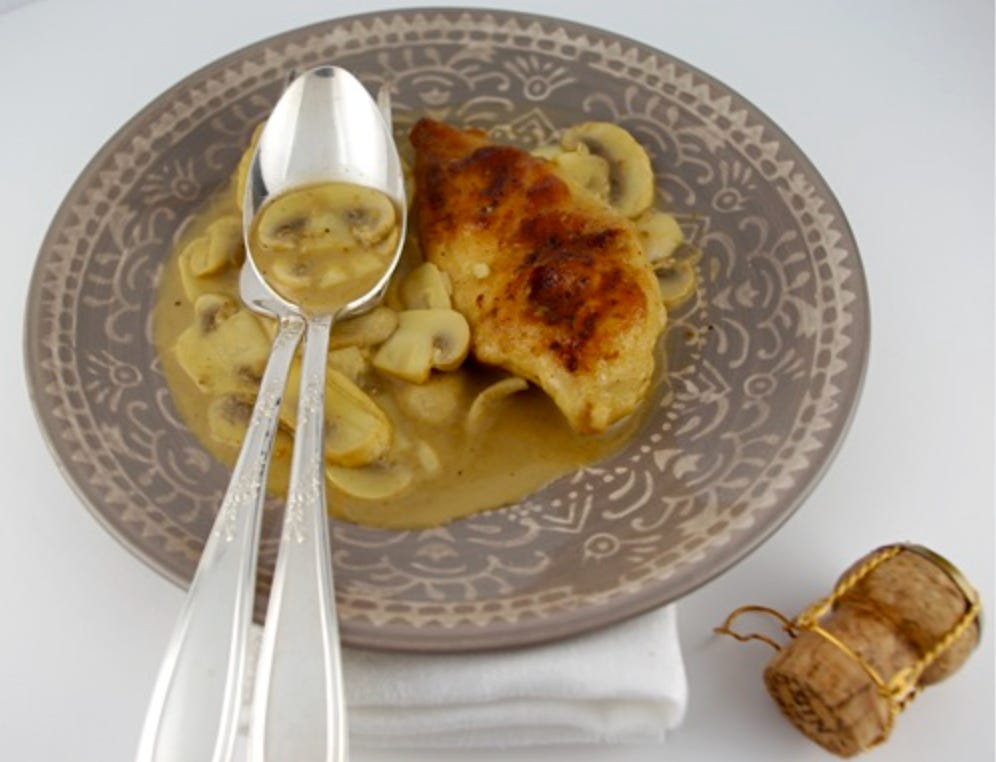
Champagne Chicken for 4
It is, after all, quite a delicious dish.
½ cup (about 60 grams) flour
½ teaspoon salt, more to taste
2 whole boneless chicken breasts, skin, trimmed, rinsed, patted dry, each sliced into 2 thin escalopes
Freshly ground black pepper
3 tablespoons (45 grams) butter, margarine or half butter or margarine and olive oil
⅔ cup (150 ml) Champagne brut or another sparkling white wine (I used Cremant de Loire blanc)
Juice of 1 lime
½ pound (250 grams) white mushrooms, cleaned, trimmed, sliced
¼ teaspoon ground nutmeg
Season the flour with the salt and a very generous grinding of black pepper and put in a large bowl or soup dish. Dredge the 4 chicken escalopes in the seasoned flour until well coated, shake off the excess flour and set aside on a clean plate.
Heat a non-reactive 10-inch (25 cm) skillet over medium heat and add the butter or margarine and the olive oil. Sauté the chicken until well browned on both sides, 3 to 5 minutes per side. Remove from the pan and return to the plate while you prepare the mushrooms and the sauce.
Lower the heat under the skillet to medium-low and add the sparkling white wine and the lime juice. The liquids will sizzle and boil up briefly; scrape up the brown bits from the bottom of the pan then continue simmering the liquid for a few minutes to allow the alcohol to burn off.
Add the mushrooms and the nutmeg to the pan and stir until the nutmeg is dissolved and the mushrooms are under the liquid. Lower the heat and cook, stirring occasionally, for about 5 minutes or until the mushrooms are soft and the sauce reduces by about a third.
Return the chicken to the skillet and push the pieces down into the sauce. Allow to simmer for 5 to 8 minutes longer until the chicken is heated through. Salt and pepper to taste.
Jamie Schler is an American food and culture writer — immersed in French culinary history — living in France where she owns a hotel, makes jam, and writes the Substack Life’s a Feast.
