


“The mind deliberates, and the heart decides.” —Louise Dupin
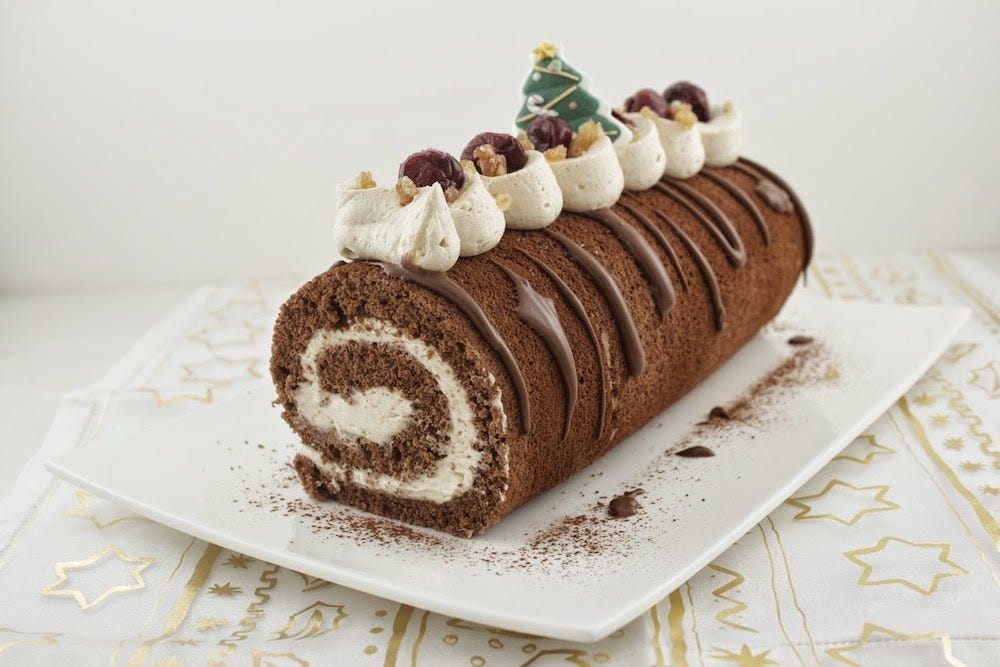
Chenonceau is curious and wondrous. A Renaissance jewel in the Loire Valley, it is considered the most beautiful of all the châteaux that dot the countryside from Orléans to Nantes.
What makes Chenonceau special is that it was owned, designed, built, restored, renovated, decorated and preserved by an almost uninterrupted succession of women.
From a king’s mistress, to the reigning queen, to a visionary patron, each woman infused this monumental landmark with her grace and influence, transforming Chenonceau in her image and adding to its unique feminine legacy.
I visited Chenonceau yesterday, as I do every December when the château is once again transformed by sumptuous Christmas decorations. Even though I sometimes have to squeeze past tourists on the stairwells or wait patiently for a straggler to move so I can take the perfect photo, this beautiful place never fails to fill me with joy and peace.
I was going to write about the extraordinary women of Chenonceau, each of whom left an indelible mark on this elegant pile of stones—women who shaped politics, guided the arts, and influenced the philosophical and artistic ideals of a nation through 16th-century religious wars, the French Renaissance, the Age of Enlightenment, and on through the 20th century—and how they inspire me, as a woman, with a quiet power and an overpowering sense of strength. But instead I chose to write about my single day in a place of beauty and grace, a morning spent breathing in centuries of life and art among the exquisite Christmas displays in soft snowy white with a group of friends.
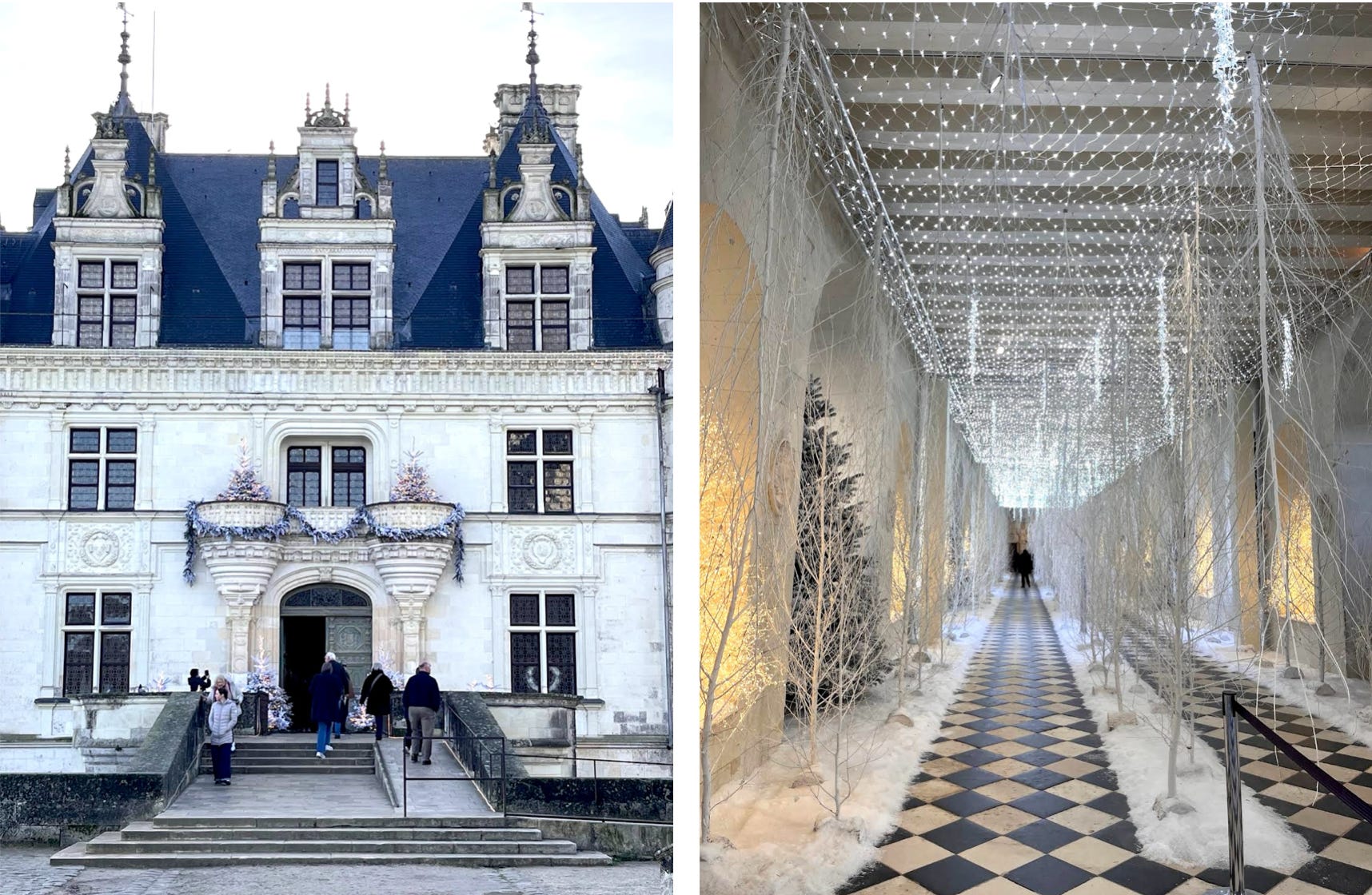
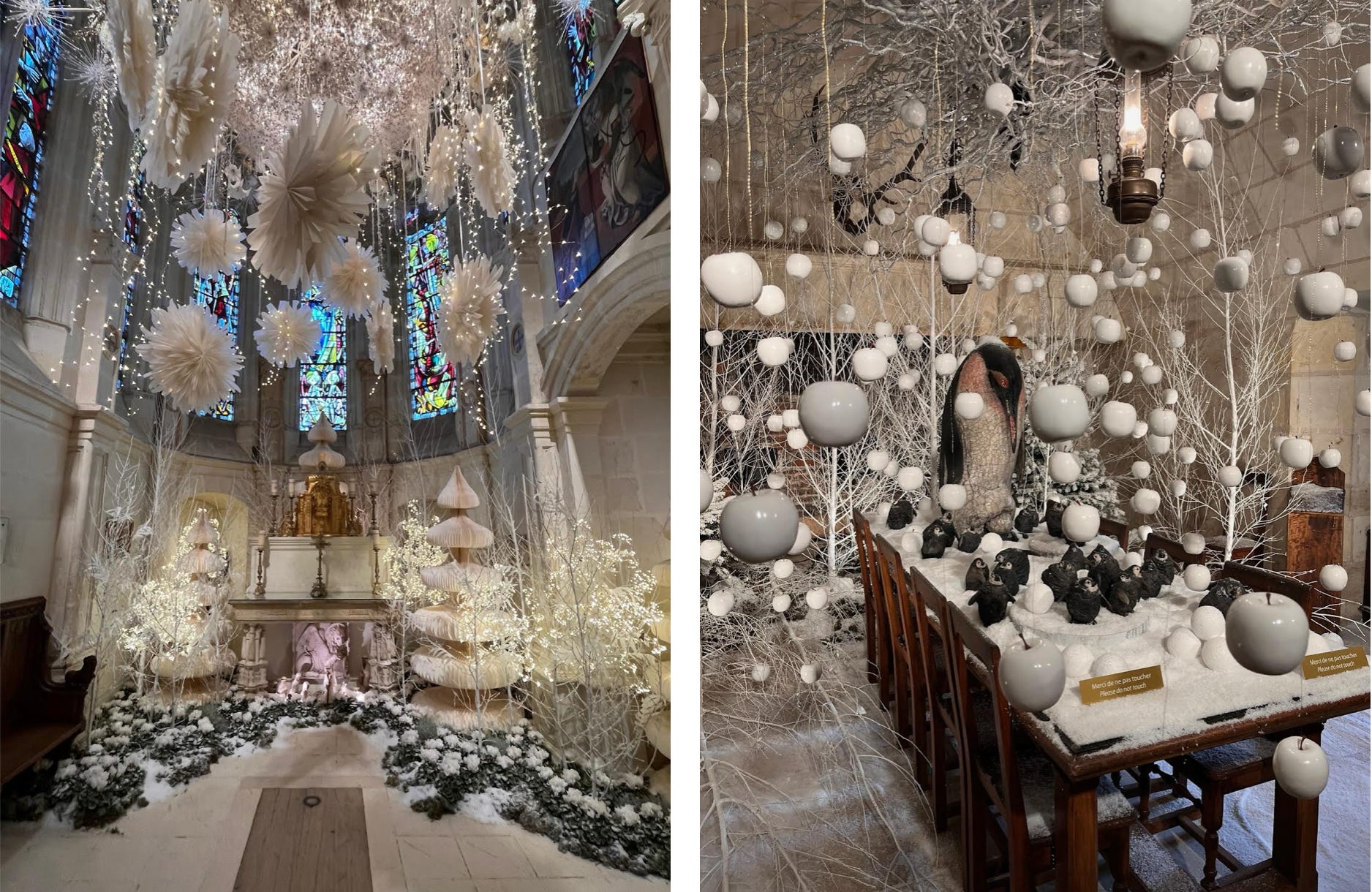
I spend so much time, as most of you who read The Contrarian do, laser-focused on the news. We sometimes feel that if we let it go for a few days or more, the world risks collapsing, or our country will careen off the edge of a cliff. But as the holiday season approaches—no matter which holiday we celebrate—I’m reminded by a day such as yesterday that stepping back isn’t avoidance, and isn’t a danger for the balance of the world. We deserve the experience of something that reawakens our creativity or softness, especially if these are qualities we sometimes fear we may have lost.
Diane de Poitiers, Catherine de Medicis, Katherine Briçonnet, Louise Dupin, Madame Pelouze: despite personal tragedies and scandals, despite feeling the weight of a nation heavy on their shoulders, each of these women filled the halls of Chenonceau with music, art, and festivities, taking refuge in the sumptuous gardens they helped create, crafting a sanctuary for creativity, elegance, and imagination.
We can do the same, albeit on a smaller scale. We can take the time this December and through the new year to revel in those joys of life, surrounded by music, good food, the glittering magic of the holidays, and, of course, family and friends, without worrying that the world will crumble without us. Au contraire: sharing time, laughter, and gifts of our own making is healing for the soul. Moments of joy, beauty, and grace are necessary every day, and we have to give ourselves these as well as receive them. Find delight, amusement, and lots of good cheer in this most festive of seasons.
Some of you who follow me and subscribe to my Substack have seen my favorite bûche de Noël, the traditional French yule log. This year, take the time to actually make it. The concentration it requires, the rhythm of the work, and the time it takes will center you, absorb your attention, and, for a little while, let the chaos of the world fade away. And you will have created something beautiful: a small work of art to be shared, savored, and remembered.
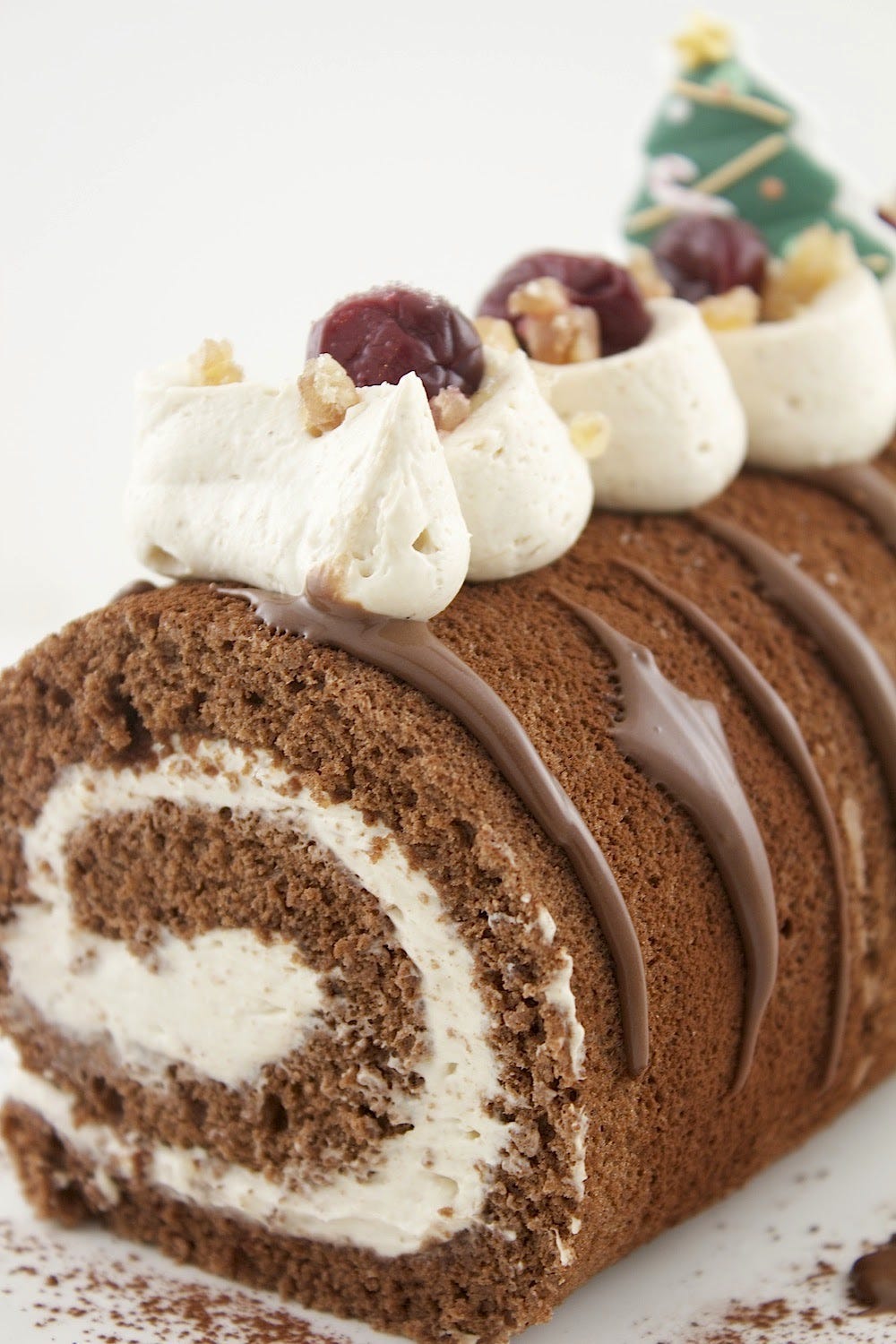
Chocolate Chestnut Rum Bûche de Noël
The French are nothing if not traditional and their holiday celebrations never waver from one year to the next; the Bûche de Noël or Yule log is a delicious, sophisticated, and impressive dessert for any occasion but an absolute must for the holiday season.
For this bûche, prepare the chestnut mascarpone whipped cream and the rum syrup the day before making the genoise/sponge and assembling the cake. I topped the cake with chopped candied chestnuts and drizzles of chocolate ganache thinned with 2 capfuls of amber/dark rum.
Recipe for the ganache is at the end of the recipe.
For the Chestnut Mascarpone Whipped Cream Filling:
Scant 1 teaspoon powdered unflavored gelatin + 2 tablespoons cold water
¾ cup (190 ml) heavy whipping cream
½ cup (125 grams) mascarpone cheese
3 – 4 tablespoons crème de marrons – sweetened vanilla chestnut cream
Place the gelatin in a small saucepan; add the 2 tablespoons cold water and let sit for 5 minutes to soften, swirling the pan gently to pull all the granules of gelatin into the liquid. Place the pan over a very, very low heat to warm the water and melt the gelatin – you want to heat the water for about 4 -5 minutes without allowing it to come to a boil or to boil away. When the water has heated, holding the pan just off of the flame/heat, swirling and whisking (I have a tiny drinks whisk I use) almost constantly, allowing the small amount of water to stay heated for long enough to allow the gelatin to melt. After 4 - 5 minutes, remove from the heat and allow to cool for 5 minutes or until barely tepid to the touch.
Beat the heavy cream in a chilled bowl until thick, soft peaks hold. Continue beating as you pour the gelatin water into the heavy cream in a very slow stream while you beat. Beat in the mascarpone about a tablespoon or two at a time. Add and beat in the chestnut cream; add a bit more if you want to accentuate and deepen the chestnut flavor.
Place in the refrigerator to chill for at least an hour to overnight to allow the gelatin to add body to the filling.
For the Rum Sugar Syrup:
Scant half cup (100 ml) water
Scant ⅜ cup (80 grams) sugar
2 - 3 tablespoons dark or amber rum (the rum can be replaced with Cointreau, Grand Marnier, Kahlua, etc, or 1 - 2 teaspoons vanilla)
Place the water with the sugar in a small saucepan and bring to the boil. Let boil for 2 minutes then remove from the heat. Stir in the rum to taste. Set aside to cool to room temperature.
For the Chocolate Genoise/Sponge:
4 large eggs, separated, preferably at room temperature
Pinch salt + 2 drops lemon juice for the whites
½ cup (100 grams) sugar
¼ teaspoon vanilla
½ cup + 1 ½ tablespoons (80 grams) flour
2 tablespoons + 1 teaspoon (20 grams) unsweetened cocoa powder
¼ teaspoon baking powder
Unsweetened cocoa powder and a sifter or sieve
Preheat the oven to 375°F (190°C). Very lightly butter a 15 ½ x 10 ½ x ¾ inch (40 x 27 x 2 cm) jellyroll pan and line with parchment paper. Have a clean dishtowel larger than the jellyroll pan as well as a large, clean flat baking sheet ready.
Separate the eggs, placing the yolks in large mixing bowl and the whites in a clean medium-sized bowl (I prefer plastic). If you like, add a tiny pinch of salt and 2 drops lemon juice to the whites to help stabilize them.
Add the sugar to the yolks and beat with an electric mixer on high until thick, creamy and pale, about 3 minutes. Beat in the vanilla.
Stir or whisk the flour, the cocoa powder, and the baking powder together in a bowl.
Using clean beaters, beat the whites until peaks hold and the meringue is dense. Fold the whites into the yolk/sugar mixture gently but firmly using a spatula, a third of the whites at a time, alternating with the flour, cocoa, baking powder mix (preferably sifted onto the batter to remove all lumps) in two or three additions. Do not over mix/fold but do make sure there are no more clumps of whites visible—no pockets of flour.
Spread the batter evenly in the parchment-lined jellyroll pan all the way into the corners. Bake in the preheated oven for just 15 minutes or until lightly puffed, just set, and the cake springs back when lightly pressed.
Remove from the oven. Immediately slide the parchment paper and cake together onto the second large flat baking sheet. Invert the warm jelly roll pan and place on top of the genoise and, holding both the jellyroll pan and the baking sheet firmly together, flip them over and remove the (now) top baking sheet; the top of the genoise is now face down while the parchment paper is up. Peel off the parchment paper. Sift a very light layer of cocoa powder all over the genoise and then place the clean dishtowel over the genoise. Once again place the clean baking sheet inverted on top of the dish towel-covered cake and, holding the baking sheet and the jelly roll pan firmly together, flip. Remove the jellyroll pan.
You should now have the warm genoise topside up, the cake on the clean dishtowel on the clean flat baking sheet. Sift the top of the genoise with a very light layer of cocoa powder and, starting on a short end of the cake, roll the genoise up – gently but as tightly as possible without crushing or breaking the cake - in the towel (the towel will be rolled up with the cake). Set aside to cool completely.
Assemble the Bûche:
When the genoise is completely cool, carefully unroll and slide the cake off of the dishtowel and onto a clean sheet of parchment paper. Using a pastry brush with soft bristles, brush/dab a good amount of Rum Sugar Syrup all over the cake’s surface, really allowing a good amount of it to soak into the cake. Not only will this add flavor to the dessert but will moisten the sponge cake, helping to keep it from breaking when rolling.
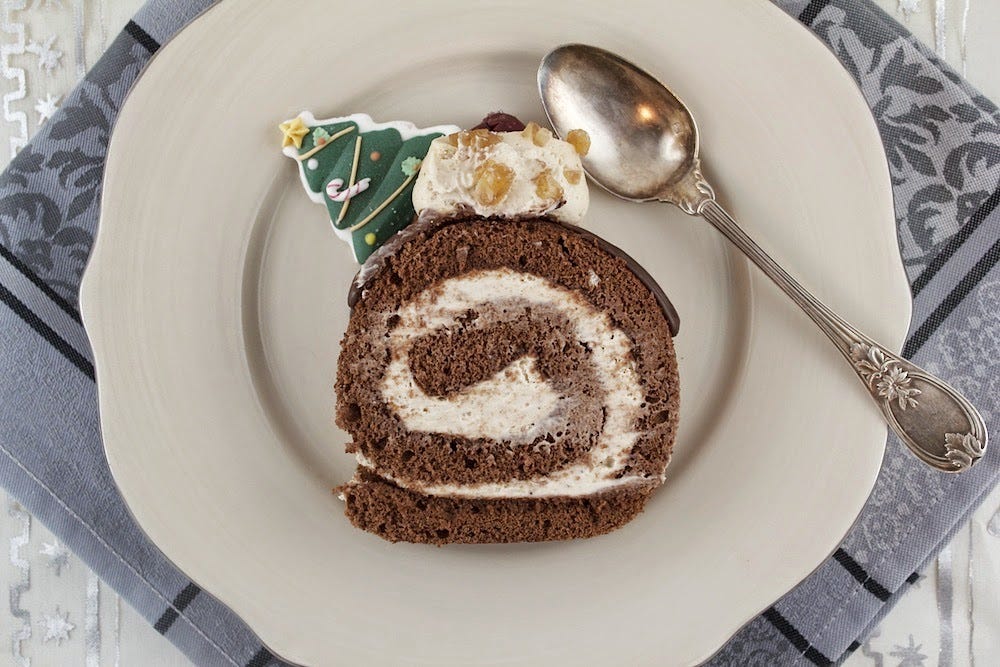
Once the cake is infused with the rum syrup, spread most of the Chestnut Mascarpone Whipped Cream evenly over the genoise almost, but not quite, to the edges of the cake; save about 4 or 5 tablespoons to use for piping a decorative swirl on the top of the roll. The cake might be curled at one end; do not try to press it flat if you can help it, just follow the curve when spreading on the cream.
Starting at the short end of the genoise (the end rolled up first in the towel to cool), roll up the cake as tightly as possible without pressing or rolling so tightly that the cream oozes out.
When completely rolled, scrape off any filling that has oozed out and add it back to the bowl with the extra filling. Using a sharp or serrated knife, cleanly trim off both ends of the roll or bûche (these can be eaten now). Very carefully, lift the bûche onto the serving platter, placing the seam side down, remove the parchment paper and gently reshape the log so it is even from one end to the other.
Cover with plastic wrap and place in the refrigerator to chill until just before serving time. The bûche can be made, assembled, and chilled several hours or the day before serving; as it chills, the filling will continue to firm and the cake itself to moisten.
Just before serving, dust the entire surface of the roll lightly and evenly with cocoa powder or powdered/icing sugar, drizzle with chocolate rum ganache then pipe the rest of the cream on top and decorate as you like with fruit, colored sugar, crushed candy canes or chocolate curls. Or candy Christmas shapes. I used chopped candied chestnuts.
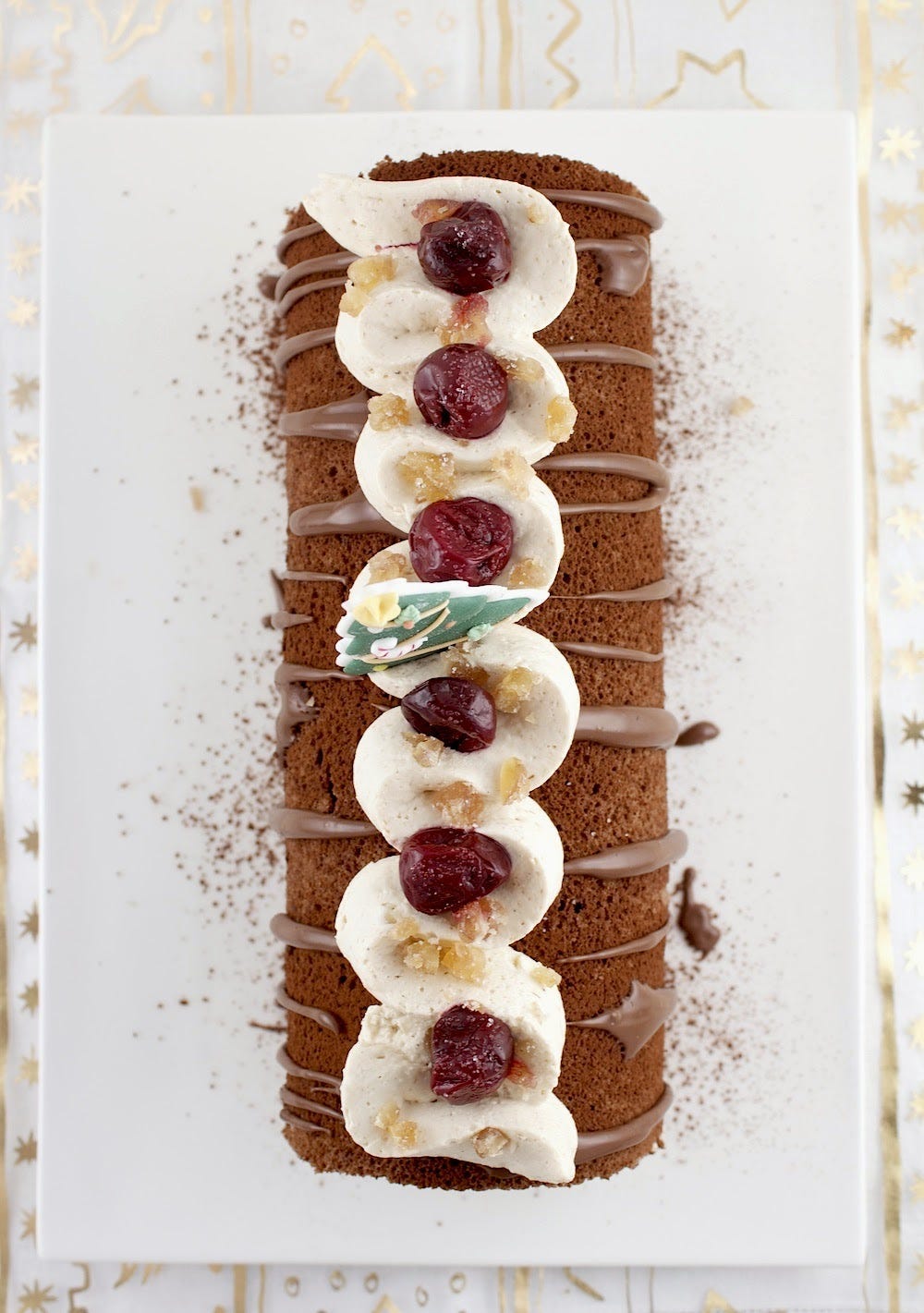
Prepare the Chocolate Ganache by chopping 3.53 ounces (100 grams) chocolate and placing it in a heatproof/Pyrex bowl. Bring ½ cup (125 ml) heavy cream just to a boil and immediately pour over the chopped chocolate. Allow to sit for about a minute then stir until all of the chocolate is melted and the ganache is smooth. Allow to cool to room temperature, stirring occasionally, until thickened. Stir in 2 tablespoons dark/amber rum. Reserve in the refrigerator. The ganache will firm up as it cools. Take out enough time before decorating and serving the bûche for the ganache to come to room temperature and drizzling consistency; it should drizzle easily yet be thick enough to stay on the cake and not run off and pool on the serving platter.
Jamie Schler is an American food and culture writer—immersed in French culinary history—living in France where she owns a hotel, makes jam, and writes the Substack Life’s a Feast.

“Moments of joy, beauty and grace are necessary every day.” That’s a lovely sentiment and I second it. The chocolate chestnut buche de noel looks exquisite.
That Christmas log sounds and looks delicious. Unfortunately, my hands consist of nothing but thumbs when it comes to baking (and most anything else in the kitchen). 😢