


“Pastry is an art of exactness and precision; it demands as much science as it does taste.”—Jules Gouffé
I thought today’s post should be a cautionary tale—but it’s not really. I just like the expression “a cautionary tale.” Let’s call it instead a tale of perseverance, a triumph of persistence. Or maybe a cautionary tale in reverse—what would happen if you stop after one try, one failure. You will never enjoy the sweet taste of success.
An object lesson then: a striking, practical example of a principle or ideal.
That’s it.
My tale today is one of a recipe gone wrong, a test of patience and will - a baking story that is really about more than pastry. I’ve been thinking about what we’re living through in the United States right now and how hard it can be to keep going when everything feels broken. History teaches us that when fascism, authoritarianism, scapegoating erodes democracy and takes hold, it never, ever ends well. And though we’re tempted to give in to exhaustion or despair, or when any effort at political activism seems ineffective, we can’t. We mustn’t.
So, this is the object lesson, and we can take it where we find it—in flour and failure, in trying again and again, struggling though the missteps and setbacks until something beautiful finally succeeds.
Baking takes precision, understanding how things work, order and organization, attention to every detail. Sure, you can—I have many times—just do rough measures, dump every ingredient, some untried substitutions, into a bowl, mix and bake and get really good brownies or quick breads. Yum. But most baking, from cake to bread, is a science blended with passion. It takes determination to learn how yeast activates, how ingredients must be blended together, how temperature, time, and even humidity can impact results. How substitutions or a step overlooked can lead to disaster. It takes practice, trial and error, and a certain trust in one’s own instincts.
It takes time.
There’s a great expression in French: “mettre la main à la pâte” - literally “to put one’s hand in the dough.” It means showing up, actively participating, doing the work, getting your hands dirty to get the job done. And I find it à propos not only to baking but also to our fight against this government: If we want change, we all have to mettre la main à la pâte. Despite setbacks, we have to roll up our sleeves and do the work together until we succeed. Like baking, it will take patience and persistence. Pastry, unlike cooking, cannot be corrected and saved at the end. Say the same about losing our country.
I thought it kind of timely to share a little baking story from about 10 years ago when I first made this coffee cake. This wasn’t just for pleasure; not only was this going to go on my blog, but it also was my turn to select a recipe for a monthly bread-baking group I belonged to. I wanted to make something sweet. I’ve always loved enriched doughs - those tender yeast doughs enriched with eggs and butter; they are so pleasurable to work with, always forgiving, and they almost always succeed, unlike regular breads which are much more temperamental. Then I stumbled upon an unusual, slightly daring recipe for a coffee cake in a trusted cookbook: soft, light dough beautifully swirled with a cinnamon-nut filling lightened by a simple meringue.
Attempt #1: I made the dough. It was incredibly easy to stir together; I had made no-knead sweet brioche-type dough in the past several times, and this one seemed as it should. I covered the dough and left it to rise overnight. The next day, I should have known better than to simply dump the dough onto a floured board as instructed, slice it in two, and just start rolling. It was clearly too wet, too sticky, too unruly to handle, let alone roll out properly. I could already see where this was heading, but I forged ahead anyway. I was impatient to move the project forward and wanted results, and so I rolled it out and cut it in two. I started whipping the egg whites for the filling, following the recipe. Again, my impatience overruled my logic and instinct. Something niggled in my brain that the proportions were off. Although the meringue looked beautiful, I could see that it was fairly wet and much too loose for a jellyroll-type filling. Still, I decided to be clever and fold in chopped nuts—nothing better than a bit of crunch in a coffee cake—instead of the ground nuts the recipe called for, which, of course, would have thickened the meringue. I knew I was wading into deep water, but my stubbornness and impatience got the better of me. I could see that there was way too much meringue for the two rectangles of dough, but by then I was frustrated and angry with myself for not slowing down, thinking things through, and trusting my experience, so on I went. I slathered that meringue onto the dough rectangles … and attempted to roll them up. They slithered and slid across and off the wooden cutting board; the gooey meringue was spreading everywhere, in my hair, up and down my arms and across the counter. No matter how I fought that thing, it only got worse. No way in hell was this thing going to roll up and then behave long enough to be lifted from the cutting board to be fitted into the cake pan.
So I scraped it off, all of it, straight into the trash.
Attempt #2: Back to the drawing board. I increased the amount of flour in the initial mix of dough until it was the consistency I expected. Into the fridge it went for the night. The next day, I scraped the dough onto a floured cutting board and, staying calm and careful, I kneaded the dough briefly, adding more flour until it was malleable, soft rather than sticky, and easy to control. I didn’t correct the filling and still used chopped instead of ground nuts, but I succeeded in rolling the dough around the filling, or rolling the filling up into the dough, and lifting the 2 logs into the pan. It rose, it baked, it looked good. And, as all food bloggers are obliged to do, I took photos of it. At least I thought I did. Three, maybe four days later, the cake was almost completely eaten – all by myself, I would like to add, as my husband and older son were both out of town and my younger son rarely eats cake. I went to download the photos so I could prepare the blog post and … no photos. Not a single one.
Attempt #3: Here we go again. I had to start over. All for the photos. By the third attempt in less than a week, I should’ve had this recipe down pat: 3 cups of flour, add the other ingredients. I have a beautiful, firm, nicely elastic dough sitting in my mixing bowl, and I’m scratching my head. “Why is it so dough-like and not all sticky and wet like an enriched dough is supposed to be?” I skimmed through the list of ingredients and looked around my kitchen and see—with horror—that I had forgotten to add in the 2 sticks of melted butter that was still sitting on my stove. “Maudit! Cursed! This recipe is cursed!” was all I could think. Wailing and cursing, I dumped the liquid butter onto the firm dough, pushed my hand into it, and tried to knead the butter into the dough.
I had melted butter up to my wrists as I pushed my knuckles deep into the butter-slick dough (which was sitting in a full inch of it), push and fold, push and fold—then whack at it a few times with a wooden spoon. I was so fed up that I actually just wanted this entire experience to be done and finished with. But I kept at it for heaven knows how long - pushing, folding, cursing, squeezing—until finally, finally I succeeded in kneading in all of that melted butter and had a unified, smooth, lovely dough. I covered the bowl and put it in the fridge.
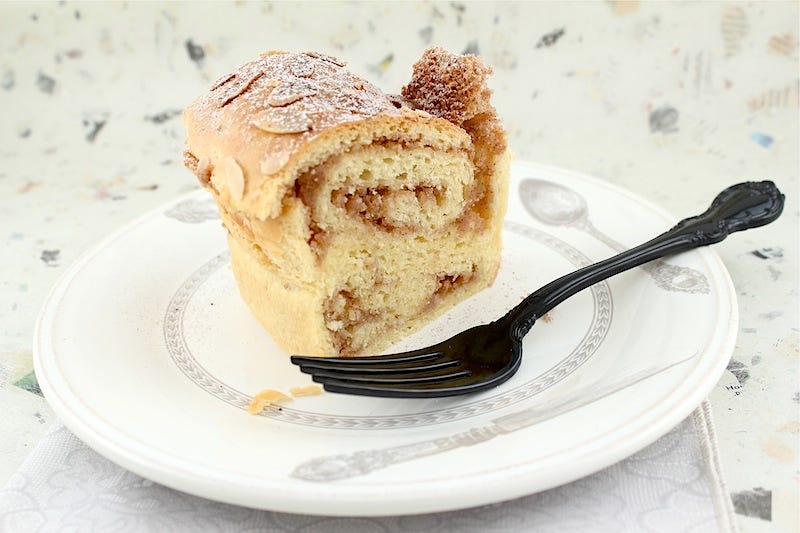
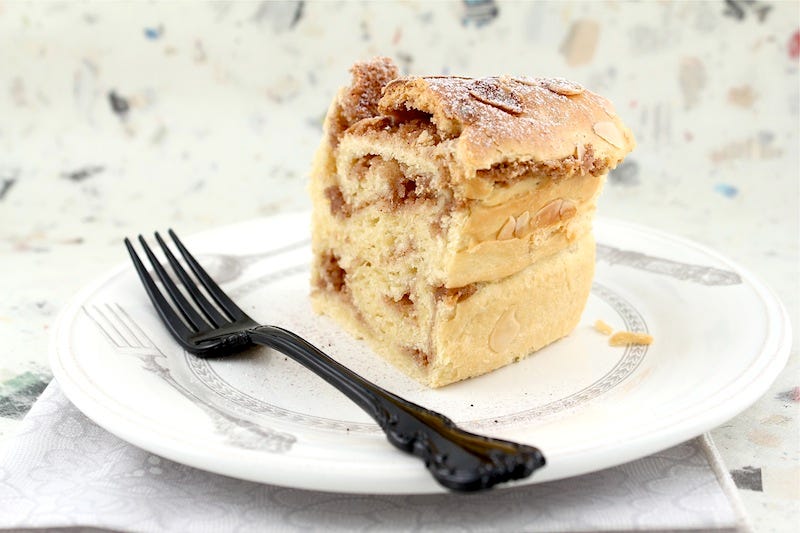
The following day, the dough that I pulled out of the refrigerator was … perfect, beautifully risen, and it rolled out the dream. I made the meringue, decreasing the quantity of egg whites and sugar to ⅔ the original quantity, used ground nuts as I should, and continued on my merry way. I rolled out the dough, spread the meringue onto each rectangle, and rolled them up with no difficulty. I lifted and slipped them into the pan, settling them nicely around the tube, and decided to treat them to a little milk wash and a pretty little dusting of slivered almonds. The second rise was perfect, and it baked up giddily high and golden. I took my photos, sliced and tasted it, and it was perfect! I downloaded the photos—yes, no illusion, they were indeed there. And I smiled.
Trial and error, often messy and frustrating, sometimes an utter disaster, is part of the job of being a food writer and recipe developer. But if I let each failed attempt, every doubt or problem bring me down, I would never experience the successes, I’d never reach those hard-won moments of triumph. It’s why I love doing this in the first place.
And so, I take this as an object lesson. I’m reminded of this coffee cake exercise whenever my voice seems useless, whenever I feel exhaustion, frustration, and despair. One shouldn’t give up, no matter how strongly or how often one would like to. With time, order and organization, precision and persistence, we can—and will—finally succeed.
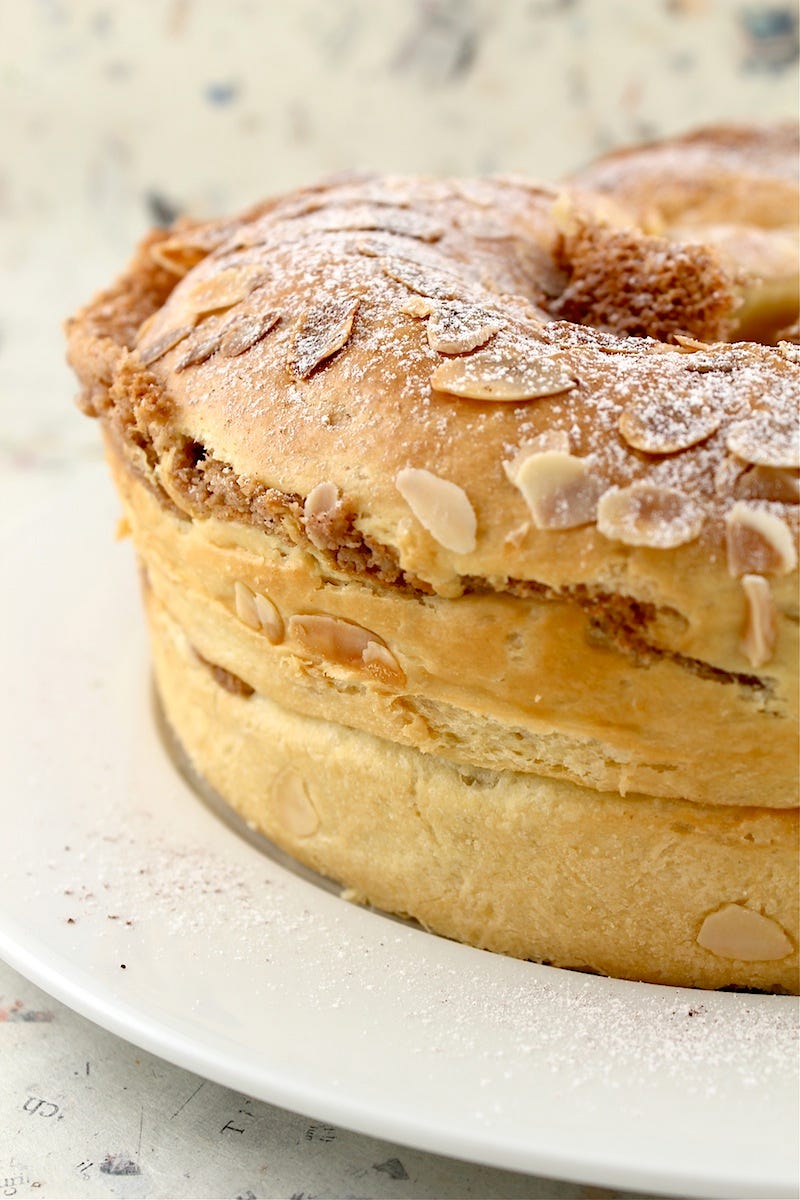
Cinnamon Nut Roll Coffee Cake
This is a fiddly, time-consuming coffee cake but really worth the effort, dedication, and attention to detail.
Note that the dough rests in the refrigerator overnight, so start the process the day before! If you are using European regular flour, which is softer than U.S. all-purpose, start the basic dough with 3 cups (420 grams) flour; if using American all-purpose flour, begin with 2 ½ cups (350 grams) then add more as needed on the second day when kneading the dough before rolling.
Note To measure flour, lightly spoon into the measuring cup and then level off with a flat blade or bench scraper; 1 cup weighs approximately 140 grams.
You will need a stand mixer or hand beaters to whip egg whites for the meringue filling and a 10-inch (standard) tube pan, preferably with a removable center.
For the dough:
4 ½ teaspoons (½ ounce/14 grams) active dry yeast
¼ cup (65 ml) warm water (110°F to 115°F)
16 tablespoons (240 grams) unsalted butter, melted and cooled to tepid
½ cup (125 ml) warm milk
4 egg yolks
2 tablespoons sugar
¾ teaspoon salt
2 ½ cups (350 grams) all-purpose flour (if using European regular flour, increase total flour to 3 cups (420 grams), more if the dough is too sticky or runny.
For the filling:
2 – 3 large egg whites for a total of 2.65 ounces (75 grams)
⅔ cup (135 grams) sugar + 2 tablespoons (30 grams) sugar
4.4 ounces (125 grams) finely ground hazelnuts, almonds, walnuts, or pecans
1 – 2 teaspoons ground cinnamon
2 tablespoons milk
A bit of milk for brushing the top and the seams of the cake and slivered blanched almonds for dusting, optional but pretty
The day before, prepare the dough:
In a large mixing bowl, dissolve the yeast in warm water; allow to activate for 15 minutes until foamy. Whisk in the tepid melted butter, warm milk, eggs yolks, sugar, and salt and then stir in the flour. Beat or stir until smooth—the mixture will be sticky. Cover and refrigerate overnight.
The day of baking, prepare the filling:
In a small bowl, beat the egg whites on medium speed until soft peaks form. Gradually beat in ⅔ cup sugar, about 2 tablespoons at a time, on high speed until the sugar is incorporated and dissolved, leaving a thick, glossy meringue.
In a large bowl, combine the ground nuts, cinnamon, and remaining 2 tablespoons sugar then stir in the milk until the dry ingredients are all moistened; fold in the meringue.
Prepare the Coffee Cake:
Grease/butter the bottom, sides and center tube of a 10-inch tube pan.
Scrape the dough out of the bowl onto a floured work surface. Gently knead in more flour as needed for a nice smooth dough that handles easily—it should not be dry but no longer sticky. Divide the dough in half. On a well-floured work surface, roll each portion into an 18 x 12–inch (45 x 30 cm) rectangle with the longer side perpendicular to your body (the longer edge lying on the cutting board left to right). Spread half of the filling evenly over each rectangle within ½–inch (1 cm) of the edges. Lightly brush the farthest, top edge of each rectangle with milk. Roll each up, jellyroll style, as tightly as possible without squeezing out the meringue, starting with the long side closest to you and rolling up; pinch seam to seal. You’ll have 2 long logs.
Place one filled roll, seam side up, in the greased tube pan. Pinch the two open ends together. Place the second roll, seam side down on top of the first roll, again pinching and sealing the two open ends. Gently brush the top all over with a bit of milk and dust with some slivered almonds.
Cover the pan with plastic and allow to rise for 1 hour.
Preheat the oven to 350°F (180°C).
Once the coffee cake has risen, discard the plastic wrap and again gently brush or dab the top surface all over with a bit of milk and add more slivered almonds where there are spaces.
Bake in the preheated oven for about 45 minutes or until puffed and golden brown. Remove from the oven and allow to cool for 10 minutes. After 10 minutes, loosen the coffee cake from the sides of the pan and lift out the center tube, placing the tube with the cake onto the rack to cool completely. Once cool enough to handle, loosen the cake from the bottom of the pan and around the tube using a long, thin blade and carefully invert, lift off the tube and flip back, top side up, onto a serving platter. Or lift the cake off the tube onto the serving platter.
Eat as is or drizzle with glaze or dust with powdered sugar/cocoa powder.
Jamie Schler is an American food and culture writer living in France where she owns a hotel, makes jam, and writes the Substack Life’s a Feast.

"There’s a great expression in French: “mettre la main à la pâte” - literally “to put one’s hand in the dough.” It means showing up, actively participating, doing the work, getting your hands dirty to get the job done. And I find it à propos not only to baking but also to our fight against this government: If we want change, we all have to mettre la main à la pâte. Despite setbacks, we have to roll up our sleeves and do the work together until we succeed. Like baking, it will take patience and persistence. Pastry, unlike cooking, cannot be corrected and saved at the end. Say the same about losing our country."
Parables are great teachers!
I absolutely love cinnamon! That looks, smells, and tastes delicious!