

By Jacqueline Kelly and Mimi Rocah
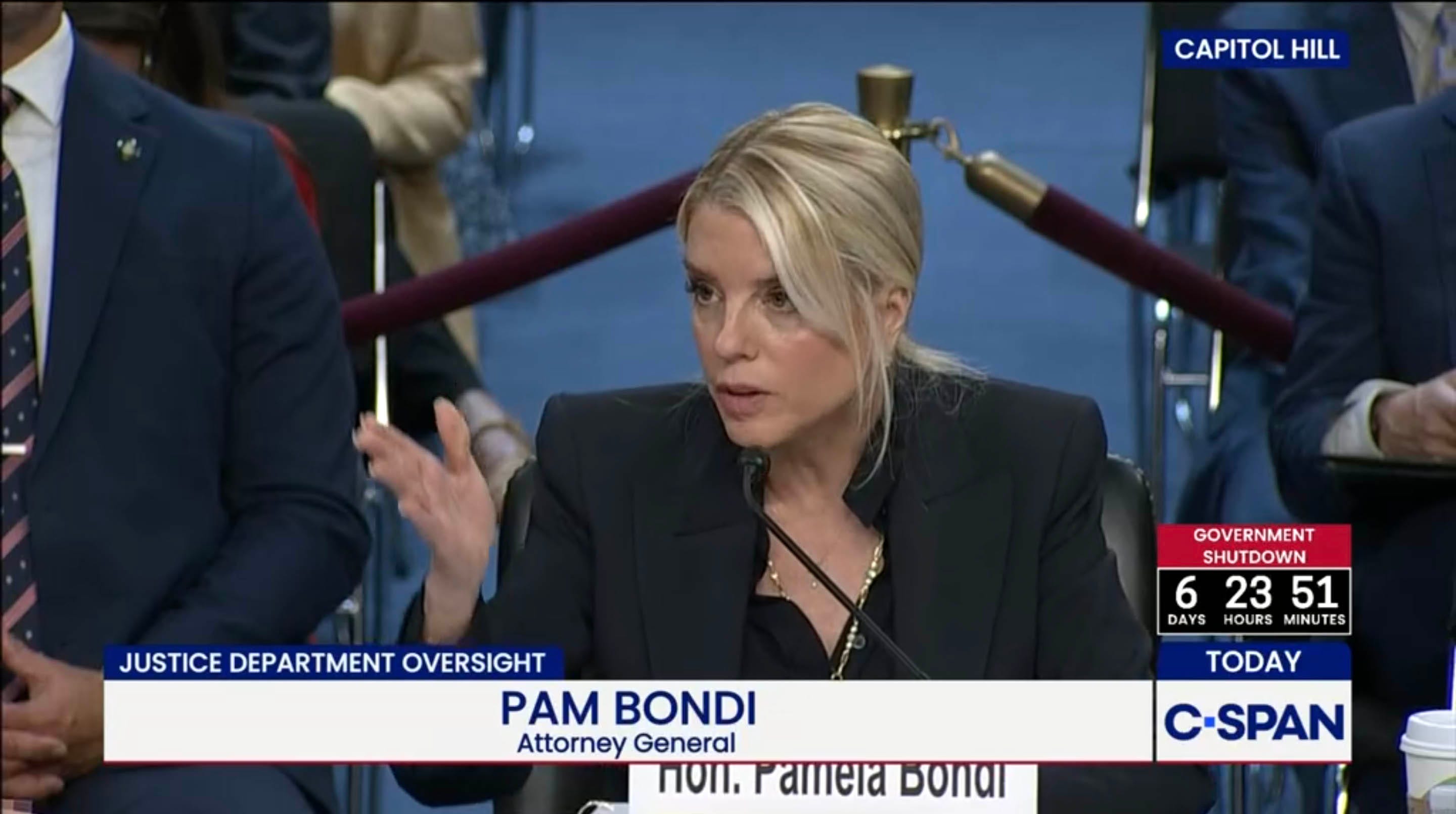
During Attorney General Pamela Bondi’s combative testimony before the Senate Judiciary Committee Tuesday, Bondi repeatedly voiced commitment to the Department of Justice’s anti-trafficking efforts and to victims. And yet she refused to answer any questions about her handling of the Jeffrey Epstein files and demurred on questions about DOJ’s decisions to slash critical funding that supports state and local anti-crime and victim services initiatives.
The testimony was just the latest example of lip service from DOJ leadership to survivors of sexual abuse and domestic violence that is far removed from reality on the ground. In recent years, the Justice Department has been on the forefront of prosecuting high-impact human trafficking and sexual abuse cases—seeking to hold abusers to account for federal crimes that often carry harsher penalties than their state counterparts—DOJ’s leadership is rolling back that important progress. By prioritizing political interests over justice, including by flirting with pardons for convicted criminals and hinging federal funding for victims on immigration status, DOJ is jeopardizing the work of federal and state law enforcement to protect survivors. If the ship is not righted soon, DOJ risks losing the credibility it has left with the survivors whose cooperation is desperately needed to bring these cases successfully.
The tenuousness of the moment was on full display last week when Sean Combs was sentenced to 50 months’ imprisonment following his federal conviction in the Southern District of New York for transporting individuals for prostitution. Presiding U.S. District Court Judge Arun Subramanian rightly commended Cassie Ventura and Jane, survivors who testified at trial, for their bravery in telling the truth about the abuse they endured. The judge noted that “a substantial sentence must be given to send a message to abusers and victims alike that abuse against women is met with real accountability.” Whether or not you agree that 50 months is “substantial” enough to account for Combs’ crimes, the underlying message is exactly right. For too long, survivors of sexual and domestic abuse have seen their experiences minimized and not taken seriously, including by the criminal justice system.
DOJ is supposed to be an exception to that, though. In addition to the Combs case, DOJ has prosecuted dozens of high-impact sex-crimes cases over the past decade, including by bringing charges against Epstein and Ghislaine Maxwell, Keith Reniere, Robert Sylvester Kelly (a/k/a R. Kelly), Robert Hadden, and many dozens of lesser-known defendants. Following the pronouncement of Combs’ sentence on Friday, Jay Clayton, the U.S. Attorney for the Southern District of New York, and Ricky J. Patel, head of the New York field office of Homeland Security Investigations, issued a statement that a year ago would have been neither controversial nor noteworthy. They echoed some of Judge Subramanian’s remarks, thanking him for his “thoughtful comments specifically crediting the victims and acknowledging their strength and courage for coming forward.” Clayton and Patel added that federal law enforcement were “committed to ridding our country of sex crimes” and would “prioritize a victim-centered approach” to these cases. This message, too, is obviously the right one—but like the attorney general’s testimony this week, it now rings hollow.
To be sure, the career prosecutors at DOJ and their law enforcement partners who continue to investigate and prosecute these crimes are dedicated and steadfast in their commitment to survivors. But it’s impossible to ignore the Epstein-sized elephant in the room that is endangering their ability to do this important work: DOJ’s increasingly politicized leadership. In July, Maurene Comey, one of the lead prosecutors on the Epstein, Combs, and Hadden prosecutions, was summarily fired just weeks after Combs’ trial conviction. Comey has sued the DOJ over her dismissal. The same month, Todd Blanche, the second-in-command at Justice and Trump’s former personal lawyer, conducted a “proffer” of Maxwell despite that she was convicted by a jury of the sex crimes she perpetrated with Epstein and had been charged with perjury for lying about her criminal conduct in the past—a charge only dismissed after her conviction on the more serious charges. During that interview, Blanche pitched her softball after softball, and then demurred when asked on live television whether Maxwell was telling the truth, stating—absurdly—that it was an “impossible question to answer.” And, of course, seemingly in violation of Federal Bureau of Prisons policy, Maxwell was soon transferred to a minimum-security prison and, as recently as this week, President Donald Trump has not ruled out pardoning her. Now that the Supreme Court has denied hearing her appeal, DOJ is out of excuses not to swiftly shut down any further speculation about Maxwell’s conviction.
Most revealing about how far from victim-centered this DOJ has become is its resource allocation. Since January, and unlike during the first Trump administration, DOJ has slashed millions of dollars in funding for victim-based programs; redirected to immigration enforcement agents whose primary mission was combating trafficking and exploitation of children; and announced new restrictions on federal funding for survivors of domestic violence, sexual assault, and other violent crimes that would prevent states from using certain federal grants to provide some services to individuals unable to immediately prove their immigration status. When pressed about the cuts during her testimony, the attorney general offered to work with lawmakers to hear appeals on particular grant cancellations but offered no explanation whatsoever about why certain funding would be tied to immigration status. In reality, these cuts and funding restrictions will undoubtedly serve only to silence survivors from speaking out and disrupt essential channels of victims’ services. A coalition of 21 state attorneys general is challenging the latest funding restrictions in court.
But the critical question is: Why are we here? Of course, a substantial portion of human trafficking victims are non-citizens. Putting aside the moral failure to protect people within our borders because of their immigration status, this redirection of law enforcement resources harms not only survivors who happen to be immigrants but also any survivor, regardless of status, because fewer perpetrators will be caught and held accountable. Likewise, the grant cuts will impact all survivors of domestic violence and sex abuse by hamstringing service providers. Programs tied to immigration status, in particular, will push survivors without legal status back into the shadows–endangering them further and preventing law enforcement from holding their abusers to account. All together, these are serious missteps that will roll back decades of work based solely on politics.
Judge Subramanian got it right when he said that “real accountability” is necessary to show that abuse against women will not be tolerated. But if law enforcement is stripped of the resources needed to combat sex crimes and provide necessary services to victims, and the finality of convictions is thrown into question for political ends, who will be left to seek that accountability? Words of support are not enough. Survivors deserve so much more.
Jacqueline Kelly is a former federal prosecutor in the Southern District of New York who supervised sex crimes prosecutions and served as the Chief of the Civil Rights Unit, Human Trafficking Coordinator, and Victims’ Rights Coordinator. Mimi Rocah was the Westchester County District Attorney and a former federal prosecutor and Division Chief in the Southern District of New York.
Jacqueline Kelly, Mimi Rocha,
I want to thank you both for your honesty, authenticity, compassion, reporting truth to power with evidence of DOJ's present biography. We are in this together. No Kings. Peace.
Christopher and family
Pam Bondi would do well to remember what happened to John Mitchell.