


This week, Military.com reported that Secretary of Defense and group chat enthusiast Pete Hegseth had ordered the Navy to rename the USNS Harvey Milk, an oiler named for the gay civil rights leader who was assassinated in 1978.
Though he is known for becoming the first openly gay elected official in San Francisco, Milk also served four years in the Navy during the Korean War and received an “other than honorable” discharge because of his sexuality.
Hegseth’s order is reportedly part of a broader review of a class of ships named after civil rights champions, including Harriet Tubman, Medgar Evers, and Thurgood Marshall—people who did more for their country than Hegseth and his star-spangled pocket squares ever could.
The timing of the news—at the beginning of Pride Month, amid World Pride celebrations in Washington, D.C.—hardly seems like a coincidence, given the administration’s disregard for the accomplishments of anyone other than straight white men.
Even without a ship named after him, Milk’s legacy is evident all over the city of San Francisco, as noted in a New York Times piece about the landmarks named for the former city supervisor.
And it is also present in the numerous films, books, podcasts, TV shows, and even an opera about his short life.
One of the most remarkable things about Milk is how much change he was able to affect in less than a year in elected office.
He spent most of his adult life drifting from one job to the next before moving to San Francisco in the early 1970s. He opened a camera store on Castro Street, became an organizer in the gay community, and ran for office unsuccessfully three times before finally winning a seat on the city’s board of supervisors in 1977.
A year later, both he and San Francisco mayor George Moscone were dead, killed by Dan White, a disgruntled colleague and former police officer who had resigned from his post as a supervisor.
Yet in that short time, Milk became a national political figure who helped establish basic civil rights for gay people in California. His work enabled a generation to come out of the closet. His death—and the astonishingly lenient sentence White received—helped galvanize the gay community.
Here are a few recommendations:
The Times of Harvey Milk (Max)
Directed by Rob Epstein and produced by Richard Schmiechen, this pioneering documentary traces Milk’s political biography and looks at his lasting impact on the gay community in San Francisco. Released just six years after Milk’s death and featuring interviews and archival footage, there’s an immediacy to The Times of Harvey Milk that makes it incredibly powerful to watch, even 40 years after its release—especially the footage of people marching by candlelight the night he was assassinated. It paints a portrait of Milk as a deft politician who knew how to work the press and how to appeal to diverse groups of voters in San Francisco.
Like its subject, the film also made history: In 1985, it won the Oscar for documentary feature, the first gay-themed film and the first made by openly gay filmmakers to win the category. In his Oscar acceptance speech, Epstein thanked his partner —which was itself a remarkable thing to do early in the AIDS epidemic, at the height of the Reagan era, when homophobia dominated.
Milk (Peacock)
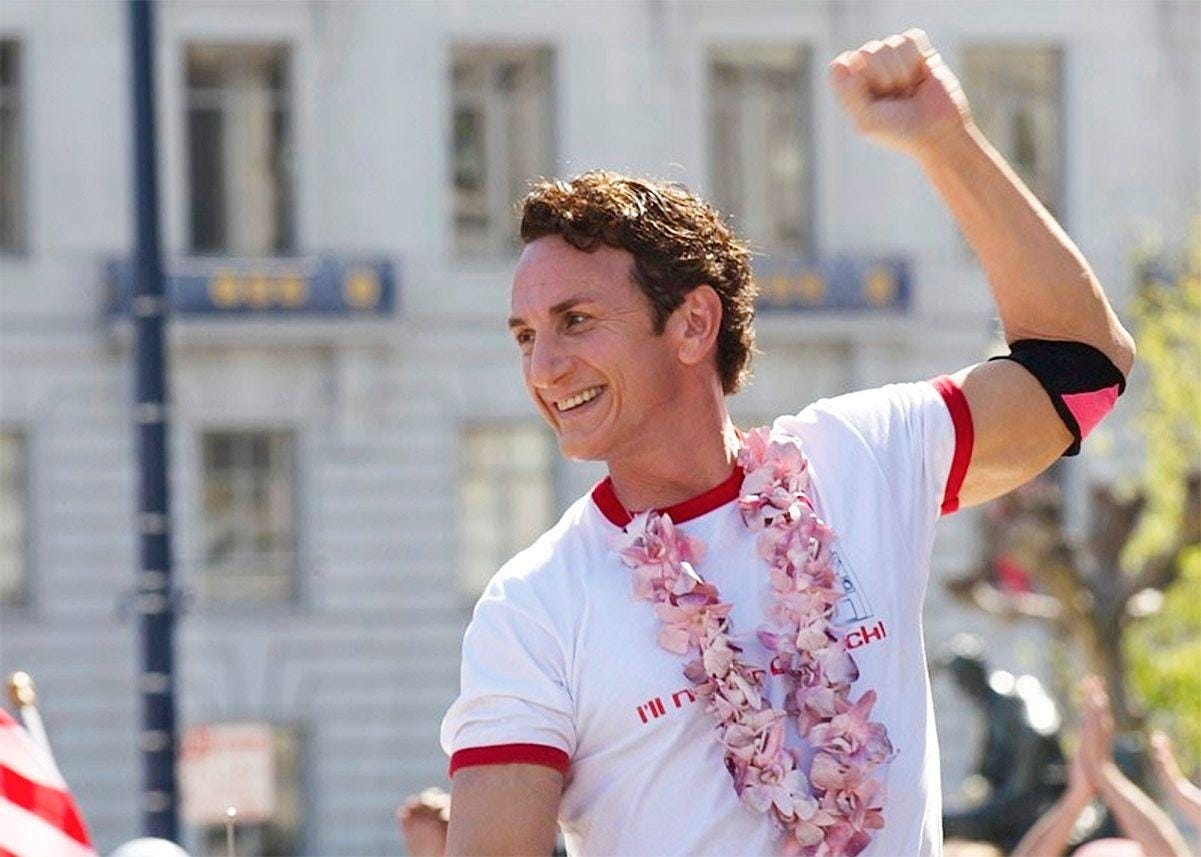
For decades, Hollywood attempted to make a biopic about Milk. But the projects—including one written by Oliver Stone and based on Randy Shilts’s book The Mayor of Castro Street: The Life and Times of Harvey Milk—languished in development hell. Then came Milk, directed by queer filmmaker Gus Van Sant, which introduced the politician to a new generation and won two Oscars: for screenwriter Dustin Lance Black and star Sean Penn, who eschews his usual brooding to portray Milk as a joyful, funny political warrior. The film also sheds light on the psychology of his killer, Dan White, played by a very creepy Josh Brolin.
Slow Burn: Gays Against Briggs
Season 9 of Slate’s reliably engrossing history podcast tells the in-depth story of the civil rights battle over the Briggs Initiative, which would have made it illegal for gays and lesbians to work in California schools. It ultimately failed, thanks to activists including Harvey Milk. Gays Against Briggs also covers Milk’s assassination and its aftermath and features extensive notes for each episode for anyone who wants to go further down the rabbit hole.
Other weekend recs:
Good Night, and Good Luck (Saturday, CNN)
George Clooney made his Broadway debut in this stage version of his 2005 film about Edward R. Murrow. On Saturday, the penultimate performance of the play will air live on CNN, followed by an Anderson Cooper-hosted special about [sigh] the global state of journalism. Good Night, and Good Luck is up for five Tony Awards Sunday night, with Clooney nominated for lead actor in a play for his performance as the legendary broadcaster. (If he wins, he would have three-quarters of an EGOT.) Those without a cable subscription can watch at CNN.com/GoodNightGoodLuck, at 7pm ET.
78th Tony Awards (Sunday, CBS)
Broadway had one of its most exciting seasons in recent memory this spring, thanks to revivals of Gypsy and Sunset Blvd., exciting new musicals like Maybe Happy Ending and Death Becomes Her, and acclaimed hit plays including Purpose, Oh, Mary!, John Proctor is the Villain, and The Picture of Dorian Grey. The theater community will honor the year’s best Sunday night at the Tony Awards, which will be hosted by Cynthia Erivo, because she doesn’t have enough going on at the moment. The broadcast will feature performances from nominated musicals including Gypsy, Sunset Blvd., Maybe Happy Ending—and a special reunion of the original cast of Hamilton to celebrate the show’s 10th anniversary. Don’t be surprised if you hear some political commentary—and more than a few jokes about Patti LuPone.
News of note:
In a note posted to her website last Friday, Taylor Swift announced she had purchased the rights to her first six albums, bringing an end to a saga that began in 2019 when her catalog was sold to Scooter Braun’s Ithaca Holdings and inspired her to begin rerecording her albums. But it also marked the beginning of a new era (sorry) in the ever-lively Swift discourse. Though many fans celebrated the news—some tearfully—others were mildly disappointed that they might never get to hear “Taylor’s Version” of Reputation and Taylor Swift, the two albums she had yet to rerelease.
Comedy nerds—a group nearly as passionate as Swifties—were devastated to learn that Marc Maron will be bringing his hit podcast WTF to an end after 16 years. Maron was one of the first artists to see the potential in the format. He has produced more than 1,600 episodes of the show, featuring long, emotionally probing interviews with figures including Robin Williams, Barack Obama (while he was in the White House), and Courtney Love. The final episode is expected this fall.
Patti LuPone has apologized for making impolitic comments about fellow Broadway stars Audra McDonald and Kecia Lewis in a juicy New Yorker profile published last week in which she lashed out at everyone from Glenn Close to the overly chatty young women seated next to her at a restaurant. The story lit up social media and resulted in a condemnatory open letter from the Broadway community. “I regret my flippant and emotional responses during this interview, which were inappropriate,” Lupone said in the statement.
Meredith Blake is The Contrarian’s culture columnist.