


Anand Gopal’s Days of Love and Rage is a history of how the city of Manbij in Syria ousted the Assad regime in 2011 — and the extraordinary experiment in democracy that followed — through the eyes of the people who made it happen. Gopal spoke with The Contrarian on March 3, a day after the book launch. The following is excerpted from that conversation, with edits for length and clarity.
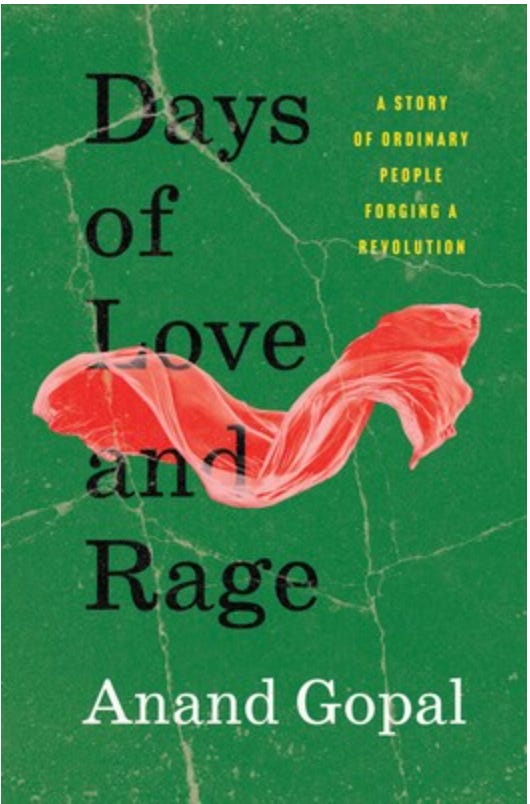
Your book has close to 2000 interviews; eight years of reporting on your part. What kept you coming back to this story that you tell in Days of Love and Rage?
Well, I’ve been a war correspondent for many years, reporting in places like Iraq and Afghanistan and Yemen and often seeing people at some of the worst moments in their lives. And in the course of reporting on the Syrian conflict in 2011, 2012 it was more of that, as people were being killed by their own government.
But in the midst of that, I heard a story about a city that had overthrown the dictatorship and was trying to build a democracy from scratch, essentially. I was drawn to that just because it was different from the usual kind of stories of destruction and loss and devastation, even though there’s a lot of that. I was looking for something that could be a little bit more instructive about, what does it look like to build a democracy from scratch?
It took me eight years, as you said, to write it, but throughout that, I kept coming back because I was always pretty astonished by people’s resolve in the most difficult of circumstances. And the whole time I was reporting on this, the backdrop was the United States. I was thinking about the kind of problems of inequality and authoritarianism that have been plaguing Western countries, and seeing how people in Syria are trying to solve the same problems.
You’re following particular characters throughout a multi-year span. Why did you decide to structure it around these characters, rather than an approach that was more about the events?
I’ve always been interested in the ways in which people’s personal lives, their intimate lives, kind of get translated into their political positions and political actions — and every time I’ve looked into that, it’s always been surprising to me. It’s always been the case when I really try to sit with somebody for months, if not years, and try to understand them, that how they came to their worldviews is not what I would have expected.
We have the story of Abdul Hadi. We meet him in the book early on as a pro democracy activist. Really brave individual who ends up getting arrested and tortured horrifically by the Syrian regime, and then gets out and continues the protests, all in the name of freedom and democracy. And he ends up kind of drifting from that and falling under the sway of ISIS. To me it was a very surprising trajectory, although it turns out that that’s not that uncommon.
Telling that story of how somebody could become disillusioned with democracy and drift towards authoritarianism was one that I thought was best told by zooming into someone’s personal lives and the intimate sort of choices they face.
One of the things I was most struck by, and I think you’ve alluded to this, but you have a society where there’s almost not only no democracy, but no civil society, right? And then suddenly there’s an explosion. What do you think allowed for that enthusiasm and that approach to creating a civil society when no one had really had a chance to do that for decades in Syria?
This is one place where some of my ideas going into the book are really overturned through all the research. I used to think that, basically, people just want to be left alone. People are not going to create organizations or civil societies unless outside agents come in to help them.
But what happens here is there’s 40 years of dictatorship in which there was almost no civil society. There’s no freedom of speech, freedom of assembly. And once the regime was overthrown in the city, all these organizations kind of appeared out of nowhere, and people started to create what were called assemblies, which were like these clubs.
There were occupational groupings, there was councils, there was charities, there was dozens of newspapers that appeared. And people were doing that, not because they had some preconceived idea of what they should be doing, or not because they were political theorists, they just did this because they needed to get things done. You need to figure out how to keep the streets clean, the schools open, the lights on, right? And so people started to band together collectively to try to solve these problems.
Something I was really struck by in the book is this complex view of how ISIS eventually takes over Manbij. It’s not this kind of Hiluxes with black flags, there’s this growth within the city of interest in ISIS.
When the government was overthrown, protesters basically took over the city. They set up something called the Revolutionary Council [who] were all people who had suffered greatly under the dictatorship, and so they really believed in the idea of freedom. What ended up happening as the months went on is people began to debate, “well, what does freedom exactly mean?” Prices started to rise, partly because of the conflict. At the same time, people were fleeing other cities, and so it was driving up the cost of rent.
And so there was a cost-of-living crisis that began to emerge, and the Revolutionary Council was saying, “well, we believe in freedom, and that means freedom of speech, freedom of assembly, and also freedom of markets.” Whereas many ordinary people, working-class people, were saying, “freedom of speech and assembly are great, but freedom of markets, I don’t know, because I need to put food on the table.”
Into that came a small group of outsiders, about six foreigners. They studied the divides in the city, and they realized that the vast majority of the city were poor and working class, and they were growing disaffected with the leadership. So they began to wage what basically is a populist campaign against the leadership. Many people began to gravitate towards these six individuals, who revealed themselves to be ISIS.
Within six months, they grew from six people to like, 1,000 and they became the largest political grouping in the city. Eventually they’re able to take over the city and dissolve the democracy, largely from within.
The last year or two has seen dramatic changes in Syria on the ground. Have you stayed in touch with your sources in Syria?
I finished the draft of this book maybe a few days before Assad fell. I had to go back to Syria and write a new ending.
On the one hand, it’s an amazing accomplishment that the regime has been overthrown. On the other hand, the new people in power aren’t real egalitarian Democrats either.
But the difference between now and the Assad regime is because of the legacy of the revolution, there is a little bit of space to try to resist some of the activities of this new government. For example, there is freedom of speech right now in Syria. There is some freedom of assembly. All of that is a legacy of the uprising. Six hundred thousand died in this conflict, and when I talk to Syrians, one of the things they feel is that it wasn’t for nothing, since things are not good and perfect now — but at least they’re better than they were.
Here in the states, we’re at 250 years since the Declaration of Independence, where we launched our own liberal democratic experiment. What do you think Americans can learn from these democratic experiments in Syria?
I think the first thing is we tend to think of democracy as something that happens once every two or four years for a few minutes when you go to the ballot box, and the rest of the time people whom we have no control over basically decide things. This experience in the city shows that there are much more capacious visions of democracy. Not to say that we shouldn’t be able to elect our leaders, but that that’s only the beginning of what a real democracy is. A real democracy has to be responsive to people’s needs. And for a time, democracy in this city was.
The current leader of Syria is someone who used to be al Qaeda. You documented really beautifully how people went from being believers in democracy to leaning into ISIS. Over the last year, and since ISIS was overthrown, have you seen people going back the other way?
If someone would write a book about the city now, the next 10 years, a lot of that would be people who were previously in ISIS or other groups now discovering themselves as egalitarian democrats. This goes back to your earlier question: why I like to focus in on the individual lives and not take the bird’s eye view is because these are the truths of any political system.
People are opportunists. People, even if they’re not opportunists, try to interpret their conditions based on what they see around them. Now, whichever way you end up changing, who knows, but every single person has changed. There’s nobody, I think, in the Syrian conflict who today is the same person they were, had the same ideas they had, back in 2011.
Anand Gopal’s Days of Love and Rage was published on March 3 and is available at your closest independent bookstore.

One day it will be love and roses again. Can’t wait. Hope I am still alive. Love always. Roses forever.
I am prying open a can of paint. One quart, cheaspest = $16. Good grief. I am white washing my signs for Saturday. I learned itty bitty signs are much better than big ‘ol poster board signs. The collective vote was - “I’ll have mine with…NO ICE”. Two itty bitty signs. I bought big paint bucket stirrers that I will anneal with double sided tape stronger than life itself. My third sign will be “Dump Trump” Disposable brushes. Hate that but would rather not rinse paint in a sink. See you all on Saturday, please!!!