


Georgia Sen. Jon Ossoff’s dimples do nothing to soften the devastating impact of his ruthless rhetorical style. He treats his Republican opponent as a dart board, and he’s got unerring aim. For many Democrats, his rallies, debates, and media hits have triggered both instant gratification and 2028 fantasies.
Yet Ossoff did say last week that he has “zero interest” in running for president. Asked if he’d promise to serve out his six-year term, he sounded unequivocal: “Yes, I will.”
So, game over?
Not quite. The future, as always, is hard to predict.
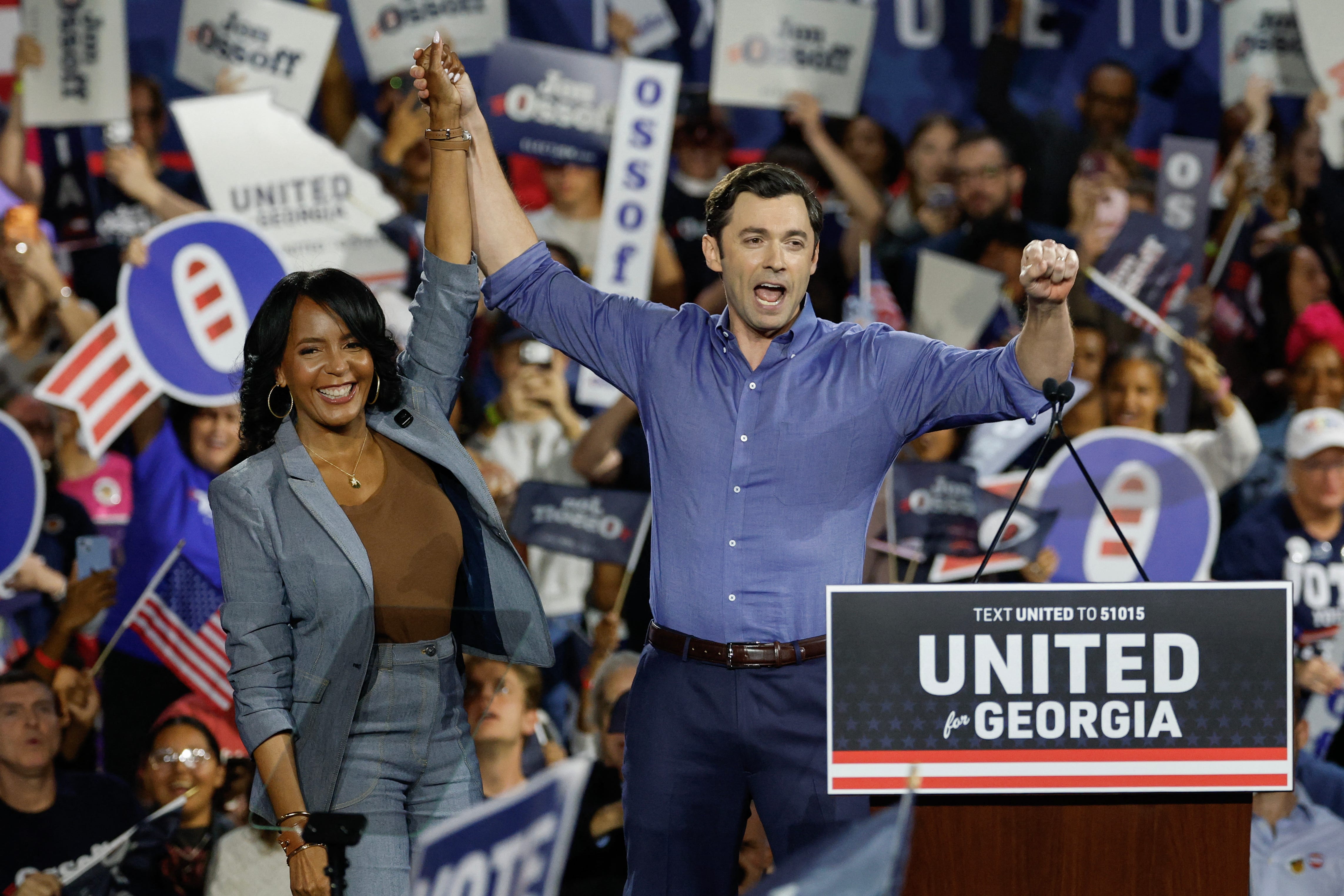
One almost sure thing right now, given polls and spending patterns, is that Ossoff will win a second term. But the Georgia governor’s race is a jumpball. Democrat Keisha Lance Bottoms, after leading over the summer, is even with Republican Rick Jackson in one poll from the past few weeks and trails him by 1 to 2 percentage points in the rest.
This matters to Georgia, but it also matters to Ossoff and, ultimately, to America. A Republican governor would name a Republican to the Senate if Ossoff were to leave, and, in a subsequent election to fill the seat, that person would be the incumbent. It’s hard to imagine Ossoff handing the GOP that opening.
That said, he and Bottoms have worked as a team since Georgia’s May primary to make sure they both prevail. “Together we are building a massive and unstoppable winning coalition to deliver decisive victories statewide,” Ossoff said back then. They’ve been showcasing their synergy and talking points about Donald Trump, inflation, and their opponents (billionaire “slick Rick” Jackson for governor, “crumbling little bigot” Mike Collins for Senate) at joint “United for Georgia” rallies across the state.
Even the price of caskets has gone up, Bottoms said at their most recent appearance, on Saturday night in Cobb County: “Donald Trump is wreaking havoc for the living and the dead!”
If Bottoms pulls off a win Nov. 3, Ossoff’s optimal path could be to skip a presidential race and be ready to join the national Democratic ticket as the vice-presidential nominee.
There are numerous advantages to this scenario. First, what’s the rush? Ossoff is only 39 years old. Second, the odds are he’d be at or near the top of the VP list. Third, running for vice president is roughly a four-month gig, from convention to election night — a plus for people like Ossoff, who have day jobs and young families.
Compare that with the traveling and positioning that’s already begun for many potential 2028 White House prospects. In Nevada, second in the new Democratic primary lineup, the Nevada Independent is tracking visits from the hordes. And, lest we forget, Donald Trump entered the 2024 race just a week after the 2022 midterms.
Granted, Trump was a special case and, as usual, not in a good way. He knew he’d be less vulnerable to prosecution as a declared candidate for president. But others weren’t far behind.
Nikki Haley, a former governor of South Carolina, became an official candidate on Valentine’s Day 2023. Vivek Ramaswamy (now running for Ohio governor) came a week later, followed by a cavalcade of once and future famous-ish names: former Arkansas Gov. Asa Hutchinson, Florida Gov. Ron DeSantis, South Carolina Sen. Tim Scott, North Dakota Gov. Doug Burgum, former Vice President Mike Pence, and former New Jersey Gov. Chris Christie. Oh, and Trump wasn’t even first. Corey Stapleton, a former Montana state senator and secretary of state, had filed four days earlier.
Back to the list. Fourth, and finally, was there ever a politician more suited to the customary vice-presidential role of attack dog? Picture Ossoff on that 2024 stage with JD Vance. Would he have let Vance pretend to be a nice guy? I don’t think so. I think he would have fileted him like a fish, just like he did to the unfortunate Collins in this season’s most riveting debate double feature.
Now, I get why 2024’s last-minute nominee Kamala Harris chose to run with Gov. Tim Walz, a high school football coach steeped in Minnesota Nice. I even get why he might have been thrown by Vance’s hail-fellow-well-met demeanor. I mean, the guy had spent the previous couple of weeks fueling a vicious lie about Haitians in Springfield, Ohio, eating their neighbors’ pets.
Still, I am haunted by the advice — a warning, really — that former GOP strategist Stuart Stevens offered to Democrats this month on how to close out their campaigns: DO. NOT. GO. POSITIVE. It’s tempting, he said, but resist. “You want to make sure that you are delivering negative information about your opponent, reminding people what is at stake,” he said in an interview with Democratic strategist Simon Rosenberg.
Contrast what you’re offering, versus the alternative, right to the end, Stevens says. And by the end, he means the very last weekend, the very last Monday, the very last hours before Election Day — because that’s when some voters finally focus on the choice before them.
Stevens compared the final days of a campaign to closing arguments in a courtroom. If you’re a lawyer trying to get somebody convicted of murder, “at the end, when you really think you have the jury, you don’t go ‘well, you know the guy’s not that bad of a guy.’… You’re not trying to cover the spread here. You’re trying to win.”
Exactly. Harris showed how it’s done as Joe Biden’s ticketmate in 2020. Amid Trump’s partisan, anti-science handling of the COVID pandemic, on top of his general aversion to telling the truth, Reuters said Harris “largely succeeded at fulfilling the running mate’s traditional attack role” in her debate against Pence. In 2024, however, Democrats spent the last week going mostly positive, Rosenberg lamented. They did not follow the Stevens rule, he said, and it may have cost Harris the White House.
Ossoff is not trying to be anyone’s nice guy, and he keeps landing lines that get at truths that Democrats are desperate to hear. For instance: “In my view, based upon the evidence I’ve seen thus far, the president’s misconduct, abuse of power, and corruption already exceed any prior standard for impeachment.” Then he immediately accused Trump of enriching himself while Americans struggle with high prices driven by the Trump war and tariffs Collins supported.
That’s a perfect audition for vice president, and it’s just one clip from one debate. Beyond that, if there’s a Democratic governor leading Georgia and enough clamor nationally, Ossoff could decide to go for the top job.
Ossoff at either position on the 2028 ticket would mean breaking his promise to serve a full term, but he wouldn’t be the first. Bill Clinton and Barack Obama made similar pledges back in the day. They later reconsidered, and both went on to become two-term presidents.
Sometimes you can’t pick your moment. It picks you.

Ossoff for President 2028!