


“We are here to stay. The Chicago people demand it.”—Homeland Security spokesperson Tricia McLaughlins
It’s impossible to overstate how ridiculous McLaughlin sounded when she claimed last week that Chicagoans wanted Customs and Border Protection agents to remain at full force in this city.
As it turns out, McLaughlin was wrong as well as ridiculous. At least some Border Protection agents, Texas National Guard troops and Homeland Security personnel have now left town. It’s not necessarily the “unconditional surrender” Chicago Mayor Brandon Johnson claims, because it’s unclear how many agents, including from Immigration and Customs Enforcement, remain.
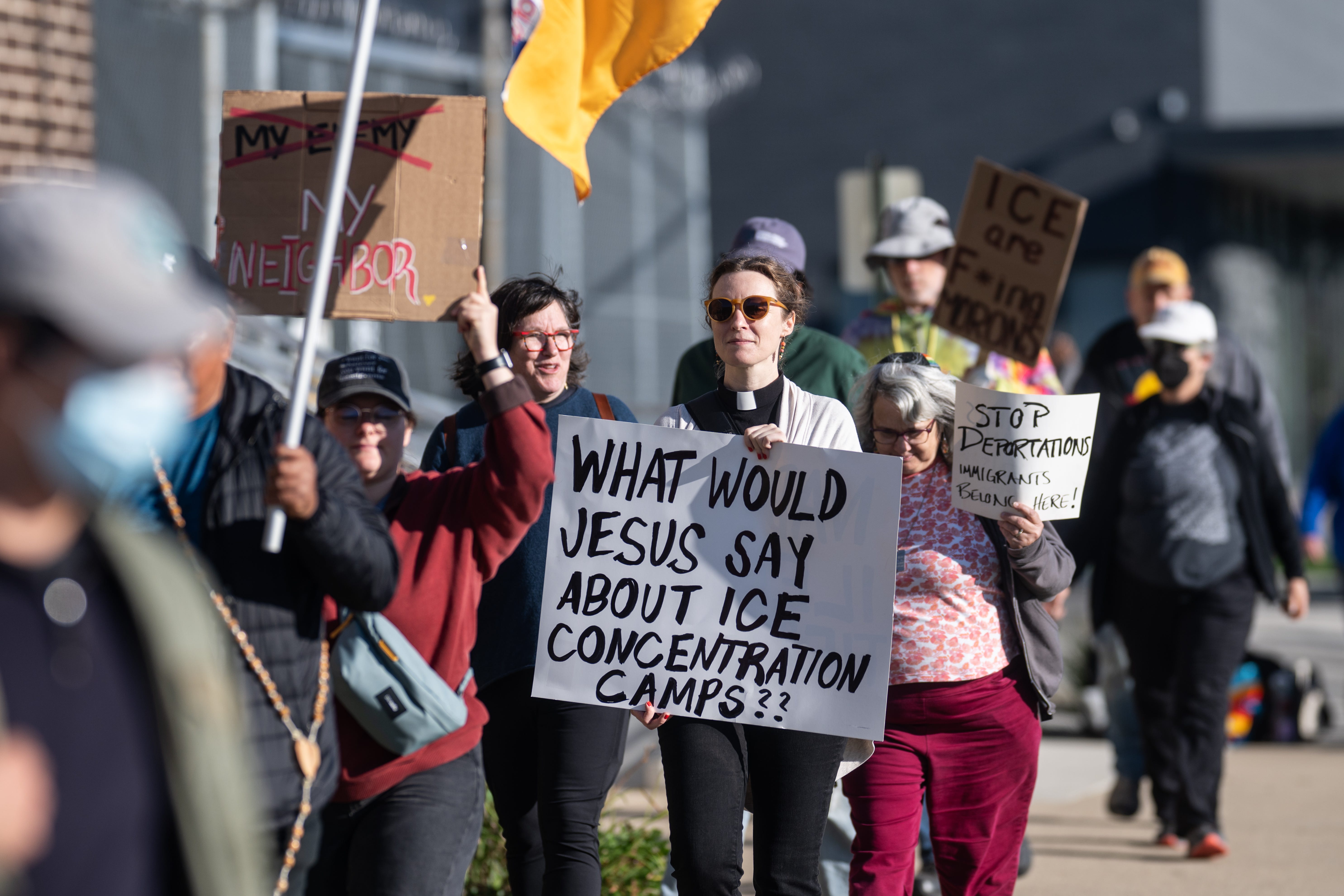
But it’s crystal clear that Chicagoans and suburbanites alike have shown in recent weeks that they’re willing to stand up, every day, to peacefully oppose the aggressive, abusive tactics of masked, armed federal immigration agents.
“People are coming out of their homes, people who’ve never protested before, people who have never been engaged before,” Gov. JB Pritzker said during a recent podcast taping before the feds left town. “The people of Chicago have just done a terrific job [since] they’ve been under siege.”
A larger force of federal agents could return in the spring. Meanwhile it wasn’t the “worst of the worst” who were swept up in the chaos of Operation Midway Blitz, no matter how many times the Trump regime makes that claim.
The numbers speak for themselves:
Out of 614 people detained during the operation, just 2.6% had a criminal record, a Chicago Tribune analysis found. Many of these detainees might have to be released following a federal judge’s ruling last week that their arrests might have violated a 2022 federal consent decree between the city and Homeland Security. It’s just one of the many losses federal judges here have handed the Trump administration since Midway Blitz launched.
A military-style overnight raid in September at a rundown apartment building supposedly filled with Venezuelan gang members netted several dozen arrests. Federal officials declared it a victory against crime. But only two of the arrestees turned out to be suspected of being members of the Tren de Aragua gang, ProPublica found.
With that track record, it’s not surprising that the Trump administration decided to pack up and leave. It’s convenient, too, that the departure happened just as a Chicago winter sets in, prompting Pritzker to call Border Patrol “snowflakes” fearful of the cold.
I’m not the only Chicagoan concerned about what might happen next summer as the campaign for next year’s midterm elections starts in earnest.
News reports, videos and photos posted all over social media and conversations with family and friends make it clear to this city that federal agents won’t hesitate to go overboard in the face of community opposition.
They’re willing to hide their identities behind masks and altered license plates and to blanket neighborhoods with tear gas, even when children are nearby. They won’t hesitate to drag a daycare teacher out of her classroom, tackle a clergy member at a protest or shoot a pastor with pepper spray pellets. They shot and killed a man during an arrest. Border Protection Chief Greg Bovino was caught on video lobbing tear gas unprovoked. One of his agents, who shot and injured a woman after ramming her car, boasted about his marksmanship in a Signal chat.
A federal judge recently issued an order restricting agents’ use of force. But can anyone trust the Trump administration to abide by that order should federal agents return–especially if it’s desperate before next year’s midterms?
“It’s going to come back,” one activist mom, Julia Rohan, told me, “and it’s going to be so much worse.”
From the community to courtrooms
I spoke with Rohan last Friday, not long after she returned home from her weekly trip to ICE’s detention center in Broadview. That day, 21 people were arrested, although by state and local law enforcement, not ICE. Multiple people, including clergy, were injured.
Rohan wasn’t hurt that day, but she’s been tear-gassed several times and had begun bringing a face mask and respirator to demonstrations. Other protesters routinely showed up with helmets and knee pads for protection. “We’re all of a mindset to keep each other safe,” she said.
“We did a beautiful job of uniting over this,” Rohan said. “I’m just a mom in Chicago. It’s important for others to see people like me out there, putting a body on the line.”
She and other activists told me that they hope to do more training and outreach to bring neighborhoods together, in advance of the possible surge of agents and troops next year.
Activists’ efforts have been bolstered by a string of legal wins in federal court against Homeland Security, in lawsuits stemming from the actions of Border Protection and ICE.
One lawsuit alleged that the filthy, crowded conditions at Broadview’s ICE detention center were unconstitutional. U.S. District Judge Robert Gettleman called the conditions “disgusting” and issued a temporary restraining order requiring ICE to make improvements and allow lawyers access to the facility. Another hearing on the case is scheduled for December.
In the lawsuit involving use of force by federal agents, U.S. District Judge Sara Ellis said she found “little reason for the use of force that the federal agents are currently using. … I don’t find defendants’ version of events credible.” A trial that could lead to a permanent injunction against excessive force by agents here is set for March.
And in the case that could lead to the release of potentially hundreds of detainees held in custody, U.S. District Judge Jeffrey Cummings ruled that the arrests by ICE and Border Protection likely violated a immigration law that governs whether arrestees can be subject to mandatory detention.
“In all these instances,” Ed Yohnka of the American Civil Liberties Union of Illinois said, “judges are very aware of what is happening in other [cases] and the community at large.”
Lorraine Forte is a Chicago journalist and former editorial page editor of the Chicago Sun-Times.

Filthy detention centers go against public health and safety standards. Those people should be removed from that facility and they should be forced to clean that place up. It is a cesspool of diseases. If people are to be detained it should only be allowed under humane conditions. Period.
"Out of 614 people detained during the operation, just 2.6% had a criminal record"
For those who don't think in percentages, that is just 16 with criminal records out of 614.