


“Illinois, in the face of cruelty and intimidation, has chosen solidarity and support. Donald Trump, Kristi Noem, and Gregory Bovino have tried to appeal to our lesser instincts. But the best of us are standing up to the worst of them.” Illinois Gov. JB Pritzker, Dec. 9
From the moment he took office last January, Donald Trump wanted to bring Chicago to its knees with the militarized deportation campaign he and his cabal dubbed “Operation Midway Blitz.”
Chicago’s left-leaning, anti-Trump politics made it an obvious target to become “ground zero” for deporting “millions and millions of criminal aliens back to the places from which they came,” as Trump said in his inauguration speech.
Like a lot of what Trump claims he’s going to do, it didn’t happen.
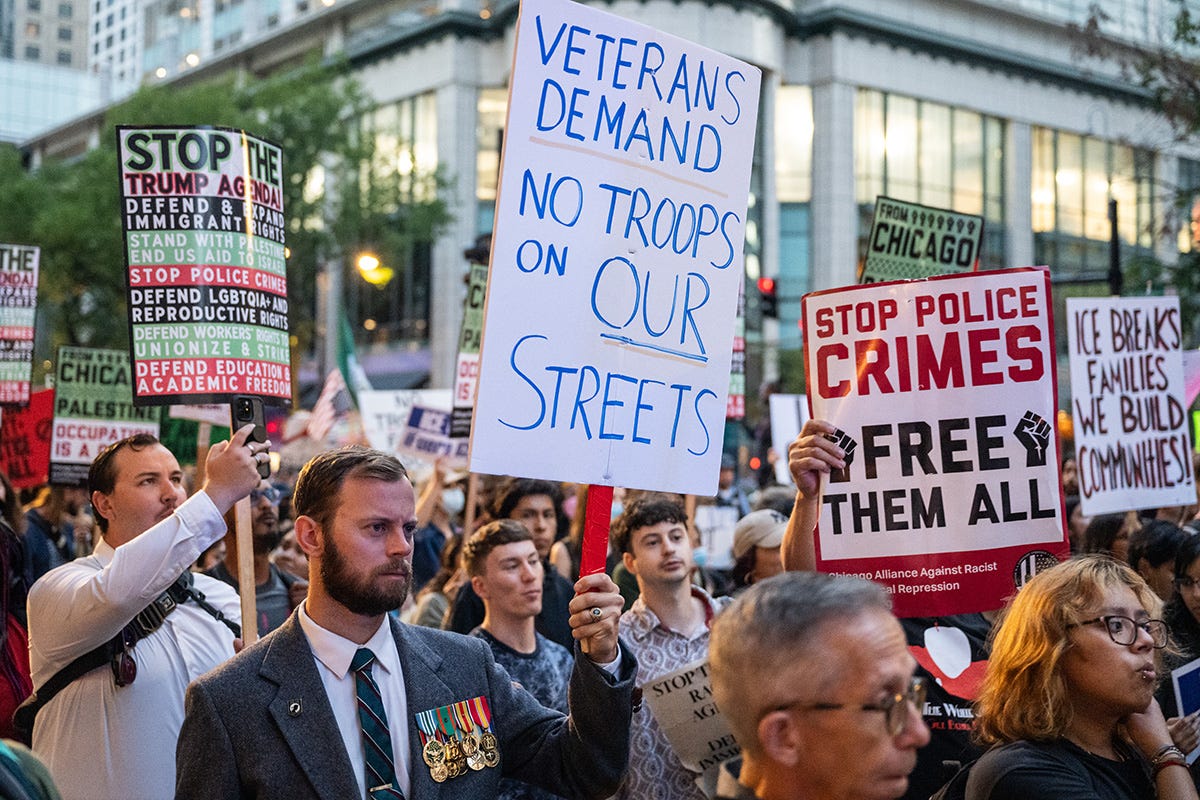
Instead of being cowed, Chicagoans pushed back against the White House’s ugly rhetoric and brutish, increasingly unpopular mass deportation tactics. The “city that works” became a model for Charlotte and New Orleans and for any other city where Trump decides to unleash his armed, masked agents to grab overwhelmingly law-abiding people off the streets.
Expect Chicago to keep pushing back, too. On Tuesday, amid the holiday season, Customs and Border Protection Chief Greg Bovino and an estimated 200 agents returned to the Chicago area a month after they left to carry out enforcement in Charlotte. Agents were reportedly seen detaining a man in Little Village, a mostly Mexican neighborhood in Chicago, while bystanders blew whistles and shouted at them. More arrests were reported in the city and in Cicero, a predominantly Latino suburb. A spokesperson for the Department of Homeland Security insisted, “We aren’t leaving Chicago.”
“They call it enforcement,” Gov. JB Pritzker said Tuesday. “We call it harassment.”
“I’m very proud of the way that Illinoisans have reacted to CBP and ICE … pulling out your whistles and your phones, video [recording] everything and posting it online,” Pritzker, whose national profile soared in 2025 as he repeatedly stood up to Trump, added. “We have a population that knows how to react when their community is being invaded.”
Our city and state took an economic hit because of Trump’s militarized enforcement. Businesses run by immigrants reported losses, sometimes of up to 50%. The ripple effect means lost revenue for state and local governments.
The social cost was heavy, too. Families were split when parents were detained. Children missed school because parents kept them home out of fear.
But at year’s end, more legal protections for immigrants were in place to target abuses by Immigration and Customs Enforcement and Border Protection. That’s an important development because up to 1,000 agents reportedly could be headed to the Chicago area in the spring.
Pritzker on Dec. 9 signed new state laws that prohibit civil immigration arrests without a warrant in and outside Illinois courthouses, where at least 14 people were detained or harassed by federal agents in 2025; and require hospitals, healthcare facilities, community colleges, public universities and daycare centers to set up protocols for responding when federal agents show up. In an October executive order, he created an Accountability Commission for people to report immigration abuses.
Neighbors helping neighbors
Last December, Trump’s “border czar,” Tom Homan, Homan spoke to a gathering of Republicans, insulted Pritzker and Chicago Mayor Brandon Johnson, and acted like a schoolyard bully. Days after Trump’s inauguration, Homan showed up in Chicago, with cameras and TV personality “Dr. Phil” McGaw in tow.
Homan warned that anyone who merely happened to be with those detained by federal immigration agents would be arrested, too.
Chicago’s activist community prepared for what would come.
In August, Pritzker and a large group of community leaders held a news conference on the Chicago River to highlight the city’s beauty and declining crime rate. Trump later called the city a “war zone” that he would save by sending in National Guard troops.
“Midway Blitz” began in earnest the next month.
On Sept. 25, armed Border Patrol agents sailed down a tourist-heavy stretch of the Chicago River. Several days later, armed agents, some in masks, strolled along Michigan Avenue in the high-end downtown shopping district known as the Gold Coast.
An intimidating display of deportation might? Chicagoans saw it as a laughably obvious publicity stunt.
In the following weeks, agents commonly used tear gas and pepper spray on nonviolent protesters and journalists, including in residential neighborhoods when children were in the area. The military-style overnight raid of a rundown apartment building sparked national as well as local outrage.
Bovino had said the quiet part out loud when he told a local public radio station reporter that arrests would be made based in part on “how they look.” Up to 3,000 people were detained, including legal residents and U.S. citizens. Several analyses found that only about 3% of detainees had convictions for violent crimes. None of those arrested in the apartment raid was ever charged with gang-related crimes, ProPublic found.
“The whole episode is a lie. All of it was built on an edifice of lies,” Ed Yohnka of the American Civil Liberties Union of Illinois said. “They did not get the worst of the worst. The people who were caught up in this and detained were family folks, hard-working, who had been engaged in the community for years and years.”
Because of lawsuits filed by the ACLU and other groups, federal judges stepped in. They reined in excessive force by agents, including deployment of tear gas, flash-bang grenades and pepper-spray pellets. ICE was forced to improve conditions at its suburban detention facility.
As for Trump’s vow to send in the National Guard – that didn’t happen. Trump federalized hundreds of Illinois and Texas guard members, but a federal judge blocked Trump’s plan to deploy them in the city.
In the end, community members came together to make the biggest difference in the everyday lives of neighbors living under the threat of unwarranted deportation.
Whistles became symbols of resistance to warn neighbors of the presence of ICE and Border Protection. School patrols helped ensure children could go to and from school while protecting immigrant parents. High school students raised money for classmates whose immigrant parents had been detained. Cyclists bought out tamale carts so that vendors wouldn’t have to risk their freedom to make a living. Black community leaders issued a statement in support of Latinos, saying that “the only pathway to collective freedom is to stand in solidarity with one another.”
Chicago was bruised by Midway Blitz. But we weren’t broken.
Lorraine Forte is a Chicago journalist and the former editorial page editor of the Chicago Sun-Times.

What the people of Chicago are doing is upholding and fighting for freedom and democracy, resisting oppression from a hostile force. I'm proud of them. If I hadn't moved downstate from there 52 years ago, I would be right there with them, carrying signs, blocking the invasionary forces, and blowing whistles.
Chicagoans are so brave! It’s so sad it has come to this.