


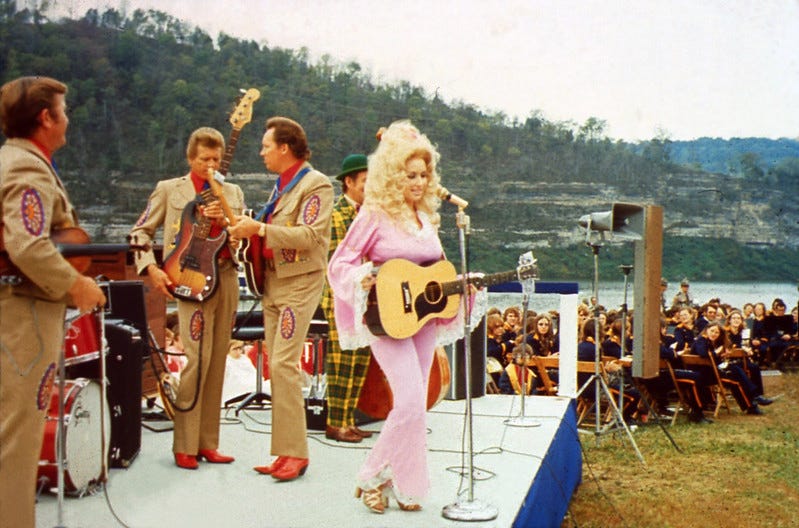
On Tuesday, Dolly Parton’s family announced the death of the beloved country music icon, a woman whose career spanned so many decades and so many disciplines, who wrote so many unforgettable songs and inspired so many people through her joy, kindness, and empathy, that attempting to summarize her legacy feels as futile as bottling up the Pacific Ocean with a teaspoon.
Parton grew up in poverty but rose to become one of the most successful, instantly recognizable musicians of the 20th century — embodying the American dream in a way that few ever have. She was a savvy entrepreneur, and an actor with a knack for delivering plucky dialogue in classic movies like Steel Magnolias and 9 to 5 (“I’m gonna change you from a rooster to a hen with one shot!”) She was an astonishingly prolific songwriter, and one of the best to ever do it, penning “Jolene” and “I Will Always Love You” within a matter of days.
Parton’s creative gifts were legion. Yet she was, if anything, just as well-known for her outrageous personal style: the voluminous blond wigs, the rhinestone-bedazzled outfits, the bold acrylic nails that helped inspire the opening riff of “9 to 5.” “It costs a lot of money to look this cheap,” she famously said. With a gift for folksy zingers, Parton was effortlessly funny — certainly more amusing than the uninspired comedians who made countless lame jokes about her bust — and she typically made fun of herself rather than others.
There are few Americans alive today who aren’t familiar with some aspect of Parton’s life — whether her music, her screen performances, or even just her ubiquitous image, emblazoned on T-shirts, prayer candles, and countless tchotchkes across the land. Parton was a secular saint, admired by people across the political and cultural spectrum who shared little else in common, so untouchable that not even Donald Trump had a bad word to say about her.
Which is all to reiterate that quantifying Parton’s contributions to the world is exceedingly difficult. But here is one number that can at least begin to put her extraordinary contributions into context:
332,411,218.
That’s the number of books that her charity, the Imagination Library, has given to children around the world over the last 31 years. In addition to being a brilliant entertainer and an exceptional entrepreneur, Parton was also one of the country’s most generous philanthropists. The organization, which provides free, age-appropriate books to preschool children, was founded to honor her father, Lee, who was illiterate.
“He was the smartest man I have ever known, but I know in my heart his inability to read probably kept him from fulfilling all of his dreams,” Parton has said.
Originally intended to benefit the children of Sevier County, Tennessee, the program has since expanded across the United States and to Canada, Australia, Ireland, and the U.K., instilling a love of reading in millions of young people who eagerly anticipated the arrival of their monthly gift from “Aunt Dolly.” Because Parton knew the stigma that came with getting “handouts,” she ensured that any child could receive books through the Imagination Library, regardless of their family’s income or economic status.
The Imagination Library is now the flagship program of the Dollywood Foundation, which Parton formed in 1988 — not long after the opening of the Dollywood theme park in Pigeon Forge, Tennessee — with the modest goal of improving educational outcomes for students in her home county. Through an initiative in the early ‘90s called the Buddy Program, she vowed to give every 8th grader who graduated from high school $500. The dropout rate subsequently decreased from 35% to 6%.
The Dollywood Foundation has continued to be a vital source of aid for the people of East Tennessee during times of crisis. In 2016, the organization launched the My People Fund to assist families who lost their homes to wildfires in the Great Smoky Mountains. In less than a year, it had distributed $12 million to those affected.
Parton was also a benefactor for life-saving medical research. She donated $1 million to fund Moderna’s COVID vaccine, and got the shot — which she called “a dose of her own medicine” — as soon as she was eligible to reassure anyone who might be hesitant. “I just want to say to all of you cowards out there: Don’t be such a chicken squat,” she teased in her inimitable way. In 2022, she gave another $1 million to Vanderbilt University Medical Centre for research into infectious pediatric disease because, she said at the time, “No child should ever have to suffer.”
Even Parton’s business endeavors have benefitted her community in tangible ways. Dollywood is Sevier County’s largest employer, with more than 4,000 people working at the park itself during high season. According to one case study, the 160-acre park — which includes a bald eagle sanctuary — makes a direct annual impact of $1.8 billion a year in Tennessee.
Parton, a leading gay icon, repeatedly expressed her support for the LGBTQ+ community, before such opinions were widely held in either country music or the country at large. Her company, Sandollar Productions, co-produced the Oscar-winning 1989 documentary Common Threads: Stories From the Quilt, which tells the story of the AIDS memorial quilt and chronicles the lives of five people in its panels. She also contributed to the compilation album Red, Hot + Country, which raised money for AIDS charities, and participated in a public awareness campaign.
Parton’s generosity was not only financial, it also extended to her humane, compassionate songwriting, which she consistently used to tell stories about the downtrodden and marginalized. Though she became fabulously wealthy, Parton never lost her working-class solidarity. And though she avoided wading into partisan politics, she made her views clear in song.
Accepting the Carnegie Medal of Philanthropy in 2022, Parton, the first female entertainer to receive the honor, spoke about what motivated her charitable endeavors. “I cannot be a hypocrite and just say I’m going to donate this money for a tax write-off. I’d really like for it to mean something to me — something I can take pride in,” she said.
Parton’s philanthropy has inspired similar largesse in other celebrities. Ahead of their wedding in July, Travis Kelce and Taylor Swift donated $26 million to various charities — including $2 million to the Imagination Library.
But with the possible exception of Swift, the world doesn’t produce celebrities as enormous as Parton anymore. The few people who rival her fame today are not once-in-a-generation artists, but tech oligarchs who hoard their wealth to buy elections and castles in Ireland, not books for preschoolers.
In a vintage TV clip that’s now circulating on social media, Parton was asked about her ultimate goal in life.
“Just to be happy, to be as productive as I can be, make as many people happy as I can, make as much money as I can, so I can do for more people,” she said. “And I just want the freedom to work, and everybody else can have the money.”
If only more people lived by her example.
Imagine the ripple effects of all the good she has done in the world. It is truly astounding.
Meredith, this eulogy of Dolly is even better than the one you wrote yesterday. Thank you.