


Stacey Abrams describes herself as a “Costco of Democracy” — starting new organizations and projects to give everyone an entry point into the work.
“I do it because in this room we each have a subject that we are the master of,” she told a crowd of hundreds in a dark conference hall in downtown Raleigh, North Carolina, last Friday. “It is when we bring those subjects together, when we knit them together, when we believe that we are woven together, that is when solidarity happens. That is when power is made real.”
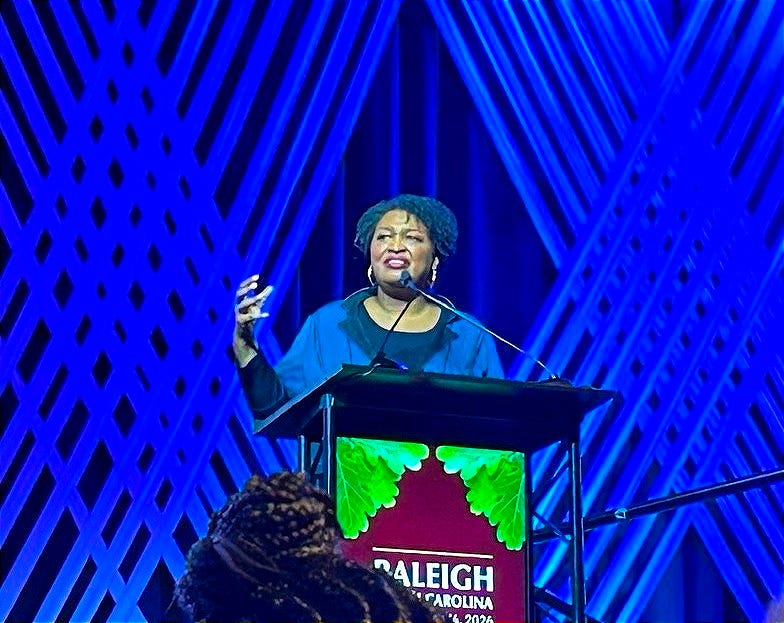
The possibility of that knitting was evident in the audience in front of her. The 2,500 attendees at the biennial Facing Race conference came from the fields of municipal government, labor organizing, nonprofits, and philanthropy. After two years of a federal government that treated their work in racial justice and DEI as a form of discrimination — with even some liberals trying to distance themselves from “woke one” — the mood, post-midterms, was jubilant.
“Last week we won some elections,” said Glenn Harris when introducing Abrams; a “we” that, given the nonpartisan nature of many of the organizations, presumably represented not so much Democrats as people who indeed still value diversity, equity, and inclusion.
Harris is president of Race Forward, the nonprofit that hosted the conference. Facing Race is touted as the “largest multiracial, intergenerational racial justice conference” in the country — a topic Harris believes is vital amid a surge of economic populism.
“In many ways, the fight around identity in the United States is not an economic question, although it leads to profound economic consequences — it’s a democracy question,” he told me later at a press conference. “Arguing that it’s either economics or race is like arguing it’s either democracy or economics, and that makes no sense.”
Part of the goal of Facing Race is to bring people together from different sectors and areas of racial justice work, so perhaps it was inevitable that speakers and participants alike focused on questions of coalition building: how to pull together across factional divides, produce results, and turn yesterday’s strange electoral bedfellows into tactical coalitions for tomorrow.
“We all need to be bridging with each other all the time, because we’re all coming from different experiences,” said comic W. Kamau Bell during a keynote Saturday, rejecting the idea of a single left-center split in the Democratic Party.
“Don’t let the media simplification of these two factions obscure the fact that there are some people who feel like they haven’t been heard from at all … (and) complicate your own narrative of what a healthy democracy looks like.”
Making connections is part of what brought Katima Dickenson, fifty-four, an assistant to the Chief Equity Officer for Jackson, Michigan, to Facing Race. She wanted to learn from other communities and find new ways to bring people to the table.
“My goal is to connect the dots to people who don’t see their space in civic service and government,” she said. “I need more people on our boards and commissions to help us do the work, because if I’m the one that’s leading the work … I’m giving you what I think you want instead of knowing what your lived experience requires.”
At one breakout session titled “Movement Politics Real Talk,” attendees from across the country brainstormed how to build durable coalitions and gain real wins: Come with an answer on how the idea will be funded. Focus on political education. Capitalize on anti-Trump sentiment as a unifying force.
But they identified sticking points too — from nonprofit funding structures to divides between center and left-wing members of the Democratic Party. If there was one worry that emerged repeatedly, it was the ability of progressive movements to set aside differences and capitalize on this moment.
Sophia DeLoretto-Chudy, thirty, wants to reach people who aren’t being heard and maybe aren’t even in the conversation. She moved to Texas because of a spreadsheet: it was the state with the highest population of young people who were not voting. She now runs a small non-partisan organization, the Texas Voter Project, focused on increasing civic participation among young people.
DeLoretto-Chudy sees the huge turnouts in the Lone Star State as a backlash against complacent politicians in power, rather than a victory for the community organizing of her work and that of others she engaged with in coalitions.
“In many ways, we are not ready,” DeLoretto-Chudy said of the midterms’ aftermath. “There is a big difference between organization and mobilization. And what we saw on Tuesday was mass mobilization. But if mobilization is not met with organizational infrastructure, it dissipates.”
The Democrats who won in the midterms did not win the Texas state Senate, and DeLoretto-Chudy worries that voters will be as disillusioned with the resulting legislative deadlock as they were when Republicans controlled the state and federal government.
“(Young people) are conditional voters,” she said. “If they do not see changes being made quickly in the way that they want, and with no understanding of how the legislature works, we are going to be set back dramatically.”
Perhaps this is why speakers, again and again, returned to the importance of connection, of using the moment to expand organizations and cement coalitions.
“We are here because this month we decided to show America that we have the power of our identity, and that identity is what’s going to save America,” Abrams concluded in her speech. “We have power, and now it’s time to use it.”

The big anxiety playing out now seems to be whether Dems trust their leadership to, using Heather Cox Richardson's terminology, act with a sense of urgency.
Schumer spent 2025 and 2026 seeming reluctant to act like the leader of an opposition party. This is in stark contrast with McConnell who made opposing Obama, then Biden, his top priority as Minority or Majority leader. Now that we won the midterms, Schumer's decision to let the BAAJA bill pass during the lame duck session is a worrying sign given how it weakens a lot of environmental protections.
Why do it now, when in two months he'll be majority leader with a huge margin and could negotiate a more favorable bill. If it's a good bill, then why is it not being sold to Democrats that way, or why not try to pass it when Dems are in control so we can receive more credit? If he's worried Trump wouldn't sign it if a Dem congress passes the legislation, use that to hammer Trump and Republicans for their disinterest in governing. If the bill is to do something for moderates, why not wait until 2027 when the new senators from red states will be taking a seat?
It just feels like Schumer is willing to give up a lot for minor concessions, even after a resounding political victory. And if he keeps that up for the next two years, that will undercut the Democrats ability to claim that if we win the Presidency we will enact changes to benefit all Americans.