

By Brian O’Neill
Last week, Americans were met with an unusual sweep of televised images—some inspiring, some unsettling, all reminders of what courage can achieve and what unchecked power can extinguish.
We watched footage from Ukraine: drones striking deep into Russian territory, eliminating bombers used in attacks on civilian targets. The precision was striking. So was the intent—resistance without fanfare but with effect.
We marked the anniversary of D-Day with historical footage from Normandy, scenes that still carry weight: soldiers advancing across sand under fire, a visual legacy of organized sacrifice in service of democratic ideals.
We recalled June 4, 1989—the military takedown of the weeks-long student protest on Tiananmen Square that resulted in the deaths of hundreds, perhaps thousands, of civilians—and the image that followed the next day: a lone man, shopping bags in hand, facing down a column of tanks. “Tank Man” remains one of the most iconic moments of protest ever captured—not because it changed the regime, but because it revealed, in a single frame, the asymmetry between moral defiance and state power.
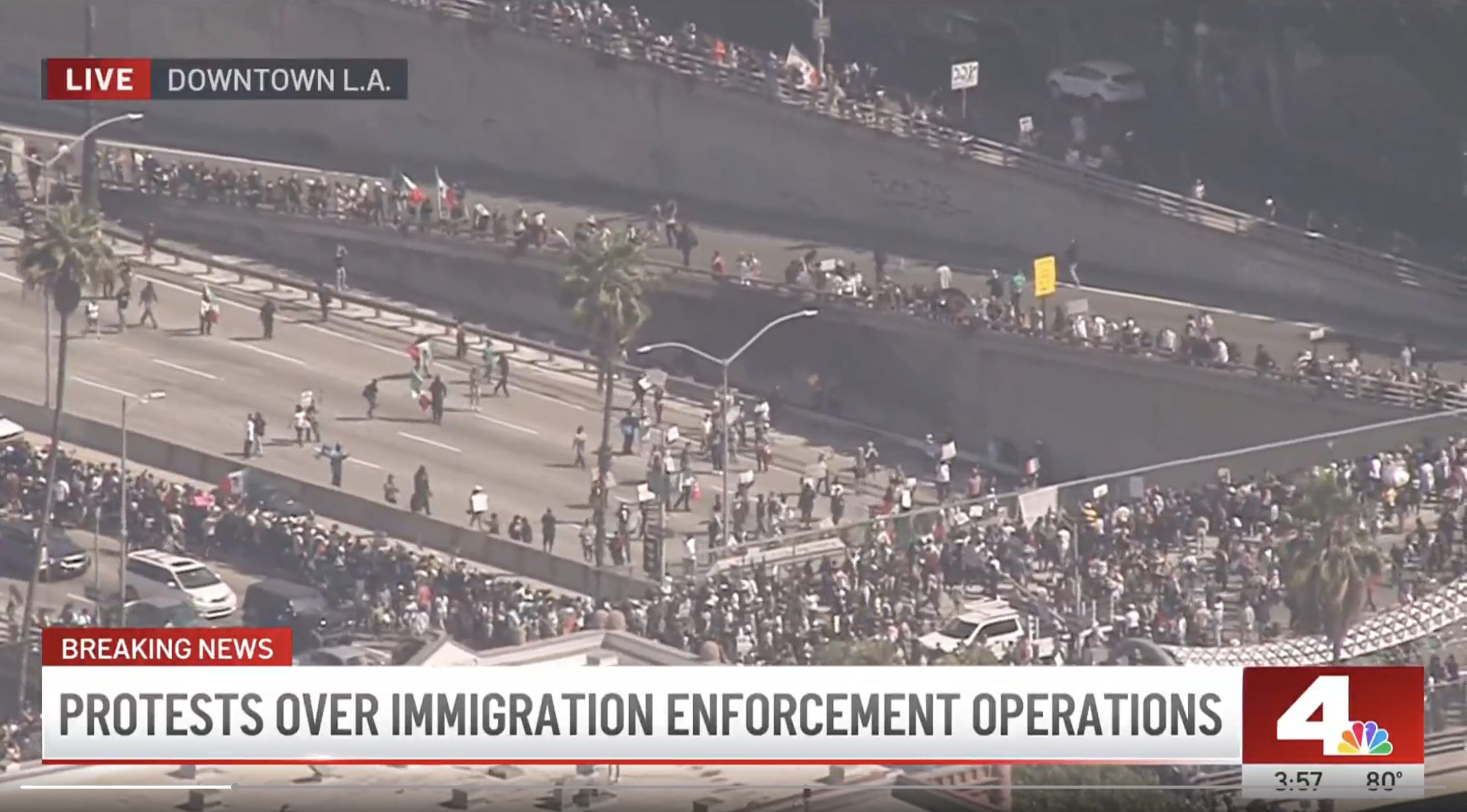
And, here at home, we saw something quieter but more dangerous. President Donald Trump deployed National Guard troops in Los Angeles to confront protestors rallying against federal immigration raids. Gov. Gavin Newsom had not requested help. No state of emergency had been declared. But the Guard arrived.
Among all the images aired last week, that scene carried the most enduring consequence. Not for what it showed but for what it normalized: that dissent will be labeled rebellion, and that federal force might follow without consent, justification, or resistance.
This is not the first time the National Guard has faced American protesters. While governors often deploy the Guard for natural disasters, it’s the rare mobilizations during civil unrest that leave the deepest marks. In 1970, the governor of Ohio sent Guardsmen to Kent State University to quell antiwar protests. Four students were killed, nine wounded. In 1965, during the Watts uprising in Los Angeles, California’s governor ordered in the Guard to restore order amid fires and looting. These were moments of chaos, handled at the state level, with results that deepened public distrust but reflected the governors’ constitutional role in local crisis response.
Federalized Guard deployments are rarer—and legally sensitive. President John F. Kennedy sent the Guard to Alabama in 1963 to enforce school desegregation. In 1992, President George H.W. Bush responded to the Rodney King riots in Los Angeles at the request of California’s governor. In both cases, federal authority was invoked reluctantly, framed as a last resort when local leadership either failed or formally asked for help.
None of those episodes is remembered with pride. But they are remembered as expressions of where the country stood—on race, on war, on inequality. The Guard’s presence reflected the tension between protest and public order, between moral crisis and institutional response.
In his first term, President Donald Trump pushed us toward a more disturbing boundary. In June 2020, federal law enforcement—including National Guard troops under Title 32—were used to clear peaceful protesters at Lafayette Square, across from the White House. There was no mass disorder. Trump tweeted the next day: “Great job done by all. Overwhelming force. Domination.”
No Insurrection Act. No request from local officials. Just a federalized display of power that sidestepped the usual legal guardrails. Then–Secretary of Defense Mark Esper later revealed that Trump had asked why the military couldn’t simply “shoot the protesters in the legs.”
This weekend, the justification was narrower—and more dangerous. There was no urgent breakdown to contain, no appeal from state leaders. Just a White House assertion that protests inhibited “the execution of federal law” and were therefore tantamount to “rebellion.”
Trump made good on a warning he issued in his 2024 campaign: Next time, he wouldn’t wait to be asked.
Before joining the U.S. intelligence community, I served as an infantry officer in the Georgia Army National Guard and later on active duty in the U.S. Army. Part of my role in the National Guard involved leading instruction on riot control—not just the physical formations but also the mental discipline required of soldiers facing civilian protest. We were taught that escalation was failure. Restraint wasn’t just a tactic; it was the mission. The Guard is not built to serve a president’s grievance or ego. Its legitimacy depends on being a stabilizing force—used sparingly and with clarity of purpose. When that line blurs, the institution suffers. So does the country.
That line is now under sustained pressure. The threshold for federal force might have shifted—from last resort to unilateral impulse.
And the precedent is portable. If protest can be recast as obstruction of federal law, the rationale can extend anywhere: student encampments, labor strikes, environmental demonstrations. Expression becomes interference. Interference becomes threat.
The risk is not just in what Trump does but also in what others absorb. Universities, courts, law firms, and statehouses all have been pressed to mute dissent or sidestep confrontation. When institutions choose caution over resistance, they concede. Each concession weakens the habit of standing firm. Each silence emboldens the next directive.
Though this is not martial law, it is a legal architecture being bent toward the same end: enforcement without consent, control without accountability. Erosion of norms, of boundaries, of the will to say no.
Trump has not crossed into autocracy. But he is drawing the route. His second term is being shaped not around policy but permission: What can be normalized? What will be excused?
We are not yet at Tiananmen. But when power begins to treat dissent as threat and force as reflex, the distance narrows. And the line we once relied on to hold might not be visible when it’s needed most.
Brian O’Neill, a retired senior executive from the CIA and National Counterterrorism Center, is an instructor on strategic intelligence at Georgia Tech.
"Some things you must always be unable to bear. Some things you must never stop refusing to bear. Injustice, outrage, dishonor, and shame. No matter how young you are, or how old you have got. Not for kudos and not for cash: your picture in the paper nor money in the bank either. Just refuse to bear them."
--Wm. Faulkner
FF47 is too mentally unstable to be commander in chief. Either invoke the 25th or outright impeach.