

By Frederic J. Frommer
A half-century ago this month, an arbitrator’s ruling that two pitchers were free to sign with any team upended baseball’s economic model, setting in motion the modern era of free agency.
On Dec. 23, 1975, arbitrator Peter Seitz ruled that the two pitchers, Andy Messersmith of the Los Angeles Dodgers and Dave McNally of the Montreal Expos, were free to sign with any team. Seitz, a professional arbitrator, was the “impartial chairman” of a three-person group with Marvin Miller, the head of the Major League Baseball Players Association, and John Gaherin, the owners’ labor representative. The owners immediately fired Seitz, stating that “professional baseball no longer has confidence in the arbitrator’s ability to understand the basic structure of organized baseball.”
Seitz’s ruling came a year after he had declared Oakland A’s pitcher Catfish Hunter a free agent, but that was on much narrower grounds: Oakland’s breach of the contract for failing to make a required payment. The ’75 decision, by contrast, came after Messersmith and McNally had played the season without a contract, deliberately looking to overturn the reserve clause. And it came several years after outfielder Curt Flood challenged the reserve clause in a famous legal case. Although Flood’s antitrust lawsuit was unsuccessful, he helped build momentum for Seitz’s ruling by shining a light on baseball’s one-sided contracts with players.
Seitz’s decision effectively put an end to baseball’s reserve clause, which bound a player to his team unless he was traded or released. Baseball officials were stunned.
“I am enormously disturbed by this arbitration decision,” Commissioner Bowie Kuhn said. “It is just inconceivable that after nearly 100 years of developing this system for the overall good of the game, it should be obliterated in this way. It is certainly desirable that the decision should be given a thorough judicial review.”
At a news conference, Seitz declared, “I am not an Abraham Lincoln signing the Emancipation Proclamation. Involuntary servitude has nothing to do with this case. I decided it as a lawyer and an arbitrator. This decision does not destroy baseball. But if the club owners think it will ruin baseball, they have it in their power to prevent the damage.”
In his ruling, Seitz acknowledged the great stakes for the owners.
“It was represented to me that any decision sustaining Messersmith and McNally would have dire results, wreak great harm to the reserve system and do serious damage to the sport of baseball [and] would encourage many other players to elect to become free agents,” he wrote. But if those were legitimate fears, he added, “I am confident that the dislocations and damage to the reserve system can be avoided or minimized through good‐faith collective bargaining between the parties.”
Baseball challenged Seitz’s ruling in the courts. But a federal judge upheld Seitz, and, in March 1976, an appeals court did, too. At that point, the owners knew they had been beaten. “In my personal judgment, this is it,” Gaherin, the owners’ negotiator, said. They didn’t appeal to the Supreme Court.
Writing for the three-judge panel, Judge Gerald W. Heaney, a nominee of President Lyndon B. Johnson, urged the two sides to settle their dispute themselves.
“Certainly the parties are in a better position to negotiate their differences than to have them decided in a series of arbitrations and court decisions,” he wrote. “We commend them to that process and suggest that the time for obfuscation has passed and that the time for plain talk and clear language has arrived. Baseball fans everywhere expect nothing less.”
And that’s in fact what happened, but first the owners locked the players out of spring training, because the previous collective bargaining agreement had expired at the end of 1975. Kuhn unilaterally ended the lockout in the middle of March, enough time to start the ’76 season on time on April 8.
Two days later, Messersmith signed a three-year, $1 million contract with the Atlanta Braves and their flamboyant new owner, Ted Turner. That came after Messersmith had turned down a four-year, $1.15 million offer from the San Diego Padres, prompting owner Ray Kroc to fume, “He can work in a car wash.” Not missing a beat, Turner quipped, “We just felt Andy Messersmith was too good to work in a car wash.”
Messersmith was in his peak, coming off a 19-win season with a 2.29 ERA. But McNally, a former ace with the Baltimore Orioles, was coming off a subpar year (5.24 ERA) and never pitched again.
The owners and players, meanwhile, inked a new CBA in 1976 that required players to have six years’ service before they could become free agents—the same minimum requirement in place today. One difference, however, was that teams had to select players in a “re-entry draft” for the right to make them an offer.
That draft took place in November 1976. With the first selection, the Expos chose superstar Reggie Jackson. Other players in that free agents class included some of the game’s biggest names: Rollie Fingers, Bert Campaneris, Sal Bando, and Don Baylor. Jackson wound up passing up a more generous offer from the Expos to sign a five-year, $3 million contract with the Yankees. That’s something you rarely see today.
“I didn’t really push the money part,” Jackson told USA Today in 2016. “I knew I was going to be rich. I think I would have been successful anywhere, but I wouldn’t have gotten the notoriety or the level of success I had with the Yankees.”
And since those early pioneering days of free agency, salaries have continued to grow exponentially. Kyle Schwarber’s new five-year contract with the Phillies is worth $150 million—50 times what Jackson signed for nearly 50 years ago.
Frederic J. Frommer, a writer and sports and politics historian, has written for the Washington Post, the New York Times, the Atlantic, History.com and other national publications. A former Associated Press reporter, Frommer is the author of several books, including “You Gotta Have Heart: Washington Baseball from Walter Johnson to the 2019 World Series Champion Nationals.” Follow him on X.
Yes, pay has grown outrageously...to the detriment of fans (ticket prices, streaming prices, ...) but the players are doing great.
BTW did anybody else notice that, no matter how desperate NFL teams are for a quarterback (looking at you, Philip Rivers), nobody calls Colin Kaepernick?
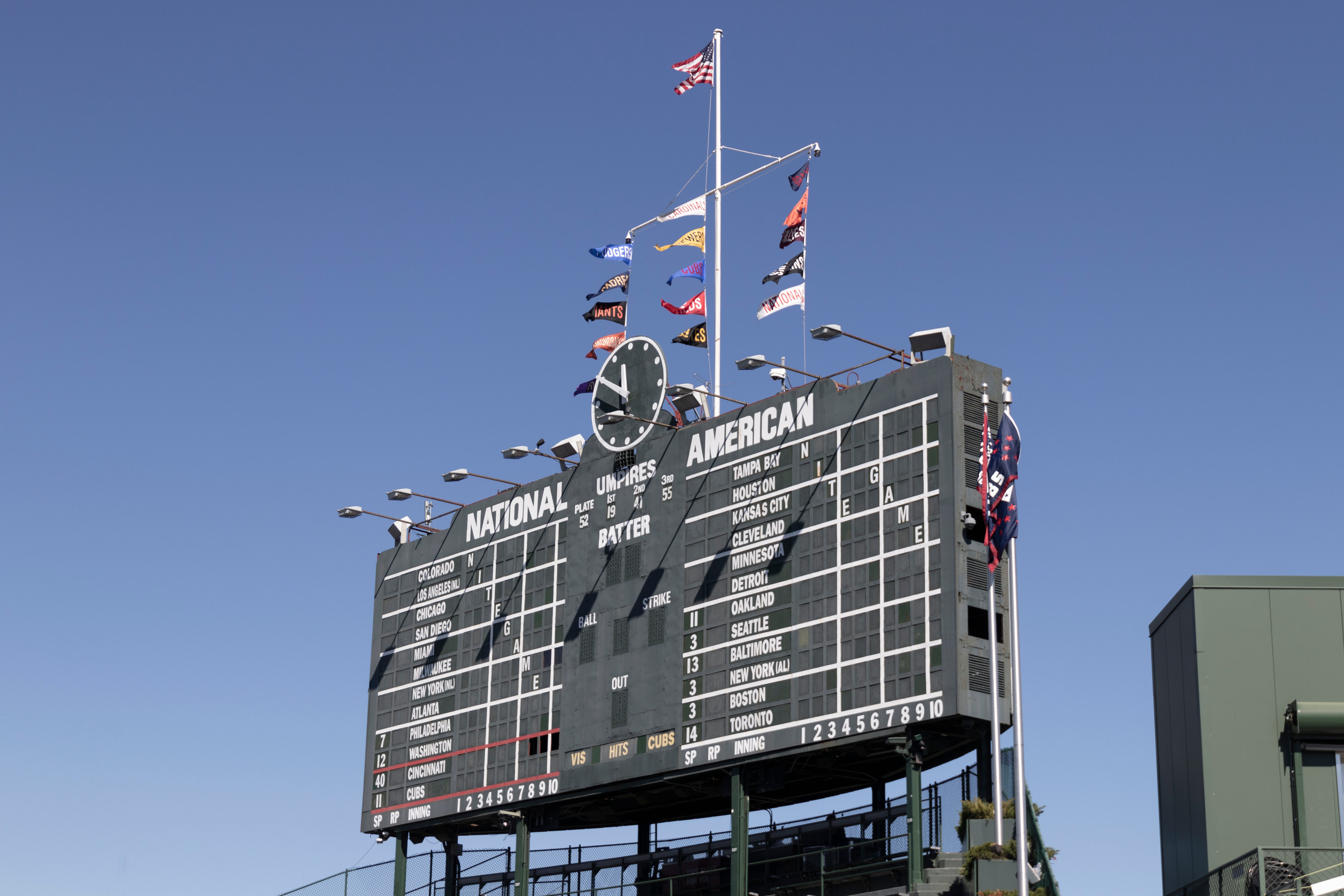
Hey, hey! That's a photo of the Wrigley Field scoreboard--a wonder of early baseball presentation that still thrives today. It's a fascinating history on its own: https://chicagology.com/baseball/wrigleyscoreboard/