


For the 250th anniversary of the Declaration of Independence, The Contrarian is holding a series of conversations with historians and journalists about aspects of our national history.
Jonathan M. Katz is a freelance journalist who previously covered Haiti and other international assignments for the Associated Press. He wrote his first book, The Big Truck that Went By, on the 2010 Haitian earthquake and his experience covering it. His second book, Gangsters of Capitalism: Smedley Butler, the Marines, and the Making and Breaking of America’s Empire covers America’s “small wars” in the early 20th century through the experience of Butler — showing how these conflicts in Haiti, the Philippines, Mexico, China and elsewhere are remembered abroad and often forgotten at home, even when they impact our current politics.
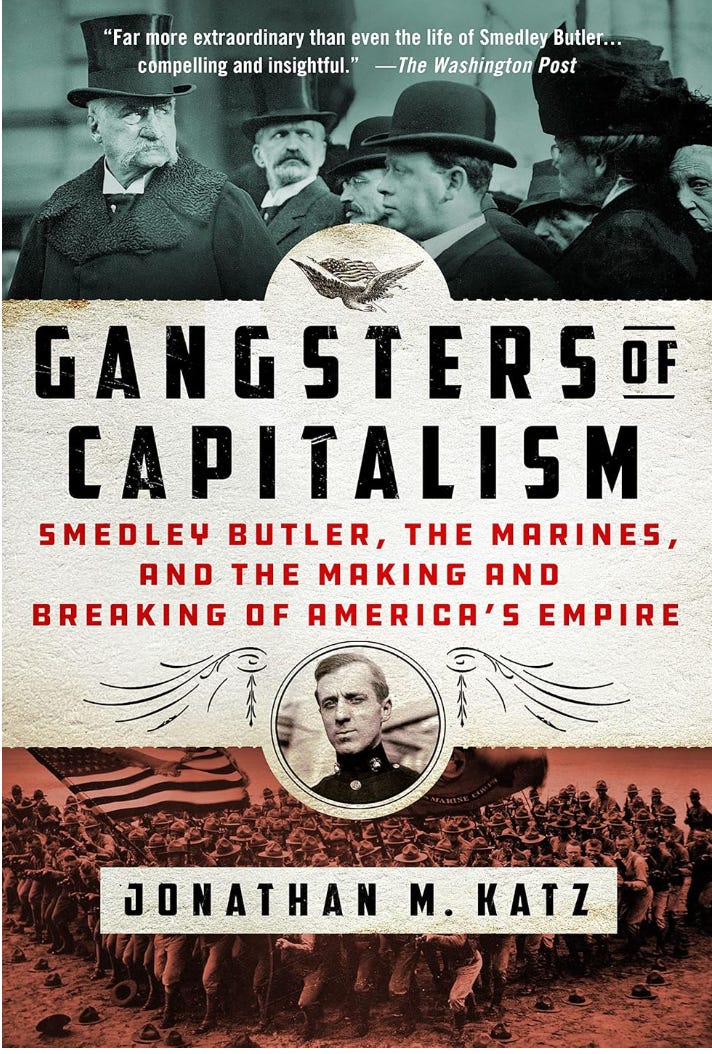
Katz spoke with The Contrarian about his book and its relevance to our current moment. The following is excerpted from that conversation, with edits for length and clarity.
When did you first become interested in this current and historic study of American interventions abroad? What drew you to this topic?
In some ways, it precedes or developed alongside my journalism career in undergrad. I went to Northwestern, I was an American Studies major, and I also got a second major in history. I was into that stuff, and then moved away from it as I got into my journalism career and became hyper-focused on the moment that I was in. Haiti is when a lot of this stuff started coming into focus — the impacts of the past on the present and the ways that those histories still lived.
Remembering and forgetting the past, these interpolations — I hadn’t learned to question those things to the degree that I did in Haiti. When I started writing my books, I started re-exercising those muscles that I had developed earlier on to go back into the histories, understand the ways that forgetting and mythologizing those histories were informing the present.
Why do you think Americans are so bad at remembering these interventions abroad?
That’s a really good question. There’s a couple of different pieces of it.
One of them is that we as humans have a deeply inborn capacity to remember and to forget. They’re both key to, in a lot of ways, a healthy life, and in some ways a healthy civilizational life. If a pain can’t heal and go away and you can’t move on, then you can’t function. But it’s also an injury to other people, and it makes for a really poorly understood life and politics if you just forget everything — especially if you forget the things that you did.
The epigraph of Gangsters of Capitalism, it’s a Haitian proverb — Bay kou bliye, pote mak sonje, “The one who deals the blow forgets. The one who carries the scar remembers.”
That capacity for forgetting, that capacity for amnesia, palliative as it may be if you are the one who was injured, becomes very destructive — and self-destructive — [if you are the one] who did the misdeed. It is a constitutive part of empire-making. This is not particular to the American empire. This is true of every single empire. It is important for the functioning of the empire to forget, but the results are bad.
Forgetting these things doesn’t make the memories go away in other people. These things end up getting sublimated and then kind of rising up through the cracks of your society.
What do you think we miss about our current political moment when we don’t know [this history]? How do these things that happened in the early 20th century, mid 20th century, impact how we do politics today in the United States, not just abroad?
Well, not knowing about this, you miss everything.
The War on Terror never ended. Obama’s big contribution to the War on Terror was continuing it, basically making it a permanent thing. And now Trump is, unsurprisingly, turning it back on to the metropol; he’s turning it back to the people who live domestically.
But even more than that, when you open the aperture even more, one of the easiest ways to answer the question of “what is missed?” is if you didn’t know about this stuff when Trump appeared it would have seemed like it came out of nowhere.
“This isn’t who we are,” right? That’s a phrase that you hear a lot. “How could Americans treat other people this inhumanely? How could we treat the world as if it’s just a repository of resources for us to invade and steal at will?”
And the answer is, because that’s been a huge current of American life since the beginning. It’s the reason why the imperial boomerang became such a philosophical obsession among a small but important group of intellectuals in the mid, late 20th century — they were trying to understand, “where did Nazism come from?”
It took the work of people like Frantz Fanon and Aimé Césaire, who had grown up under French colonialism, saw its brutality, experienced it in various forms, and then saw, French and German brutality in Europe, fought against it, and then in Fanon’s case, saw continuing renewed French brutality against Algeria. But also, Hannah Arendt is in a concentration camp. She is persecuted, hunted by the Nazis. She knows Nazis from her youth, some of them very well, and she’s also putting these things together.
It’s still a moment of reckoning that we’re in, of trying to figure out, “where the hell did that come from?” And one of the answers is, it was there all along. You ask what we miss — it is not a coincidence that so much of the Trump administration’s preoccupation has been literally erasing history.
Do you think that there has been in the last five years a better awareness [of the USA’s history abroad], perhaps prompted by this new Donroe Doctrine interventionism in Latin America? Or do you think we’re still missing a lot of this stuff that would help us explain how we got here?
I can tell you, as n equals one, that when the intervention in Venezuela happened, all of a sudden I started getting a renewed burst of interest in Gangsters and my work in general. Every day I sound less crazy talking about the fact that we’re living through a resurgence of fascism in the United States.
And insofar as moments of reckoning with fascism helped cement some of these understandings of the way that history fits into the present, maybe for many people, this could be a moment where these ideas take — and are held. But Americans have an incredibly rich and dynamic set of tools to drop memories out of our brains and just forget everything.
As I was re-reading Gangsters, [I noticed in the early 20th century] there’s people in the Philippines, in China, people looking to the United States for help in their rebellions. But 250 years on for the Declaration of Independence, how do you see that kind of modern republic idealism being interpreted or aspired to abroad? Is it still?
I think a big part of the reason why the Declaration in particular has such an incredible, sustained power is it was literally a revolutionary document. And so anyone who is fighting against the power, fighting against an empire, trying to assert themselves in any way, there’s a lot in there to look at, especially in the first part.
I don’t know the extent to which people overseas today are following in the tradition of Emilio Aguinaldo and Ho Chi Minh and others who looked at these founding documents in the United States and saw inspiration for themselves. But I would not be surprised if it remained a big piece of it.
Other than Gangsters of Capitalism, at this 250 year anniversary, what is one book you’d recommend people read to get a better sense of this American history and interventionism?
Well, Spencer Ackerman’s book, Reign of Terror. That’s a really important one to read. A good companion to Gangsters about a later period is The Jakarta Method by Vincent Bevins. I can tell you one, it’s the obverse of intervention: Kathleen Belew’s Bring the War Home, which is about the ways that in the post-Vietnam War era, people came home from Vietnam and other wars of that time and created the far right.
Also, everybody should read Robert Caro’s series on Lyndon Johnson, just on general principle.
It’s incredible. I finally bit the bullet on it, and now I’m waiting on the fifth volume, which will be the Winds of Winter for me. It’s like, “come on Bobby, you’ve got this one in you.”

American empire-building foreign policy, with the exception of the Spanish-American War, never got much attention from most Americans in the first place. So there wasn’t all that much to forget. But it is very important that Americans know this history, and I commend you and the author for putting this book out in the public eye.
Obama continued the War on Terror and made it a permanent thing? How did he do that?
I do know that under Bush the Lesser, these efforts appeared in the Budget proposal as Global War on Terror. Enter Obama, and suddenly, It's "Overseas Contingency Operations," That sounds like something that would have "collateral damage," rather than killing anybody.
Can somebody explain? Words matter.