

By Frederic J. Frommer
About a half-century before the Trump administration wielded its Federal Communications Commission to go after what it considers liberal bias on broadcast TV, comedian George Carlin provoked the agency’s ire with his famous bit about “Seven Words You Can Never Use on Television.”
In the “Filthy Words” routine, which came from his 1972 comedy album Class Clown, Carlin said that the seven words—shit, piss, cunt, fuck, cocksucker, motherfucker, and tits—“will curve your spine, grow hair on your hands and maybe, even bring us, God help us, peace without honor.”
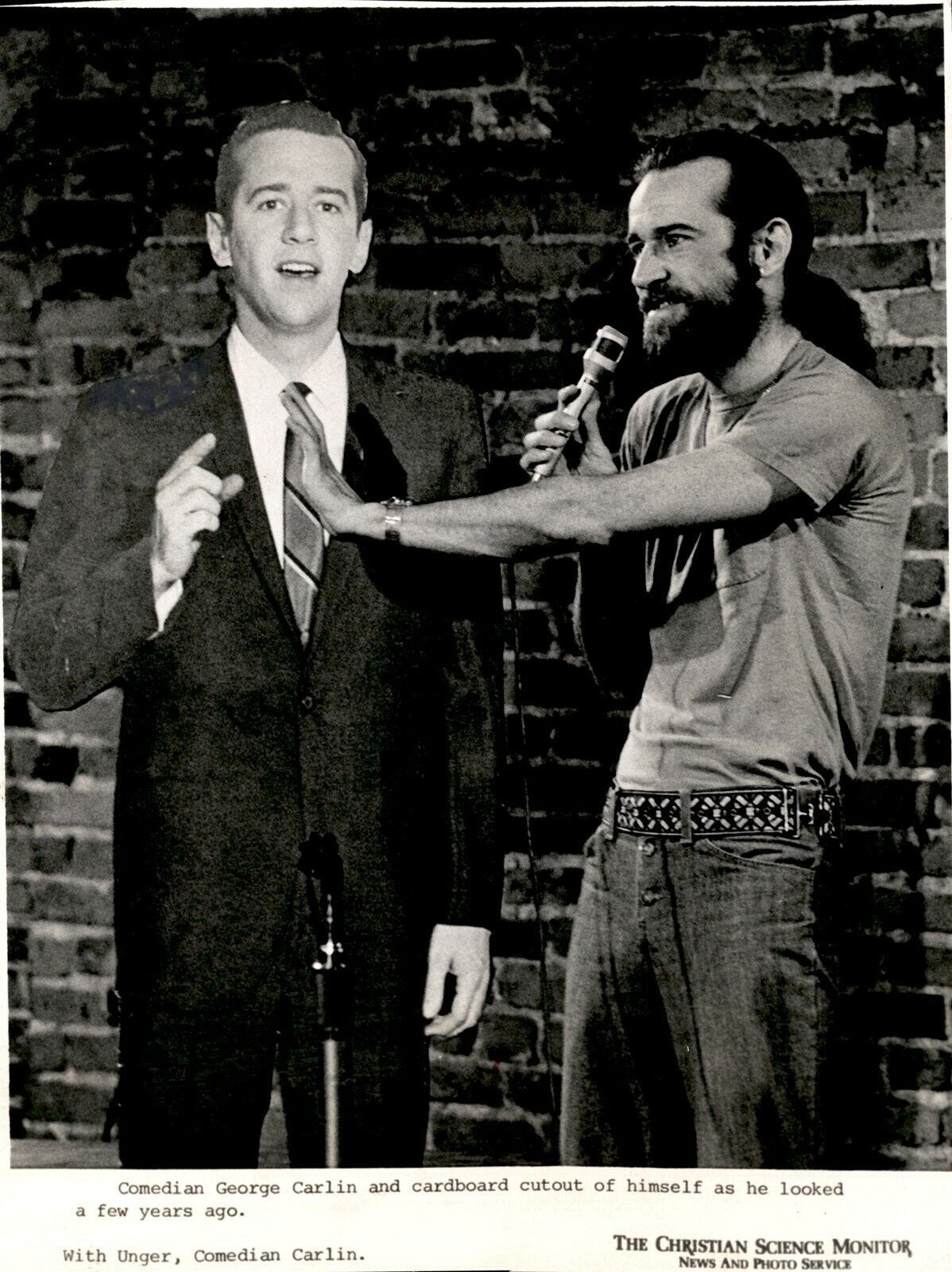
Carlin had already been a famous comedian in the 1960s, but the edgy material was part of his transformation in 1970 from a coat-and-tie performer to one who wore jeans and sported long hair, in keeping with the era’s counterculture movement. He once said that, in the 1960s “I was entertaining the fathers and the mothers of the people I sympathized with, and in some cases associated with, and whose point of view I shared. I was a traitor, in so many words. I was living a lie.”
But taking on the establishment came with a cost. Even before the seven words got on the radar of the FCC, they got Carlin arrested when he uttered them at a Milwaukee summer festival in 1972. Parents in attendance with young children complained to the police, who charged Carlin with disorderly conduct. Luckily for the comedian, the judge in the case, Raymond E. Gieringer, had a sense of humor—even laughing when the seven words were played as evidence, the Milwaukee Sentinel reported at the time—and dismissed the charge.
The notoriety around the case wound up getting Carlin even more exposure.
The next year, when New York City radio station WBAI played a 12-minute portion of Class Clown, the playing field was much different. Now the seven offending words— including “fuck” 32 times—were played on public airwaves, which are regulated by the FCC. Again, the sensibilities of a parent triggered government action. A father from Long Island complained to the FCC that he and his young son heard the bit on the car radio (although the snowflake dad later admitted his son was actually 15).
The agency censured WBAI and came out with a declaratory order that the words were indecent and banned their broadcast during hours when children were likely to be in the audience. The FCC did allow that during late evening hours “such words conceivably might be broadcast,” with sufficient warning.
Carlin, brandishing his reputation as a champion of free expression, was arrested several more times for doing the controversial material. And his career continued to take off. In October 1975—50 years ago this month—he was selected as the first host of Saturday Night Live. In his opening monologue, Carlin borrowed from one of his comedy albums to deliver his famous bit about the differences between baseball and football. A quick example: “In football you get a penalty / In baseball you make an error—whoops!”
Meanwhile, in 1977, the U.S. Court of Appeals for the District of Columbia concluded that the FCC action was unconstitutional censorship and overturned the FCC’s order. When the Supreme Court took up the case the following year, the Justice Department of the Carter administration, in a very unusual move, refused to back the FCC, concluding that the order was inconsistent with the First Amendment.
But the Supreme Court reversed the appeals court in a 5-4 decision. Writing for the majority in FCC v. Pacifica Foundation (1978), Justice John Paul Stevens—who had just joined the court three years earlier and would go on to become a champion of liberal causes—made a distinction between broadcast and other media.
“The broadcast media have established a uniquely pervasive presence in the lives of all Americans,” he wrote. “Patently offensive, indecent material presented over the airwaves confronts the citizen not only in public, but also in the privacy of the home, where the individual’s right to be left alone plainly outweighs the First Amendment rights of an intruder.”
In a dissent, Justice William Brennan chided the majority for displaying “a depressing inability to appreciate that, in our land of cultural pluralism, there are many who think, act, and talk differently from the Members of this Court, and who do not share their fragile sensibilities.”
Carlin, who died at 71 in 2008, took some delight in the notoriety, telling the Associated Press earlier that year, “So my name is a footnote in American legal history, which I’m perversely kind of proud of.”
Frederic J. Frommer, a writer and sports and politics historian, has written for the Washington Post, the New York Times, the Atlantic, History.com and other national publications. A former Associated Press reporter, Frommer is the author of several books, including “You Gotta Have Heart: Washington Baseball from Walter Johnson to the 2019 World Series Champion Nationals.” Follow him on X.
I consider George Carlin my mentor and a great philosopher and political gadfly of his time. Where Socrates used discourse, Carlin used comedy, making it as sweet or as acidic as it needed to be to make his point. He never told jokes; he commented on society and was hella funny doing it. I'm so glad he is not here now to see the garbage chute that is America, although we sorely need his wit and insights. It's "The Aristocrats" come to life, but that bit is not supposed to be real, sigh. I carry on Carlin's tradition in certain venues as best I can. A great American.
he was very funny...Canadian low coming in, not to be confused with a Mexican high...