


While Donald Trump seems to have perfected the art of turning America’s 250th birthday into a phantasmagoria of self-indulgence, bad taste, and garish dictatorial pomp, neither the occasion nor the country is his. The national celebration belongs to all of us and, thankfully, offers us much more than a cheesy spectacle. We are fortunate to have an outpouring of uplifting and illuminating media programming that allows Americans to engage with our history and to consider for themselves the real meaning of the American experiment.
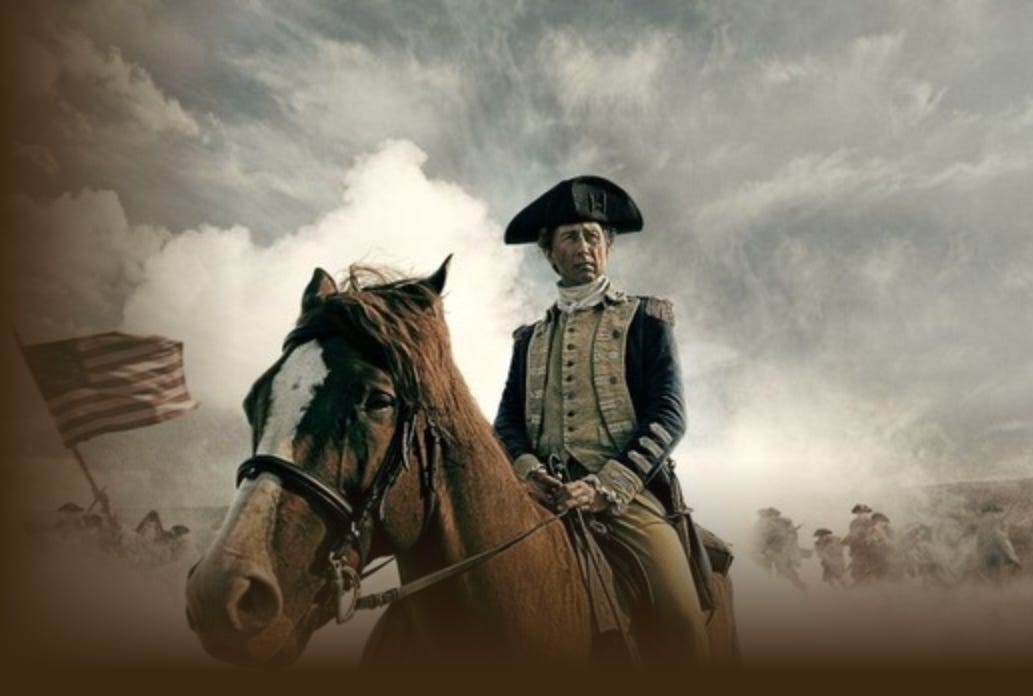
One of the best in the batch of media offerings, the 2020 series Washington, is available on Netflix. Co-executive produced by Doris Kearns Goodwin, its three well-paced episodes feature remarkable commentary from top-flight Washington scholars (e.g., Joseph Ellis, Jon Meacham, JW Brands, Joanne Freeman, Ed Lengel, Mount Vernon CEO Doug Bradburn), unique insights from prominent political figures (e.g., Colin Powell on leadership amid battlefield carnage; Bill Clinton, raised by a single mother, on Washington’s childhood under a powerful single mother), and well-choreographed historical re-enactments. The series takes us from Washington’s early (and large, disastrous) military career to his considerable trials and tribulations as he rose to command of the Continental Army, through his election to the presidency, and finally to his singular role in shaping the office and the country.
This is hardly the first Washington biography to tackle the challenge of illuminating arguably the most remote, austere, and formidable of our Founders. His unsmiling visage — the result of an excruciating dental disease — has made the task of excavating a relatable figure that much harder. However, by focusing heavily on the details of his military career, including his not infrequent stumbles, setbacks, and blunders, this series successfully presents him as a three-dimensional character navigating unprecedented circumstances, rather than as a stock grade-school character. It turns out that a warts-and-all Washington is all the more impressive.
The series begins with his blunder en route to Pittsburgh in 1754, where, in over his head in dealing with Native peoples and European political intrigue, he winds up assassinating a French officer in Jumonville who was leading a diplomatic scouting party. Washington’s blunder, which nearly ended his career before it began, helped trigger the onset of the French and Indian War. In the aftermath, Washington is trapped at Fort Necessity, loses a slew of men, signs a surrender, and confesses to killing Jumonville (amounting to a war crime). In what we hardly think of as Washington-type conduct, he then engages in a frantic PR damage-control operation to avoid reputational ruin. And yet the experience did not end his career.
Washington emerges from the ordeal sobered by battlefield chaos. When thrust into another military disaster in the making at Fort Duquesne, he maintains his presence of mind, effectively takes charge after Major-General Edward Braddock is killed, and helps extract the remainder of the British troops (gaining him the exaggerated distinction as the “Hero of the Monongahela”). The transition from a callow twenty-something obsessed with obtaining a commission as a British officer (which he never attained) to a seasoned leader is well underway.
It’s hardly Washington’s last brush with disaster that might have permanently derailed his career. His military career is pockmarked with setbacks, bad decisions, and miraculous escapes. His disastrous 1776 New York campaign, where he is forced to abandon Manhattan, foolishly divides his troops, gets defeated at Brooklyn Heights, and only narrowly escapes capture thanks to his flight from Long Island, does not finish him off. He survives, and by year’s end, stages the triumphal crossing of the Delaware and surprise victory against the Hessians at Trenton. Washington’s stature grows not because he is a flawless leader, but because he has the uncanny ability to compose himself, maintain the confidence of his troops, press ahead, and find the next opportunity to press his advantage.
Likewise, Pennsylvania’s losses the following year (e.g., his defeat at Brandywine, the abandonment of Philadelphia) do not overwhelm him. His setbacks, in retrospect, make his feat in keeping the army together at Valley Forge that winter even more impressive. His ability to withstand adversity and to inspire his men under the worst conditions only builds his reputation (as does his iron will in implementing cruel, uncompromising military justice, without which the military cannot survive).
But arguably Washington’s unique and irreplaceable contributions to the Revolution come from his supreme self-discipline and devotion to the cause of self-government (e.g., staring down the 1783 Newburgh Conspiracy, the invitation to launch a military coup, and resigning his commission at the end of the war) and his ability to inspire the loyalty of young talents, including Alexander Hamilton, Nathaniel Green, and Henry Knox. He defined public leadership in the service of democracy and thereby made America possible.
Coming from a modern perspective, when public protestations of modesty are routinely and reasonably dismissed as phony, and grotesque ego glorification has become the norm, Washington’s rejection of an invitation to undertake a coup and later to refuse a kingship or even a third term baffles modern sensibility. But Washington’s character, coupled with his determination to preserve honor and personal reputation, turned out to be America’s providential blessing. Without those character traits forged in long years on the battlefield with considerable reversals, the American experiment would never have gotten off the ground.
Our current political agonies may help the country collectively to appreciate Washington’s true genius. We know all too well how 230 years after Washington warned in his Farewell Address to be wary of “cunning, ambitious, and unprincipled men… [eager] to subvert the power of the people and to usurp for themselves the reins of government,” can manipulate their countrymen “to seek security and repose in the absolute power of an individual.” We have all witnessed a power-hungry conman — whose character is the antithesis of Washington’s — severely endanger our experiment in democratic self-governance. When we cast aside public virtue and give way to cynicism about public leaders, we put our freedom at risk.
The Washington series, in other words, is the perfect antidote to Trumpian nihilism. More generally, we might treat the country’s 250th celebration and its essential collection of historical materials as a national wake-up call: Our ability to preserve democracy requires that we cultivate and elevate public virtues (e.g., honesty, empathy, self-restraint), without which we never would have gained and sustained our independence. In that regard, a crash course in the American Revolution and its indispensable founding figures could not have come at a better time.
Unfortunately, many of us do not have Netflix. I for one can't afford to buy all these streaming services. I strongly encourage everyone to read Ron Chernow's very detailed biography of Washington. Over 800 pages but well worth the read. It's going to be so very hot this 4th of July so it will be a good time to stay inside, stay cool, and read.
On a completely unrelated yet related note, do you all realize that this 4th of July is the bicentennial of the deaths of Thomas Jefferson and John Adams, founding fathers who died on the same day, 50 years after the signing of the Declaration of Independence.
For me that Washington refused to become in effect a king is the best of him.