



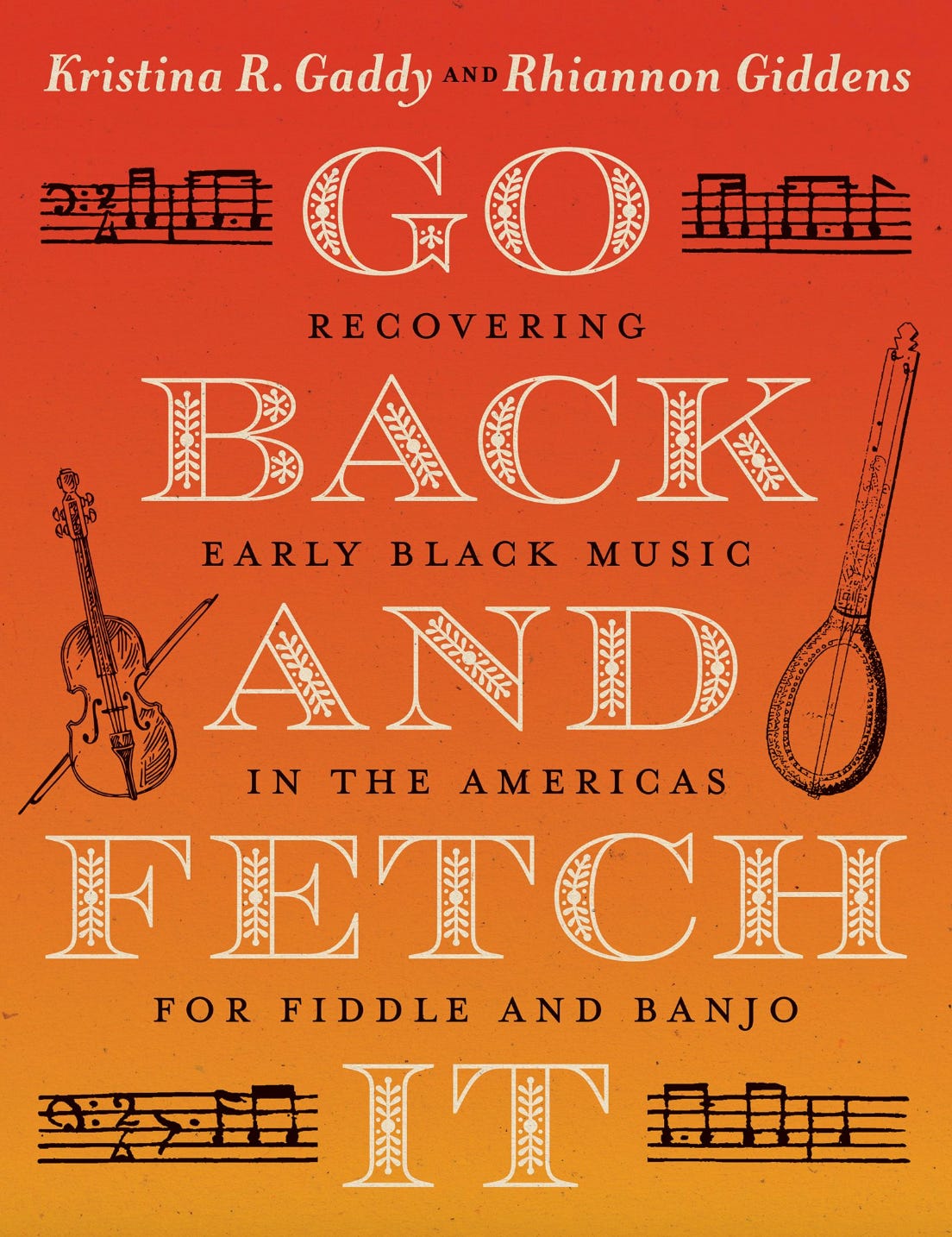
On Sept. 16 Kristina R. Gaddy, author of The Well of Souls: Uncovering the Banjo’s Hidden History and Rhiannon Giddens, Grammy-Award winning musician and founding member of the Carolina Chocolate Drops will release Go Back and Fetch It: Recovering Early Black Music in the Americas for Fiddle and Banjo. The book is a collection of transcribed music from Black musicians across the Americas and the Caribbean from 1687 to the Civil War, along with essays on each piece. Gaddy spoke with The Contrarian about the book. The following is excerpted from that conversation, with edits for length and clarity.
Abraham Kenmore: I wonder if you would start by talking a little bit about how Go Back and Fetch It came to be, as an idea and a project?
Kristina Gaddy: It was really Rhiannon's idea. I had a bunch of musical illustrations in Well of Souls, and my editor was like, “you have so many illustrations, I really don't think we need these.” So I ended up putting them on my website. But it was literally just the images of the original transcriptions.
Rhiannon was working on music for Ken Burns's American Revolution documentary and was trying to find some period pieces from the 1770s. She found my website, and was like, “wow, okay, this is great that they're available online, but they're not always legible.”
She sent me a message saying, “hey, I think we should put our heads together on putting together a book of this music and include legible treble clef, and include banjo tab so that contemporary musicians today can easily play this.” Luckily, I have a friend who's our editor at UNC press, and I approached her about it. She just thought it was a fantastic idea that really combined scholarship and accessibility and music.
I learned from this book that there were fewer than 10 songs before 1861 that are collected in the United States that we know are from Black musicians. When you're working with a record like this, where there's very few resources, what are the challenges?
It’s really challenging because you want more, you always want more. Like “Roaring River” was one song that Solomon Northrup [author of Twelve Years a Slave] wrote down during his time of enslavement. He was a prolific musician, so I imagine he heard a lot more songs while enslaved in Louisianna, and for some reason that’s the one that got printed in his book.
It's really sad to know that there was so much more that wasn't captured. What did that sound like, and how did one place in Louisiana differ from another place in Louisiana?
So a lot of it feels like archeology, like reconstructing something from a little fragment. But it’s exciting to put all this music together in one place. Even recognizing we have a span of about 150 years and 1000s of miles yet can still see patterns emerging through this music.
That's one of the interesting things about Rhiannon putting the music into banjo tab: if you look at the tunings for banjos, even if you don't play the banjo, a lot of them are the same. Sometimes I'm not sure what exactly it means; it might mean less than you want it to, but I still find it absolutely fascinating that we can see a kind of continuity.
Not only do you not have a whole lot of records, but as you mentioned earlier, a lot of them are kind of hard to read. Most of them are recorded by white musicians hearing Black performers play and recording them. What does that process look like of trying to take these records that might have errors in them and clean them up, making them readable, reconstructing what they actually would have sounded like?
One of our conscious choices was to include, especially if it's handwritten and not easily accessible online, that transcription of the original so that people can look at it and make their own judgments. We don't own these pieces. They're not exclusively ours, and people should be able to look at them and say, ‘I'm not sure that that is the right choice,’ on some of them that are really messy.
And one of the other fun things to me about historical research is that you get to uncover new things. There is so much that is still tucked away and needs to be manually retrieved from these papers in museums. My hope is always that the more we get out there, and the more that people have an interest in it, the more that comes forward.
“Snowden’s Jig” is probably one of the most well-known tunes in the book, because the Carolina Chocolate Drops recorded it and performed it. But that original piece of music came very specifically, because somebody came up to Rhiannon and the Chocolate Drops at a show and said, “have you seen this song before?” And they hadn't.
When you were writing the essays, what was that process like in terms of the scholarship that Rhiannon was contributing, you were contributing?
We kind of divided and conquered. So we, together, chose the list of songs to include. We did have to make certain choices, because we decided it was going to be 19 or 20, and we figured out what our time parameters were and what fit in the thesis.
Some of them I had absolutely not heard about while working on Well of Souls, and the best example of that is the piece “Black Dance.” My mom is from Sweden, my dad's an American but lived in Sweden for a while. He was really interested in the idea of Swedish colonies, and so started reading about that. In his reading, he came across this transcription from St. Bartholomew and this piece of music, and he's like, “Kristina, have you ever seen this?”
So to be able to almost have a follow-up and put these little addendums [to Well of Souls] into Go Back and Fetch It has been really satisfying.
Earlier this year the Pentagon went through and pulled a whole bunch of information on anything remotely related to people of color and military history. Now the president is talking about the Smithsonian museums being focused too much on slavery. What does it mean to be compiling this overlooked history of Black music in a moment when there seems to be a push to roll back a focus on under-covered stories?
Especially with music like this Black music that is in Go Back and Fetch It, it is not the side story. It is central to the creation of American music as we know it. There is no denying that these are the foundations for any genre of music that we consider American, whether that is rock and roll, blues, jazz, old time, bluegrass, country; all of these things that we think of as quintessentially American would not exist without this music.
Also, knowing that there are so many people who want this history and deserve this history, that when we discount people, when we discount these histories, we're excluding people. That is not what we should be doing. We should be trying to embrace as many people as we can. And especially when it comes to traditional music, bring in people who have traditionally felt as though they didn't belong, quote unquote.
What is your hope for this book when it launches?
My personal hope is really what we say at the end of the introduction, which is that these songs re-enter the canon.
I was at a party last year, and I heard somebody getting ready to jam and talking about “Snowden’s Jig.” And it just brought this in giant smile to my face, because all I could think was, you wouldn't know “Snowden's Jig” if it wasn't for the Chocolate Drops, if it wasn't for somebody who had dug it out of an archive and given it to them. My hope is that in a year, two years, five years, whatever, I can walk through a festival and hear “Poor Rosy” being played in a jam, or hear “Black Dance” being played in a jam.
I also hope that musicians take these and make new creative things out of them. They don't have to be preserved in amber, but that they use them in new, creative and innovative ways. And also just sharing more stories of the Black musicians who are in this historical material, and letting people know what the full, true history looks like.


The real roots of blues, jazz, and rock. I'll add this to my treasure trove of roots music, along with the great retro cuts played each week on Black Mold's "Music of Mass Distraction" show on WWOZ New Orleans. He always does a set of early recordings along with the eclectic mix. You can stream it on Friday nights or from the archive for free: https://www.wwoz.org/listen/player/
P.S. - Donate to WWOZ if you can; as a public radio station, they just had their federal funding yanked.
Interesting! The Tennessee Valley Old Time Fiddler’s Convention is always in early October. These pieces would be an interesting addition to the convention program!