


On Wednesday afternoon, CNN, quickly followed by the Associated Press, called the U.S. Senate race in Mississippi for Democrat Scott Colom. Thanks largely to Black voters who turned out in unprecedented numbers, Mississippi has elected its first African American U.S. Senator. (During Reconstruction, African Americans were appointed in 1870 and 1875.) The unimaginable has now become reality.
Colom’s campaign released a memo stating, “At this stage in the vote tally for Mississippi’s U.S. Senate race, a Cindy Hyde-Smith victory is now a mathematical impossibility. This race ends with a victory for Scott Colom and he will be Mississippi’s next U.S. Senator.” With only about “7,100 ballots cast that have not been counted, which includes 6,400 affidavit provisionals and 700 absentee ballots,” Colom’s opponent has in essence been mathematically eliminated. He concluded, “Scott Colom will be the next U.S. Senator for Mississippi and his victory is now a guarantee. Cindy Hyde-Smith has no path to win this race and she should concede.” Shortly thereafter, she did just that, a decent and responsible response in a party that has been plagued by election denial.
In a rally after declaring victory, Colom praised the power of prayer and extolled his supporters’ hard work, singling out Rep. Bennie Thompson (D-MS) for his support and political guidance. He also recognized those who had sacrificed so much. “There’s so many people that have faith in Mississippi at times when it seemed impossible,” he recalled. “People like Medgar Evers … when he served his country and came home to Mississippi and they would not let him vote. But he had faith that Mississippi could make progress. He had faith that one day everyone would have the right to vote. He had faith that a day like this was possible.”
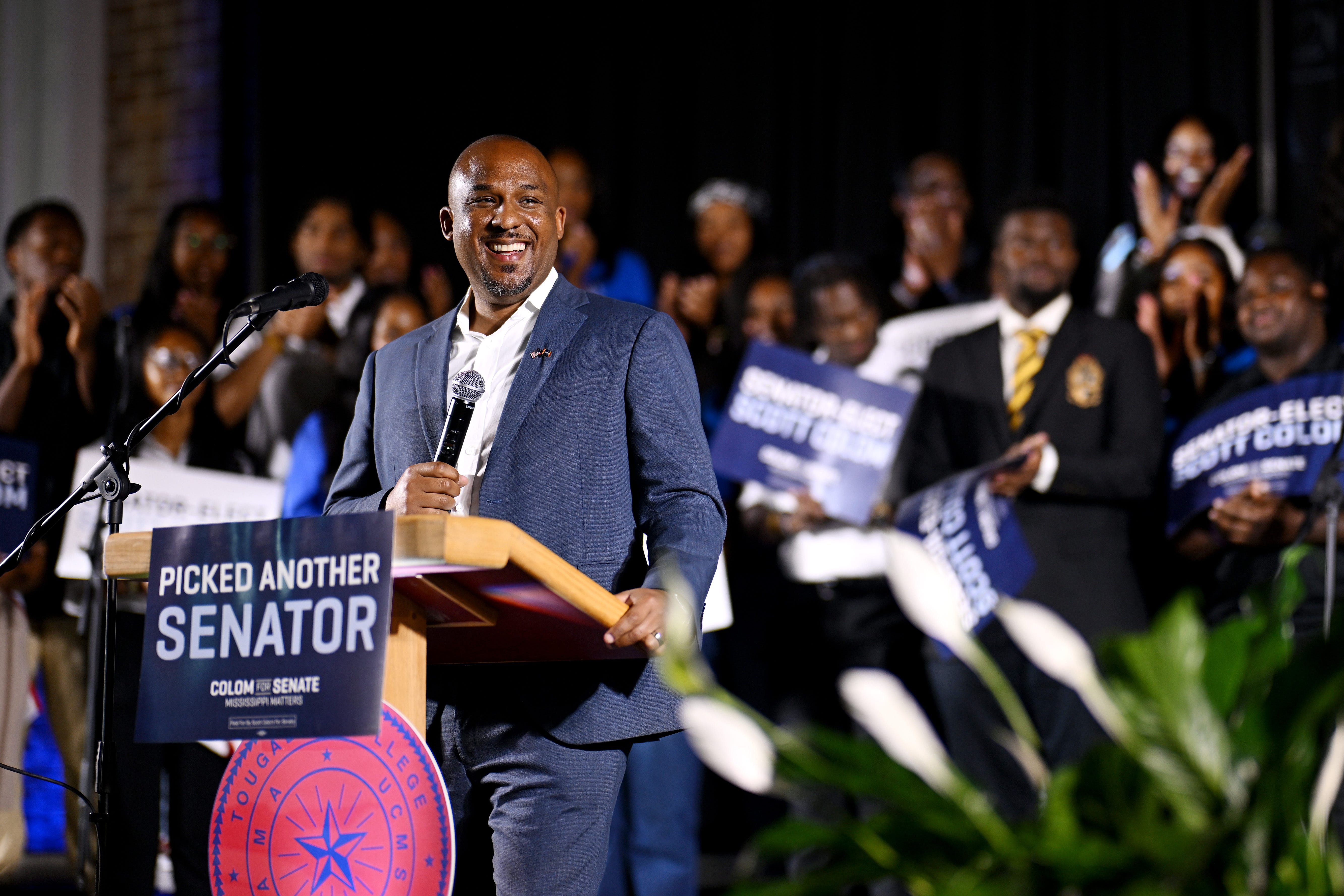
Mississippi looms large in the history and present reality of racism in American. It’s the state where White racists murdered Emmett Till, Medgar Evers, and civil rights workers James Chaney, Andrew Goodman, and Michael Schwerner, who had gone in 1964 to register African Americans to vote. It’s the state where mass disenfranchisement has been perpetuated: “Over the past 30 years, approximately 55,000 Mississippians have lost their rights to vote due to felony disenfranchisement,” the Marshall Project reported. “About six out of 10 are Black.” And it’s the state where the Southern Poverty Law Center, now the target of a bogus political prosecution at the hands of racist Trump regime, documented in 2024 the “ongoing impact of racial and socioeconomic injustices on vulnerable communities.”
As SPLC reported:
Voter suppression tactics, such as strict voter ID laws, polling place closures, and voter roll purges, further hinder Black and low-income citizens from exercising their constitutional rights, leading to far-reaching consequences beyond the political sphere. These consequences include limiting individuals’ ability to self-govern and advocate for needs that could potentially eradicate socioeconomic disparities and increase the inclusion of their voices in the democratic process. Moreover, voter suppression compounds health inequities by obstructing access to public resources, environmental justice initiatives, and policies addressing the social determinants of health.
And yet, for decades, a multi-racial coalition of Mississippians persisted. Colom’s election is the culmination of decades of community organizing and litigation. And this year, Mississippi voters even overcame a devious scheme to knock 230,000 voters off the rolls using credit information from a third-party vendor (data the state secretary of state was told was rife with errors). Those thrown off the rolls but entitled to vote showed up by the thousands to cast affidavit ballots, all of which had to be separately completed, checked, and tabulated.
But this is only one step in a long journey. With Callais on the books and the gerrymandered state still in the hands of White powerbrokers, the political injustice will continue without ongoing effort. As Stacey Abrams wrote this week:
Mississippi is already responding to the Supreme Court’s narrowing of voting-rights protections. The secretary of state instructed counties to return to 2022 legislative maps that a federal court had found diluted Black voting power. The governor has signaled that lawmakers may return for a special session to redraw districts before candidates file in January.
Historic turnout may elect Scott Colom to the U.S. Senate. But will it protect Johnny DuPree, who holds the state legislative seat that broke the Republican supermajority—a seat lawmakers have now erased again?
A statewide victory cannot protect communities from every quiet decision made in a map room.
Abrams pointed out that the work to eradicate Jim Crow will take concerted, ongoing effort not only inside the state but also from pro-democracy forces around the country. (“Fund the unglamorous work, and fund it now. Support state legislative caucuses, county parties and year-round organizers in Mississippi and Louisiana,” are among her recommendations. “Money arriving in October 2027 can buy television ads. Money arriving this winter can recruit candidates, hire field staff and prepare lawyers for the next special session.”)
If the U.S. Senate race shows us anything, it is that securing our democracy is achieved year after year by ordinary Americans doing the hard work in their communities. The state and the country at large, which will enjoy the leadership of elected officials like Colom, will be the beneficiary if the Democratic Party and its allies commit now to the arduous work of governing well and advancing progressive policies that show voters in Mississippi and elsewhere that their votes can change the quality of their lives, and refuse to allow Republicans to perpetuate their dual narrative of white Christian nationalism and election denial/suppression.
A historic victory has been achieved thanks to the courageous efforts of so many people who refused to give up on Mississippi and on the promise of democracy and equality. Colom’s brilliant, tireless campaigning, his ingenious ads, and his career in public service as a prosecutor deserve full credit. But we dare not overlook the combined efforts of civil rights and voting rights groups that refused to cower in the wake of Callais and the decades of work in politics, healthcare, education, and all aspects of society to empower people and combat the scourges of racism and poverty.
In short, if Mississippians did not give up on the promise of America, the rest of us have no right to. The struggle for pluralistic democracy must continue.
In astrophysics, a black hole event horizon is the boundary marking the "point of no return" beyond which the black hole's gravitational pull is so strong that nothing—not even light—can escape.
In politics, an event horizon marks the point at which a set of public policies or a political party, become so toxic to the population being governed, they lead to the extinction of those policies or party.
In our democratic universe, where people assume they have been created equal and have inalienable rights to life, liberty, justice and happiness, the MAGA movement has reached its life ending event horizon on Nov 3, 2026.
75-78 million Americans voted to extinguish it. The funeral may last until Jan 3 2027. RIP Trump/MAGA.
We'll see you all in hearings and courts while implimenting the policies our voters want
.
Raphael Warnock is right when he says Democrats ignore the South at their own peril. Next up: Louisiana, Florida and Tennessee. I live in the latter, and we came so close to electing a Democratic governor. And we flipped a gerrymandered House seat held by a lowlife Republican for 16 years. That race was won by a fed-up housewife with a $45,000 campaign budget. Where there’s a will…