

By Frederic J. Frommer
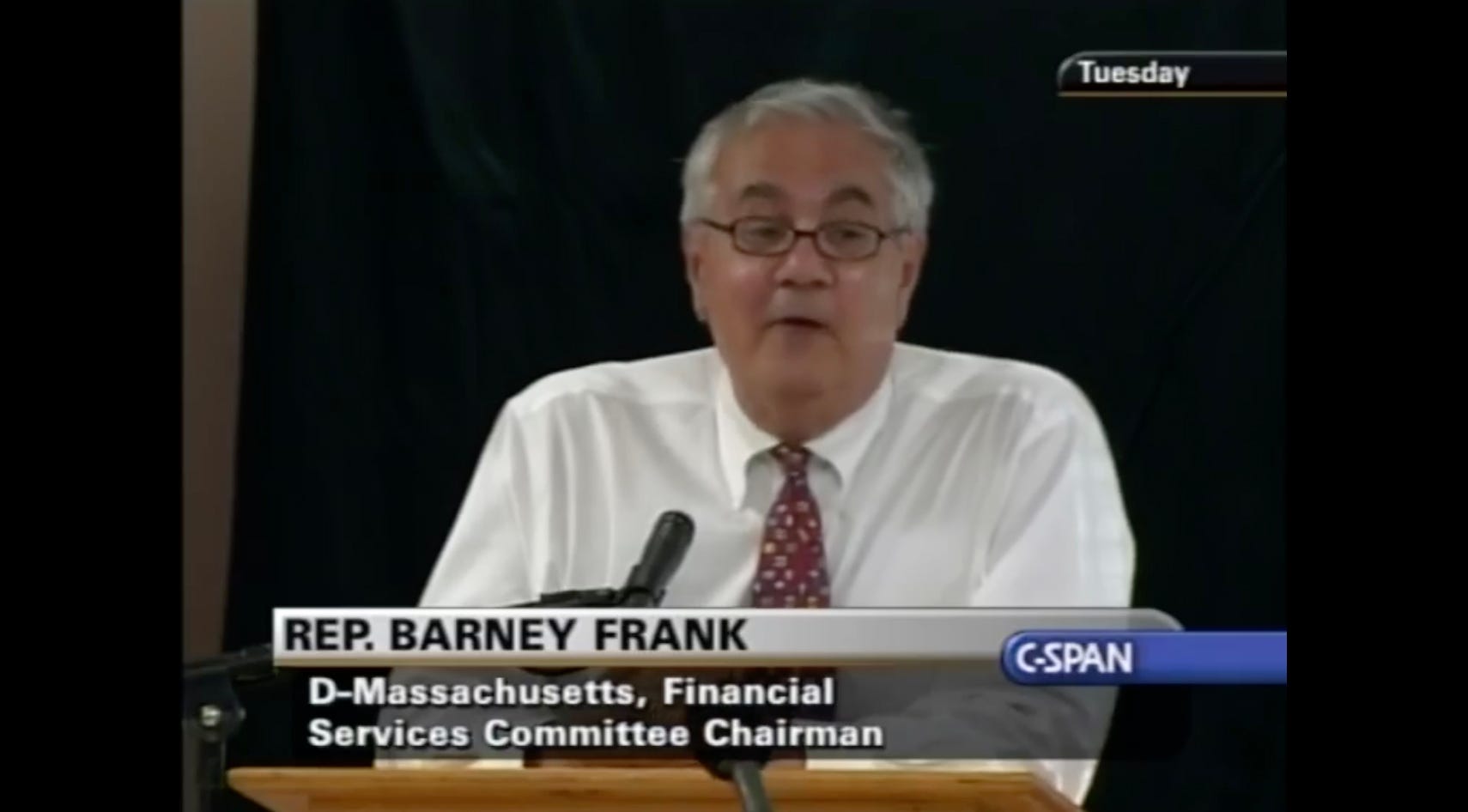
Rep. Barney Frank, who died last week at the age of 86, made history nearly four decades ago when he became the first member of Congress to out himself.
“I don’t think my sex life is relevant to my job,” he told the Boston Globe on May 29, 1987 — 39 years ago Friday. “But on the other hand, I don’t want to leave the impression that I’m embarrassed about my life. If you ask the direct question: ‘Are you gay?’ the answer is: ‘Yes. So what?’ I’ve said all along that if I was asked by a reporter and I didn’t respond, it would look like I had something to hide, and I don’t think I have anything to hide.”
Four years earlier, Rep. Gerry E. Studds had disclosed that he was gay, but only after news that he’d had a sexual relationship with a teenage House page (which led to a formal censure).
Frank’s “so what?” formulation suggests his reply was almost a throwaway line from a famously blunt, no-nonsense politician. But as he recounted in a 2015 piece for POLITICO Magazine, “My Life as a Gay Congressman,” it was actually carefully choreographed.
By 1986, Frank wrote, “I was as ready to leave the closet as I would ever be – but how would I do so?”
“For many years, I was ashamed of myself for hiding my membership in a universally despised group,” he recalled. “I’d been afraid of exposure, and angry at myself for my self-denial. I’d felt shame as I watched younger gay men and lesbians confront the bigots openly with a courage that I lacked. After all those years, lying to people was much easier emotionally than finally admitting my lie.”
That summer, he approached House Speaker Tip O’Neill, a fellow Massachusetts Democratic congressman, to let him know about a new book by former Rep. Robert Bauman, The Gentleman From Maryland: The Conscience of a Gay Conservative, which hinted at Frank’s sexuality. Bauman, a Republican who had been charged with soliciting an underage male prostitute while in office, mentioned Frank’s attendance at a gay pride rally in the book.
“Tip, Bob Bauman has just written a book that says I’m gay,” Frank told O’Neill.
“Aw, Barney, don’t pay any attention. People are always spreading shit about us,” the speaker replied.
“But, Tip, the problem is that it’s true,” Frank told him.
“He looked stricken, though he immediately made clear it was not my sexuality that troubled him but the negative impact its disclosure would have on my career,” Frank recalled.
The speaker told him, “I’m sorry to hear it. I thought you might become the first Jewish speaker.”
“As upset as I was at the prospect of a premature outing,” Frank recalled, “the fact that a man I respected so much had said such a flattering thing made me feel better.”
Frank wrote that he didn’t want to come out under those circumstances, but the Boston Globe’s Bob Healy followed up on the anecdote in Bauman’s book and asked to talk to him.
“I told him I was still not ready,” Frank remembered. “When I was, I assured him I would give the Globe an exclusive—that is, I would let them publish the news first.”
The following spring, he called the Globe editors to let them know he was ready to come out in their newspaper.
“They happily replied that they would be glad to receive my statement and interview me about it. I then explained that I did not intend to announce anything, but that I would answer honestly if a reporter asked if I was gay.” And so the Globe sent a reporter to interview him.
“Neither of us being big on ceremony,” he recalled, “she came into my D.C. office, turned on her tape recorder, and asked me, ‘Are you gay?’”
“I gave the most carefully considered answer I could: ‘Yeah. So what?’”
Frank said the response he got from people was overwhelmingly positive. He went to a performance of Cirque du Soleil in Boston that weekend, where the audience cheered when his name was announced.
“It was the only time in my experience that an entertainment-oriented crowd gave a politician a greater ovation than a genuine star,” he wrote. “For the first time, I realized that coming out could have political advantages as well as liabilities.”
That continued in Boston and when he returned to D.C. He remembered that Republican Sen. Alan Simpson called to apologize. What for, Frank asked.
“Well knowing myself and my telling outrageous jokes about everything, I figured I might have made one in your presence, and I respect you way too much to want you to think that’s how I feel,” Simpson said, adding that he admired Frank’s courage.
“I was deeply moved,” Frank said.
“On the House floor,” he added, “my Democratic colleagues literally embraced me. In so doing, they conveyed their willingness to protect me from any harm—political or other—that might threaten.”
Today, of course, a gay lawmaker wouldn’t be news at all. Back then it was, as AP picked up the story, and it ran in papers across the country, including the New York Times, which headlined the article, “Representative Frank Discloses He Is Homosexual.”
Frank said that the media coverage was mostly positive, but he took exception to the Times’ use of the word “homosexual” in a takeout a few days later.
“By then, ‘gay’ was the adjective in general use,” Frank wrote. “’Homosexual’ was not explicitly derogatory, but it was the preferred term among those who wanted to maintain some semantic distance from our cause. In the phrasing of certain aptitude tests, you might say that ‘homosexual’ was to ‘gay’ as ‘Negro’ was to ‘black.’ It wasn’t exactly an insult, but it was a message to the minority in question that the majority would decide what to call us, rather than let us pick a name we liked.”
Frederic J. Frommer, a sports and politics historian who has written for the Washington Post, the New York Times, the Atlantic and other national publications, is working on a book on ‘70s baseball.
May his memory be a blessing and an inspiration.
With today as a reference point on how the idea of coming out and owning one’s own identity is done absent the dread that it will cost you friendships, close relationships and livelihood, it took an enormous amount of courage for Barney Frank to come out in 1987 on the national level. That his peers and colleagues had his back when he did speaks clearly about the kind of man he was, that they respected him as an equal, one of their own. Remember that in 1987, the House of Representatives was not filled with the level of carnival barkers, social media wannabe influencers and spineless sycophants that characterize so much of that body today. To many of us, Barney Frank is beloved and respected for how he carried himself with dignity, courage and integrity. He represented us well, far beyond the boundaries of his congressional district, and we were fortunate to have him among us.