


Near the end of his life, in 1825, Thomas Jefferson was thinking about the Declaration of Independence he had written nearly 50 years earlier. He explained to a friend that he was not trying to be especially original in his composition; he simply wanted to “place before mankind the common sense of the subject.” He hoped to state truths so evident that they were in fact “self-evident.” He concluded that this set of arguments was intended to be “an expression of the American mind.”
That he succeeded beyond all expectations can be measured by the reverence Americans have always felt for the Declaration. It has been embraced by liberals and conservatives, even as they have found very different things to like. That became clear as I edited an anthology of writings on the great document, just published by the Library of America. From Ho Chi Minh to Ronald Reagan, from the Black Panthers to the Tea Party, from Emma Goldman to the pro-life movement, the Declaration has provided a generous buffet.

The language about human rights — “life, liberty and the pursuit of happiness” — has been especially enduring. By avoiding too much precision about what that means, Jefferson offered all a slice of the American pie.
But to call these truths “self-evident” was a stretch when roughly a fifth of the population was enslaved, another population (Native Americans) was largely excluded from the new nation, and around a third of all citizens did not want to form a new country at all.
In fact, not much was self-evident. The United States was far from an established fact in the summer of 1776, and the document’s bravado conceals some internal fissures. The most famous version of the Declaration, the one visited by a million people a year in the National Archives, did not exist on July 4, 1776 — it was created in late July and backdated.
There are internal tensions, too; some of the Declaration’s sentences push against each other. There is some bold language against slavery — as with “life, liberty and the pursuit of happiness.” But later in the same document, Jefferson complains that King George III has stirred up “domestic insurrections,” a reference to slave rebellions. So, it can be argued that the Declaration is both pro- and anti-slavery at the same time.
Despite these contradictions, or perhaps even because of them, the flawed document did reflect “the American mind,” as Jefferson hoped. To work out of the contradictions became the central challenge of the generations that followed. A central takeaway of the new book is that the reading and re-reading of the Declaration has been as important — or more so — as the writing of it. Each generation has breathed new life into it.
Alert readers were ready from the start. In 1776, African Americans were immediately aware that the Declaration’s better sentences applied to them and would accelerate slavery’s demise. Lemuel Haynes, a young Black veteran in Massachusetts, wrote an unpublished essay in 1776 (discovered in 1983) that attacked slavery and argued that the Declaration’s rights be extended to all Americans. That refrain was quickly adopted by other African Americans, some of whom used the Declaration to argue for their freedom in the courts.
But as these legal strategies were finding success, Southern enslavers began to double down and began to speak against the Declaration. In 1848, Sen. John C. Calhoun of South Carolina attacked the phrase “all men are created equal” as “the most false and dangerous of all political errors.” Others piled on; in 1853, Sen. John Pettit of Indiana called it a “self-evident lie.” These insults to America’s founding charter were crying out for a rebuttal. It came from an unlikely source, a close reader who had grown up in poverty and semi-illiteracy in Pettit’s state.
From a young age, Abraham Lincoln formed a deep bond with the Declaration. Surprisingly, he discovered it after breaking the law. To make a little money, Lincoln had been ferrying people across the Ohio River in a boat, unaware that he needed a license. A local constable explained the law to him, then gave him a copy of Indiana’s book of statutes, so he could learn them better. For Lincoln, who grew up in a house with very few books, and an illiterate father, the gift was a watershed.
The book opened with text of the Declaration, and Lincoln never stopped rereading it, especially the passages about human rights. They spoke to him powerfully, perhaps because his father had rented him out as an indentured servant when he was young, stirring a lifelong hatred of slavery.
As his star rose, he kept the Declaration close, citing it often in his speeches and correspondence. In the mid-1850s, as the South argued that slavery needed to expand, Lincoln refused to give an inch. Over and over, he argued that Declaration and slavery were incompatible. At Peoria, in 1854, he said, “Let us re-adopt the Declaration of Independence, and with it, the practices, and policy, which harmonize with it.” Four years later, in the Lincoln-Douglas debates against his opponent for a Senate seat from Illinois, Stephen Douglas, the Declaration was a frequent topic, almost as if the debaters were back in Independence Hall, wondering what kind of country to create. For Douglas, it was a document that applied only to white men of European extraction; anything less was a “monstrous heresy.” But, in debate after debate, Lincoln punctured his claimsate. Observers noticed that Lincoln grew even taller as he spoke of the Declaration, and stretched his long arms out, to fully explore the breadth of its ideas and the warmth of its embrace for all.
Lincoln lost the Senate race to Douglas, but two years later, he was elected president. In response, seven Southern states seceded, citing the Declaration in their own way, arguing that it gives a people the right to form a new government.
But Lincoln, as usual, read deeper. He celebrated the Declaration throughout his long journey to Washington as a document for all — that important word — and as a statement of union that cannot be casually thrown aside for temporary purposes, or to perpetuate human rights abuses, as the Confederacy had every intention of doing.
In the fullness of time, Lincoln’s interpretation prevailed. In Philadelphia, he stopped at Independence Hall and said, “I have never had a feeling politically that did not spring from the sentiments embodied in the Declaration of Independence.” In the first summer of his presidency, when he needed to issue a serious statement about the war, he dated it July 4, 1861. Two years, later, Lincoln’s belief in the Fourth of July became a self-fulfilling prophecy, as Union armies delivered spectacular victories at Gettysburg on July 3 and at Vicksburg on July 4. The latter victory resulted in the self-liberation of 20,000 enslaved people, emboldened to stake their own claim to life, liberty and the pursuit of happiness.
A few nights later, serenaders came to sing at the White House. Moved, Lincoln delivered a spontaneous response, full of feeling for the old document that had guided so much of his thinking. He saw the victories as a triumph for “the principle that all men are created equal,” which the Confederacy was trying to overthrow. He added that this would make a “glorious theme” for a speech.
The result came four months later, at Gettysburg, a sustained meditation on the Declaration that never mentions it by name. It’s as if all the years of reflection had burnished his thoughts into a diamond-like essence. The Gettysburg Address remains sublime for its elegant articulation of the guiding principles that Lincoln had followed since he first encountered the Declaration and realized that it described the kind of country he wanted to live in.
Lincoln did not live to see the end of the war, but he surely knew that his way of interpreting the Declaration would prevail in the end. The 13th, 14th, and 15th Amendments confirmed his understanding and eliminated the old contradictions. The 14th begins “all,” the word that was so important to Lincoln, and includes “life” and “liberty,” both present in the Declaration. It is color-blind. It is the same amendment that promises birthright citizenship, the doctrine that narrowly survived a Supreme Court decision on June 30.
Lincoln’s great insight was that we can make the Declaration whole by living up to its better sentences and refusing to give in to those who will try to weaken them. Most of its truths are not self-evident at all but aspirational. They depend on successive generations to realize them. They depend, in other words, on us.
Ted Widmer is the author of “The Living Declaration: A Biography of America’s Founding Text,” published on June 23 by the Library of America.
Limited Edition Screen Prints!
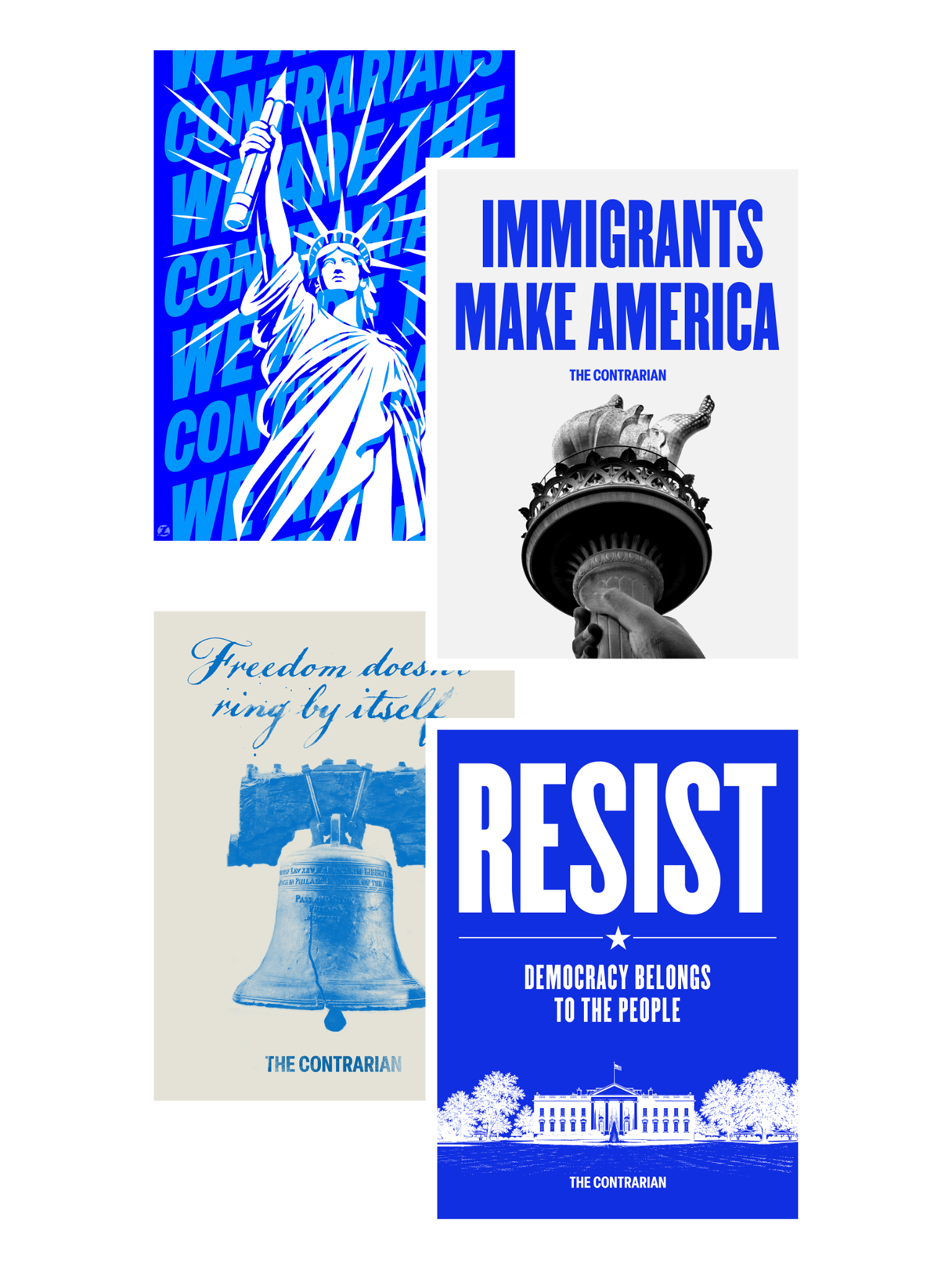
Celebrate America 250 with The Art of Resistance
This limited-edition collection of screen prints is created to honor the American tradition of leveraging creative expression to inspire change.
