


Do you have stress dreams? Mine are the predictable ones: missing a final exam or showing up for a test in a class I had skipped all semester—the former is something that did happen to me in college. Once in a while, though, I have a different one: I’m back at Fort Benning (Fort Moore) in Georgia and am told that I never completed Army Ranger School in 1983 and must do it now.
I’m still in decent shape, given my age, but I’m not 22 years old—which is why I wake in a cold sweat to the prospect of going through Ranger School again. Even at 22, after 16 weeks of basic infantry training and three weeks of airborne school, in the best condition of my life, the nine-week course nearly broke me.
That dream reminds me of a truth about training: The hardest tests work only if they rest on a foundation. Ranger School wasn’t the beginning; it was the crucible after months of preparation. You don’t send people into combat—or into a test of endurance—without layering their instruction. The scaffolding matters as much as the final challenge.
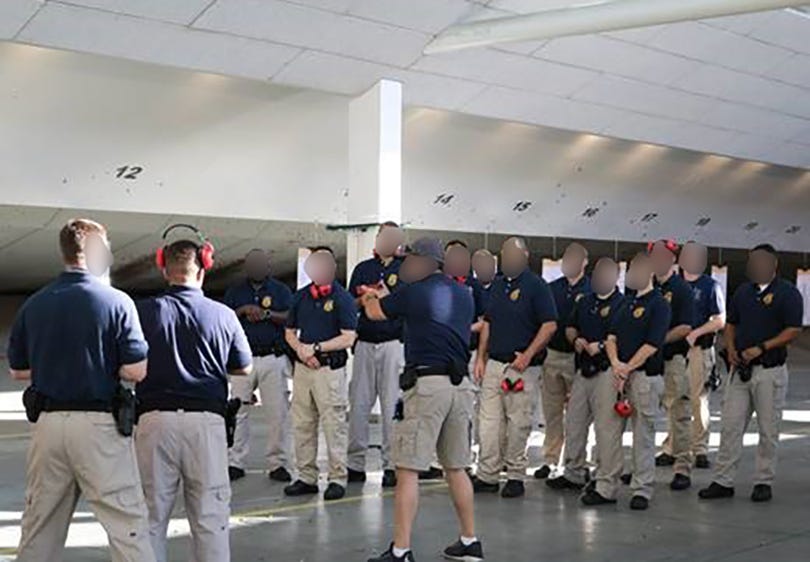
Which is why the decision to reduce U.S. Immigration and Customs Enforcement (ICE) training from 13 weeks to just eight weeks—or, as some accounts put it, a symbolic 47 days—should alarm anyone who cares about competence in the government’s front-line agencies. Training length isn’t the only metric that matters, but it is the clearest indicator of seriousness.
ICE isn’t simply skipping a crucible; it’s stripping away the foundation. Halving the time to teach law, procedure, language, and tactics and the judgment to use them responsibly is not efficiency. It is cutting corners.
Consider how other institutions approach training. The Army’s basic infantry school for officers today runs roughly 19 weeks, three weeks longer than when I went through it. The New York Police Department’s entry-level recruit training at its academy spans 17 weeks before officers ever set foot on patrol. Even basic Army boot camp lasts ten weeks. These are not arbitrary timelines. They exist because skill and judgment cannot be rushed.
Even in wartime, the U.S. military only shortened training under acute pressure—and always treated it as a stopgap. In the early years of World War II, some replacement centers cut cycles to eight weeks to push troops out the door. By August 1943, the War Department standardized a 17-week program. Late in 1944, a few categories were compressed again, but the pattern was consistent: Emergency reductions were temporary expedients, never a sustainable model. The Marine Corps learned the same lesson, cutting boot camp to as little as four weeks and seeing a measurable decline in recruit quality before restoring longer courses.
The lesson should be obvious. Leaders understood that depth mattered, even when speed was tempting. Which is why the current rhetoric of “emergency” coming from President Donald Trump and his administration rings hollow. This is not a world war. ICE training is not a battlefield necessity. Cutting corners here is not sacrifice for survival—it is politics dressed up as urgency, with competence the casualty.
The viral video of former Superman actor Dean Cain negotiating an ICE obstacle course illustrates a deeper problem. At 59, Cain deserves credit for enlisting. But the issue isn’t him—it’s what the footage was meant to project. ICE promoted it as proof of toughness, but the impression was corner-cutting. (Cain soon suffered an injury, sidelining his training for a few weeks.)
This is not about shaming Cain—or anyone—for his age. It is about what credible standards require. Most federal law enforcement agencies set their entry age limit at around 37 years for good reason: The work is physically demanding, and the government must invest years to hone skills. Removing those limits while shortening training sends the message that numbers matter more than capability—not to mention careful and unhurried vetting for judgment.
The public deserves to know that those who carry federal badges and weapons are prepared for the realities of the job. That means officers who are not only physically able but who also have endured the repetition, failure, and correction that produce judgment under stress. An agency that recruits nearly anyone, trains them for less than two months, and sends them into the field is not projecting strength. It is broadcasting fundamental weakness.
The irony is that the same politicians who thunder about law and order are now overseeing the dilution of law enforcement standards. More recruits will graduate more quickly, and the administration can point to the numbers. But the price will be paid in the field: botched arrests, courtroom errors, use-of-force incidents, and a loss of credibility that no photo op can repair.
My Ranger School nightmare doesn’t return because I fear being sent back. It returns because I remember what it took to finish. The dream is a reminder of standards, of how institutions test you not just for knowledge but for the acuity to apply it when tired, hungry, and overwhelmed. That is what produces confidence—in yourself and in the public you serve.
ICE’s new approach offers the opposite. A badge after a few weeks, with no age ceiling and a minimalist obstacle course as proof of toughness, is not a standard. It is a stunt. And though stunts might go viral, they don’t produce competence. The public should expect more than theater from the people charged with enforcing its laws.
Brian O’Neill, a retired senior executive from the CIA and National Counterterrorism Center, is an instructor on strategic intelligence at Georgia Tech. His Safehouse Briefing Substack looks at what’s ahead in global security, geopolitics, and national strategy.

This administration isn't interested in educating and training recruits in law, legal procedures or other legal niceties.
This administration is interested in shows of force, and thus far thr GOP congress and SCOTUS have shown no
interest in stopping Trump.
Shame on them.
If Noem and Miller had their way, they would issue them rifles and send them out to pick-up any brown skinned person they could find. They don't care about laws, rules or norms. Their boss is a criminal who continues his criminal enterprise in broad daylight to squealing fools.