

Donald Trump has never been shy about putting his name on hotels, golf clubs, highways, books, steaks, playing cards, sneakers, vodka, or even the Bible—so long as it boosts his ego and profits.
Evidently, he’s less inclined to put his stamp on wars, especially not the long, brutal conflict in Ukraine. “It’s Biden’s war,” Trump repeatedly bellows, seeking self-protective cover. “It would have never happened if I were president.”
But Vladimir Putin had others plans—he invaded Ukraine in February 2022. For a time, the narcissist in Trump naively believed that he, and he alone, could negotiate an end the war. He could do it “in twenty-four hours,” he promised the world. He did try, but failed dismally. As such, it has become “Trump’s war,” placing it among the rare front-page stories he never wanted to own.
The noted political scientist, Hans Morgenthau, warned against what he termed “strategic narcissism,” the belief that every global problem is related somehow to the United States. Trump is an obvious adherent of the Morgenthau doctrine. Whether sensible or not, he’s placed the United States or himself in diplomatic efforts to settle the Gaza disaster, the Thai-Cambodian scramble, the Congo civil war and, of course, the Ukraine war.
On August 6, his diplomatic troubleshooter, Steven Witkoff, a New York real estate friend, continued his on-again, off-again Kremlin negotiations with Putin, hoping for a last-minute Russian concession on a ceasefire in Ukraine. They spoke for three hours. Afterwards, Trump described their meeting as “highly productive,” adding “great progress” had been made.
The Kremlin was less enthusiastic, saying their meeting had been “constructive and useful” and “signals” had been exchanged, but providing no further clarity or explanation.
But within hours, Trump broke the news that he will soon meet with Putin and later at a trilateral meeting with Ukrainian president Volodymyr Zelensky. This was indeed big news.
Both Trump and Putin understood that this Kremlin meeting was special. It took place under the shadow of a Trump threat to tighten sanctions against Russia on August 8 and to impose secondary sanctions, including stiff tariffs, on all nations buying Russian oil and gas and thus, indirectly, financing Russia’s war against Ukraine.
On earlier occasions, Witkoff had met with Putin without any Trump threats hanging over their deliberations. Quite the contrary, both he and Trump allegedly believed that Putin was negotiating in good faith and was truly eager to arrange a ceasefire in Ukraine.
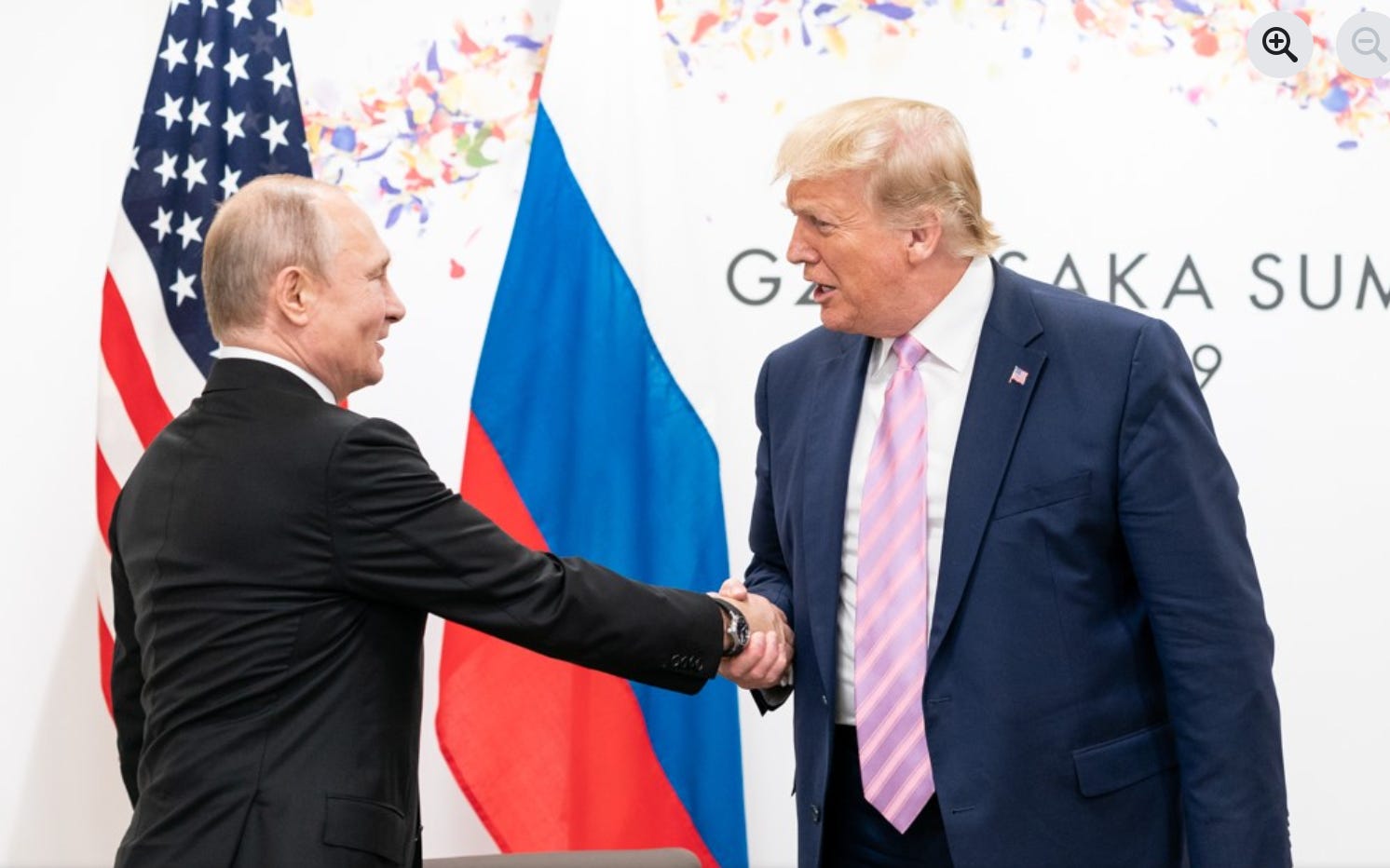
Recently, though, Trump has begun to change his mind about Putin, believing the Russian leader might be playing him for a fool, sounding sincere during their occasional telephone conversations but actually pursuing a cold-blooded policy aimed at the military conquest of neighboring Ukraine.
However, if the October 6 meeting was, in fact, as “constructive,” as the Kremlin alleged, and if “great progress” had indeed been made, then it’s possible that agreement on the realistic spadework for a ceasefire in Ukraine would finally have been reached.
If such agreement was reached, the August 8 sanctions threat would logically be lifted, if for no other reason than to facilitate further progress. But White House officials leaked word to the press that Trump still intended to act on his August 8 threat and impose stiff secondary sanctions on such nations as India, China and Iran, suggesting that whatever progress was made earlier this week, it was not enough to assuage a suddenly tough-minded Trump approach to Putin.
Even with the news about a working summit between Trump and Putin, there is no reason to believe that Putin has changed his basic approach to either Trump or the war. Putin has bet his political future on an outcome to the war that he can portray as a victory for Mother Russia, thereby resurrecting its recognition as one of the world’s great powers. For Putin, a ceasefire alone is inadequate.
Russia has already suffered more than one-million casualties in the war, dead and wounded. He requires, in a sense, a much more impressive payoff: a Yalta-type diplomatic negotiation with the West, led by the United States, that confirms Russia’s military and political control over Ukraine. And probably much more.
Such a dramatic outcome would require the clear, unmistakable acquiescence of the United States, acting on behalf of a defeated Ukraine and collaborating with its West European allies. At the moment, such an outcome seems unimaginable. Ukraine would not accept it. Most European allies could not accept it, leaving Trump with the core responsibility of negotiating with Putin some kind of conclusion to the Ukraine war.
In this sense, the war has become “Trump’s war,” and he must find a way out of it. Some say Trump could simply walk away from Ukraine, claim it’s not America’s business (many MAGA faithful would agree) and let Putin strut like a conquering hero all over Ukraine, a triumphant leader of Russian aggression. Given Trump’s transactional approach to American national interests, such an unethical Trumpian walkaway from Ukraine is possible, but it would destroy America’s standing in the world and stain its once glorious history forever.
Marvin Kalb, Murrow professor emeritus at Harvard, a former network correspondent and author of 18 books, most recently “A DIFFERENT RUSSIA: Khrushchev and Kennedy on a Collision Course.”
I believe America's standing in the world may already be on the way to destruction due to Trump's actions and sayings. And I am being mindful that Trump may be heavily influenced by the Project 2025 mindset, too. Putin will not go along with Trump as he wants to conquer a people for its lands. Appreciate the thoughts and background.
Dispiritingly possible.