


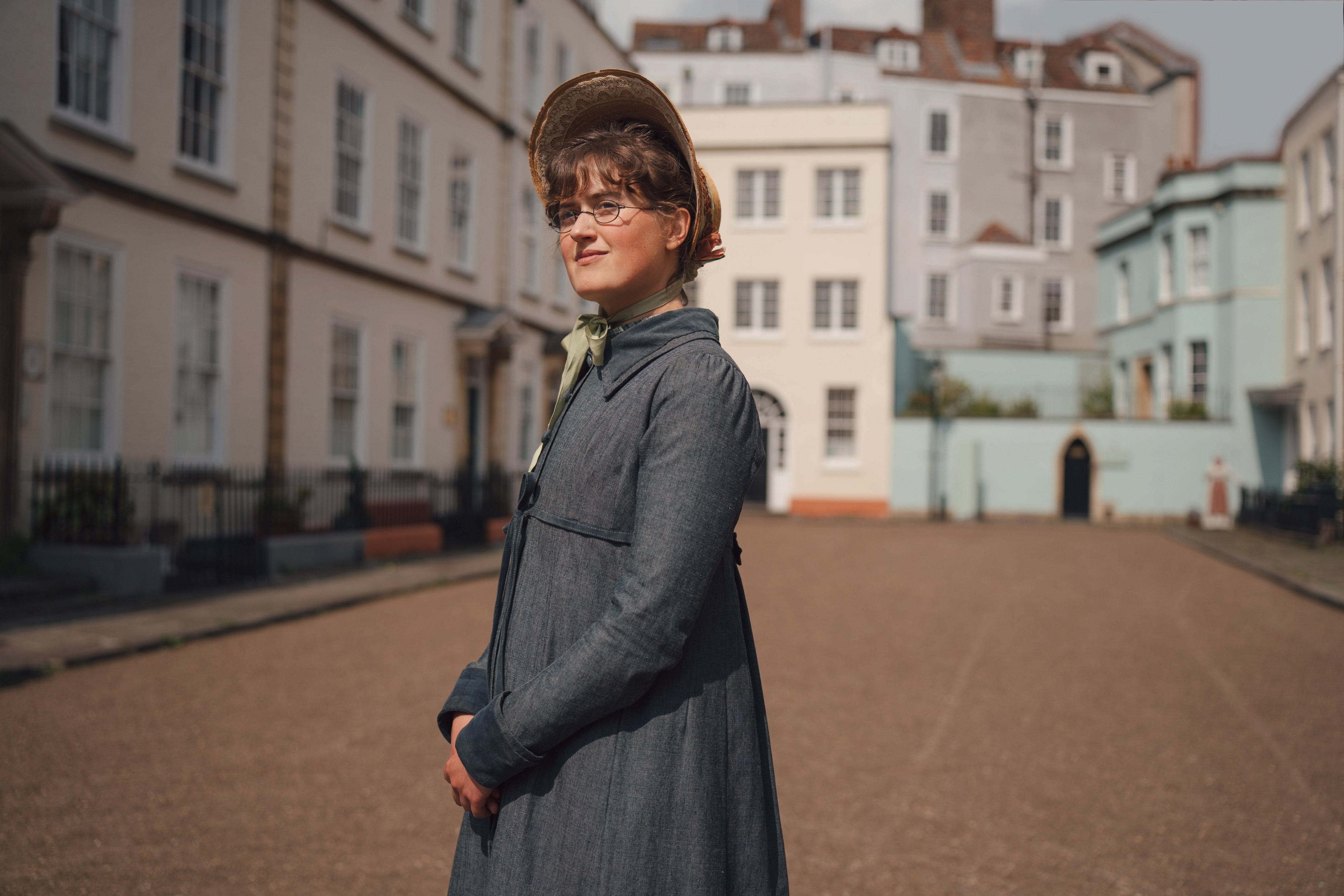
Jane Austen had very few nice things to say about Mary Bennet, the homely middle sister in Pride and Prejudice.
“Mary had neither genius nor taste;” she writes early in the beloved novel, “and though vanity had given her application, it had given her likewise a pedantic air and conceited manner.”
But a new series recasts tedious, self-righteous Mary as an awkward yet deeply relatable young woman who goes to some regrettable extremes while trying to figure out her place in the world.
Based on the novel by Janice Hadlow, The Other Bennet Sister revisits Pride and Prejudice from the perspective of a marginal character who largely serves as an object of ridicule in Austen’s story.
It stars Ella Bruccoleri as Mary, who is constantly defined in opposition to her four sisters — witty Elizabeth, beautiful Jane, spirited Lydia, good-humored Kitty.
Under pressure from her overbearing mother (Ruth Jones) to marry well, Mary tries to stand out by being the “the intellectual one.” (Spoiler: it does not go well.) But following a life-changing event, Mary goes to live with her aunt and uncle in London, where she flourishes — and attracts the attention of multiple suitors.
Writer Sarah Quintrell calls Mary “a brilliant heroine for 2026.”
“Jane Austen writes incredible characters, but I think that Mary was overlooked and unloved. Actually so many of us resonate with her — with her difficult family circumstances, with feeling like a failure,” says Quintrell. “She feels like the odd one out, the outsider. Most of us like to think we’re Lizzy, but we’re actually Mary.”
The Other Bennet Sister premiered in the U.K. earlier this year and became a huge hit for the BBC. It has also been a breakout critical success for BritBox, the specialty streaming service where it airs stateside. (The season finale lands next week.) Chock full of sly references to other films and series in the Austen Cinematic Universe, The Other Bennet Sister is aimed squarely at Janeites. But it also has a distinctly contemporary sense of “cringe humor” — there’s a thoroughly adorkable scene in which Mary and her love interest, Mr. Hayward (Donal Finn), flirt by making bird calls.
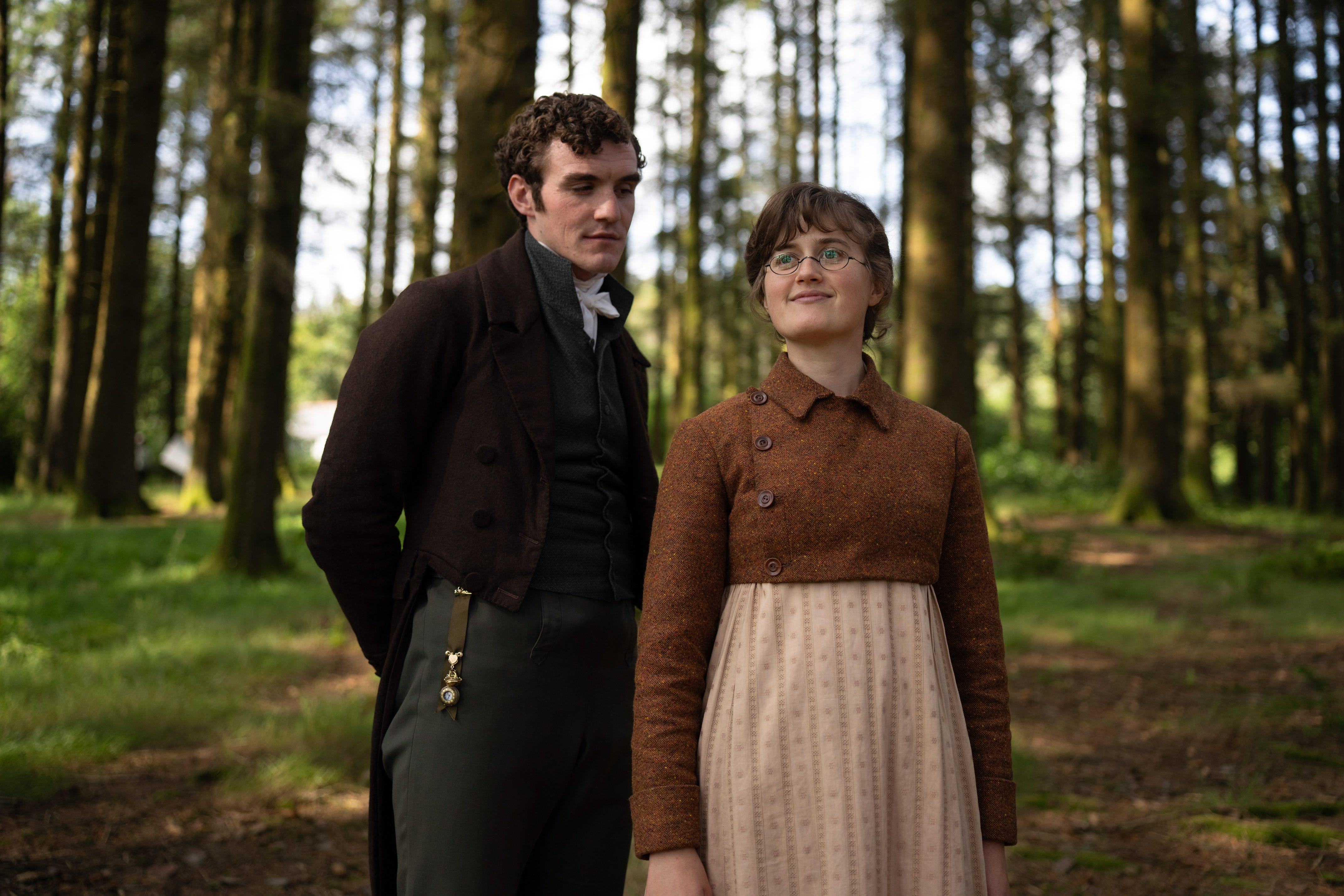
While some Austen purists have quibbled with the show’s supposed disregard for Regency social customs and its unorthodox take on canonical characters like Lizzy and Mrs. Bennet, it is resonating broadly with others who praise it as charming “nerd propaganda.”
“The Other Bennet sister, for me, was always a story about the transformative power of kindness on a young life, and I just can’t think of a better time to be telling that story than now,” Quintrell says.
“There Are Definitely Years Where She Pops”
The Other Bennet Sister is the latest project to arrive a wave of Austenmania: last year brought worldwide celebrations for the author’s 250th birthday; the Oscar-nominated short film Jane Austen’s Period Drama, a feminist satire; Jane Austen Wrecked My Life, a French romantic comedy about a Parisian bookseller who finds love on an Austen-themed writing retreat; and Miss Austen, a historical drama about the complicated relationship between Austen and her only sister, Cassandra.
And there is more to come: In October, Focus Features will release a new film version of Sense and Sensibility, Austen’s debut novel, which will star Daisy Edgar-Jones, of Normal People fame, as Elinor Dashwood (the sensible sister). Later this year, Netflix will take yet another swing at Pride and Prejudice, which was adapted into a BBC series in 1995 (a.k.a. the one with Colin Firth and his wet shirt) and into a lush feature film a decade later (a.k.a. the one with Keira Knightley and the erotically charged hand squeeze). This latest version stars The Crown’s Emma Corrin as Lizzy and Jack Lowden — a ginger! — as Mr. Darcy, and features a script by millennial dating columnist Dolly Alderton.
While Austen has maintained an almost continuous pop culture presence since the mid-90s, when adaptations and modern interpretations of her work (like Clueless and Bridget Jones’s Diary) suddenly seemed to be everywhere, “There are definitely years where she pops,” says Devoney Looser, a professor of Arizona State University and author of multiple books about Austen including Wild for Austen: A Rebellious, Subversive, and Untamed Jane. “This is another moment that will be looked back on as significant.”
In 2026, Austen is a rare cultural figure who is revered by factions that agree on little else — by conservatives who appreciate her narrative focus on marriage and family, and by liberals who see her as a protofeminist and sharp critic of social convention.
“At a difficult moment in cultural history, there’s more agreement around her and her greatness than maybe any other figure,” Looser says. “She can be claimed by people who want to see her as mild and who want to see her as wild, who want to see her as of the right or of the left, and that makes her fascinating.”
“There Are Many Kinds of Heroines”
It is safe to say that Julia Aks connects to Austen’s “wild” side. She is the co-writer, co-director, and star of Jane Austen’s Period Drama, a feminist satire about a young woman who gets her period at the very moment her handsome suitor is about to propose — putting her in the awkward position of having to explain the blood stain on her empire waist gown. Aks made the short film, with visuals borrowed from cinematic adaptations including Joe Wright’s Pride and Prejudice, with the hope that “it would inspire a lot more people to speak more openly about their periods.”
It also shares something with Austen’s writing, which is a biting sense of humor.
“Her literary voice is so freaking funny,” Aks says, “which is something I don’t think I understood just from watching the films [adapted from her novels].” As she and co-writer/co-director Steve Pinder developed Jane Austen’s Period Drama, they looked at scenes from Pride and Prejudice that they could heighten in their parody. “But you read the scenes, and you’re like, ‘She’s already done it. There’s no more heightening to be done.’”
Quintrell also leaned into the comedy with her adaptation of Hadlow’s book, which is at times “quite brutal,” she says. “I wanted the audience to really look forward to sitting down and watching this.”
The screenwriter recalls reading Pride and Prejudice for the first time when she was 17. “I’d avoided it forever, thinking Austen was probably a bit posh. I’m from southeast London,” she says. But she connected deeply to the book — much as viewers are connecting to her take on Mary.
Quintrell doesn’t think her version of Mary is radically different from the character in Austen’s pages.
“We only see Mary in public in Pride and Prejudice. We only see her when she’s being a pedant, when she’s correcting people, when she’s saying the wrong thing, when she’s embarrassing herself at the piano,” she says “What The Other Bennet Sister does is show you the private Mary, the one who’s deeply in pain, who knows she’s made a fool of herself, who knows she shouldn’t have said that, who feels like she’s getting life completely wrong. What that does is allow her to be vulnerable, which means that we connect, and we go, Oh my god, I have felt like that, too!”
As peripheral as Mary is to Pride and Prejudice, there is evidently something about the character that is appealing right now and has inspired fans to explore in their own works of fiction. In addition to The Other Bennet Sister, there are multiple books about Mary published in the last decade ,including The Secret Life of Miss Mary Bennet, a mystery series by Katherine Cowley, and Mary B.: A Novel: An Untold Story of Pride and Prejudice, by Katherine J. Chen.
Looser thinks Mary’s cultural rehabilitation reflects a broader desire “to recapture the noble aspects of the plain, bookish young woman.”
“There are many kinds of heroines, they don’t all have to be like Elizabeth Bennet, so captivating, witty, and at the same time with ‘fine eyes,’” she says, quoting Mr. Darcy. “The recovery of the most plain sister as deserving of her own happy ending and her own story — that makes sense for any moment, but I think especially for our own moment.”
Meredith Blake is the Contrarian’s culture columnist.
Thanks so much for this, from a long time Austen reader/lover. Her writing is both witty (at times even a bit snarky!) and yet so compassionate and revealing of the difficult situations women found themselves in at that time, when the only way to have a “successful” life was to find a man of means willing to marry you. How lucky were Jane and Elizabeth in that regard?!
Reading The Contrarian and watching Jane Austen movies on PBS.com are my favorite ways to comfort myself, especially while the disgusting trump regime is in power. Jennifer Rubin and Jane Austen write [wrote] about the importance of depth of character and ethical behavior, which restores my faith in my fellow humans, at least for a little while.