



On Monday, the Washington, D.C. Metro Transit Police Department arrested Bryan Betancur, a convicted (and then Trump-pardoned) January 6th rioter, charging him with assault and battery. Betancur live-streamed videos of himself creepily touching the hair of women passengers while riding the Metro. The videos went viral, leading to complaints and ultimately Betancur’s arrest.
Betancur is the latest January 6th recidivist. In October 2021, he pleaded guilty to a misdemeanor in connection with his participation in the riot. According to CREW (Citizens for Responsibility and Ethics in Washington), 33 individuals pardoned by President Donald Trump in connection with January 6th have been “rearrested, charged or sentenced for other crimes” since the attack on the U.S. Capitol. On the first day of his second administration, Trump pardoned or granted clemency to nearly 1,600 January 6th defendants and convicts. The president did not attempt to distinguish between violent and non-violent rioters. Nor did he distinguish between the rightwing extremists who planned the attack and the normal folk who were swept up in the chaos. All the Jan. 6ers received a pardon — including Betancur, a white supremacist associated with the far-right Proud Boys — as part of Trump’s obsessive desire to rewrite history and reward his most devout followers.
Betancur’s extremist beliefs and associations are well-attested in the court record, including in a sworn FBI affidavit. An FBI agent described Betancur as “a self-professed white supremacist who has made statements to law enforcement officers that he is a member of several white supremacy organizations.” Betancur “has voiced homicidal ideations, made comments about conducting a school shooting, and has researched mass shootings,” the FBI agent stated.
Betancur also “voiced support for James Fields, the individual convicted [of] killing an individual with his car during protests in Charlottesville, Virginia.” Fields, a neo-Nazi, pleaded guilty to using his car to run over and kill a counter-protester, Heather Heyer, during the white supremacist “Unite the Right Rally” in Charlottesville on August 12, 2017. Betancur “stated he wanted to run people over with a vehicle and kill people in a church,” though he “subsequently stated that he had changed his mind about hurting people.”
According to the FBI agent’s affidavit, Betancur “continued to engage racially motivated violent extremist groups on the internet” after he was released from custody following a conviction for fourth-degree burglary in 2019. He also allegedly “made increased verbalizations about his desire to be a ‘lone wolf killer.’”
Additional details concerning Betancur’s extremist beliefs and connections are contained in the Department of Justice’s (DOJ) sentencing memorandum in his January 6th case. In November 2020, Betancur “was released from custody for a previous violation of his probation” but was not allowed to leave Maryland “without permission from probation.” Betancur’s probation officer granted him permission to travel to Washington, D.C. on December 12, 2020, ostensibly for the “purpose of traveling with Gideon International to distribute Bibles.”
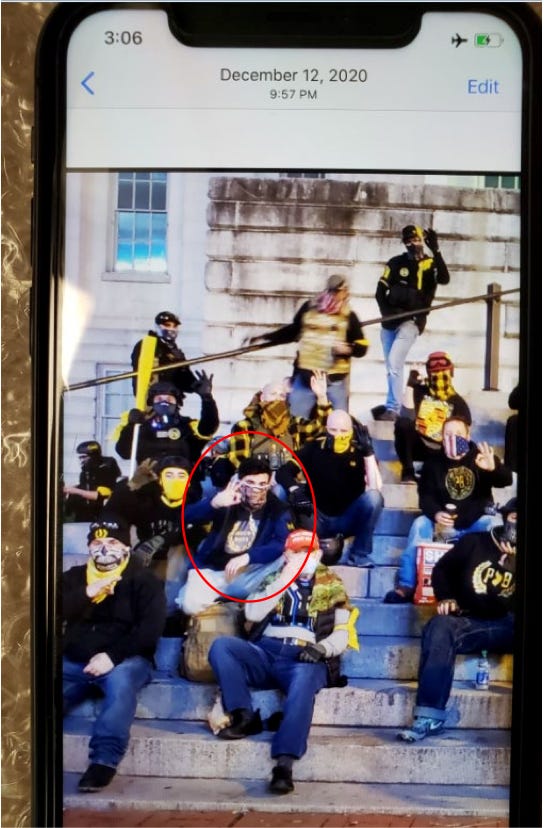
However, the government determined – citing a review of Betancur’s cellphone – that he had actually met up with the Proud Boys, who were involved in violent clashes during the December 12 rally. The FBI concluded that Betancur aspired to be a formal member of the Proud Boys, though he wasn’t officially admitted. An image recovered on Betancur’s phone allegedly shows him with a group others “wearing Proud Boys insignia while holding up his right hand to display the ‘OK’ sign” – and gesture used by the Proud Boys and other extremists that signifies, “among other things, white power.” (The image can be seen below, with the government circling Betancur in red.)
Betancur traveled to Washington – again claiming the trip was “in order to distribute Bibles” – for January 6, 2021. He “wore a distinctive jacket with a Proud Boys shirt under the jacket.” During a post-plea interview, Betancur told authorities that he “attended the speeches and met with Proud Boys members” after arriving in Washington. The DOJ’s sentencing memorandum traces Betancur’s movements, citing the “GPS-enabled monitoring device” he was wearing, and notes that he was “inside the U.S. Capitol Police barricades, from approximately 2:00 p.m. to approximately 5:00 p.m.”
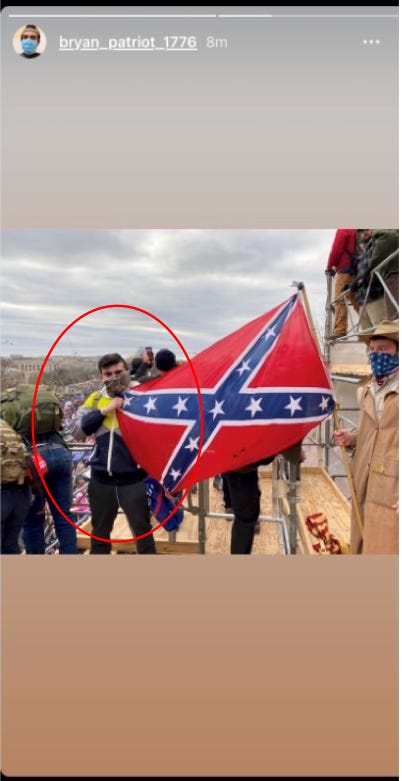
Based on photographs founded on Betancur’s cell phone and “associated metadata,” as well as “images posted on his social media account” and “publicly available video,” the government found that he “climbed on top of the Inauguration scaffolding,” which had been erected on the West Plaza of the U.S. Capitol. “While on top of the scaffolding,” the government’s sentencing memorandum reads, “he encountered an individual he recognized from other rallies and took a photograph with him, which he posted to his Instagram account (depicted below).” In that image, Betancur can be seen unfurling a confederate flag.
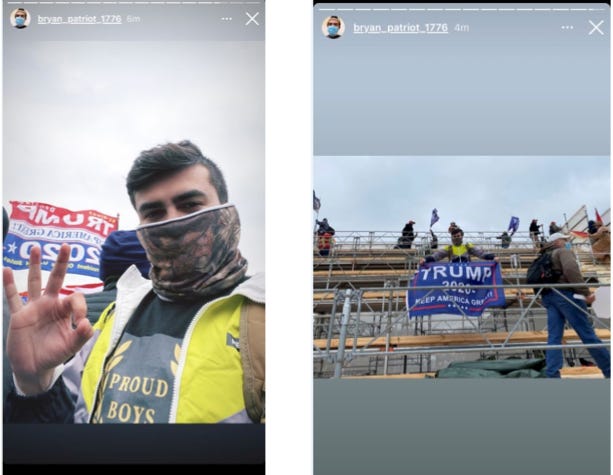
The sentencing memorandum reproduces two other images of Betancur atop the Inauguration scaffolding. The first shows him making the “OK” sign (once a benign symbol, which has been co-opted by the hard right as a hate symbol) while wearing the Proud Boys shirt. The second shows him holding a Trump 2020 flag.
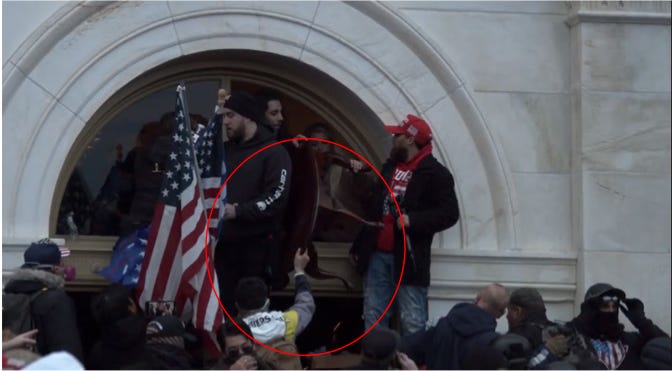
The sentencing memorandum also places Betancur at the Capitol’s Lower West Terrace, including near a tunnel where some of the “most violent” confrontations occurred that day. The DOJ found that Betancur recorded images at the tunnel and “assisted in the removal of furniture” from the Capitol building.
Other images cited throughout the government’s filing show Betancur’s additional movements and activities, including again posing with a Trump 2020 flag while inside the Capitol.
On June 23, 2022, Betancur attended a pre-sentencing interview along with his attorney. According to the DOJ’s sentencing memorandum, Betancur was “hostile and non-cooperative [and] would not provide basic contact information, familial information, or other general information.”
The next day, while riding a Metro train in the D.C. area, Betancur allegedly harassed other passengers. A Metro rider explained to authorities that an individual, “later identified as Betancur, was yelling racial slurs on the train, including the ‘N word.’” Betancur “also reportedly referred to black people as losers, criminals and having no jobs.” The Metro rider reported that Betancur “had a folding knife.” Betancur “was stopped by police officers and verbally counseled prior to leaving the area without being arrested.”
On July 11, 2022, as part of his plea agreement, Betancur was interviewed by the FBI. Betancur explained that he became familiar with the Proud Boys by attending rallies and “from his activities on Telegram,” which “he noted was encrypted.” (Telegram is a social media app the group uses to spread their propaganda and recruit.) He explained how, on January 6th, he traveled “to the area near the Washington Monument to hear the speeches.” He “observed the Proud Boys’ leaders conversing” and then a “large crowd” moving towards the Capitol building. Some of the individuals in attendance had radios and Betancur “identified some as militia” members.
According to the government’s sentencing memorandum, he “made several false statements” during his interview with the FBI. He asked if the interviewing agent was present at the Capitol during the January 6th attack and claimed it was an “inside job;” reflecting a popular MAGA conspiracy theory, which holds that the FBI itself somehow instigated the riot.
As the FBI interview concluded, Betancur allegedly flashed the “OK” hand signal — the same one associated with white power — once again.
When Trump pardoned Betancur and approximately 1,600 other Jan. 6ers, he described them as “hostages” — that is, as supposed victims of the criminal justice system. It was a disgusting smear of the FBI agents and prosecutors who had carefully pieced together the details of the attack on the U.S. Capitol and the brave law enforcement who risked their lives to protect the Capitol.
But there is another aspect of Trump’s actions that we should not overlook. Trump pardoned not only the Jan. 6ers for their actions that day, but also for their ongoing extremism. Indeed, Trump’s second administration promotes white supremacism — meaning that previously fringe hard-right ideology, as espoused by the likes of Betancur, is now the embedded extreme governing agenda of the current regime. In that sense, Trump’s January 6 pardons ushered in a new era — one in which the government went from combatting extremism to promoting it and embracing it.


Disgusting. We can't forget that domination of women, eviscerating all the rights we are entitled to and generations of us had to fight for, is baked into white Christian nationalism. That's what they have in mind for the white women they intend to make into babymaking and sex slaves, anyway. God knows what even more nightmarish scenarios they have in mind for black women or other women of color. All of us women have to unite, for real, to keep the God-awful aims of these sick and dangerous men from becoming reality.
Betancur should have been arrested at the time he was using racist epithets on public transportation.