


Did you make resolutions this year? If you woke up on January 1 with self improvement on the mind (accompanied, perhaps, by a slight hangover), you certainly wouldn’t be the first—in fact, I’m right there with you.
This year I went to sleep at 10 p.m., waking up with the babies at midnight as my toddler complained about the noise (stop the fireworks!, he shouted, waking up the whole family) and getting up for about five minutes to watch the sputtering light show in the torrential Los Angeles rain.
I attended a little New Year’s-resolutions-setting gathering a few days later, where friends shared ideas for restriction (less screen time, less anger) and expansion (more abundance, more time in nature, more feeling sexy and having fun). It was inspiring for my own focus on change, and it made me think: Why are we setting all these resolutions, anyway?
I was surprised to find that the concept of setting New Year’s resolutions is older than I expected. Here’s a little peek into the surprisingly ancient history of the resolution, and a recipe inspired by my own resolution of getting in more vegetable variety at every meal.
The History of New Year’s Resolutions
Historians trace the phenomenon of New Year’s resolution-setting all the way back to 2000 BCE, when Babylonians celebrated the new year with the springtime festival of Akity, and a general resolution to return neighbors’ farming equipment—so let this be your sign to bring back that casserole dish borrowed from the holiday party.
Resolution making on January 1 started with the ancient Romans, who celebrated the first of the month by making promises and offerings to Janus, the month’s namesake and the two-faced god in charge of beginnings and endings.
Here in the States, though, we didn’t catch on to the idea of New Year’s resolutions until well into the 20th century. January 1 became a day for taking stock and setting goals, practices that became more popular with an influx of German immigrants who brought the December 31 tradition of “Silvesterabend,” with singing, dancing, and making midnight toasts ringing in the changing year.
After electricity use became widespread, the Times Square ball drop started in 1907. As the celebration of a new year’s arrival at midnight became more popular, so did the idea of setting resolutions to accompany the fresh beginning it symbolized. These days, about 40% of Americans make New Year’s resolutions, although only 9% of us manage to keep them. And I, of course, am one of the makers. It remains to be seen how the keeping goes.
My 2026 Resolutions
I like to slant my resolutions toward fun, both to increase my chances of actually sticking with them as much as possible and because life is short and more fun feels mandatory. Last year, I vowed to buy and consume any unfamiliar fruit I came across—leading to the discovery of new family favorites like lychees, crab apples, and marionberries, as well as less successful experiments like mamey sapote (why does it smell like vanilla but taste so fishy?) and ultra seedy cactus fruit. The year before that, it was cooking every unfamiliar pasta shape I came across, a tasty adventure in carbohydrate exploration. Are you sensing a theme?
This year, I decided to stick with a winning formula by resolving to find more ways to eat vegetables at every meal. We’re already a very veggie-forward family, but I wanted to make sure that the available options increased as my toddler aged. He hasn’t hit his picky stage yet, but you can’t be too proactive, and this way I figured that there would be more chances for everyone to explore on their plates.
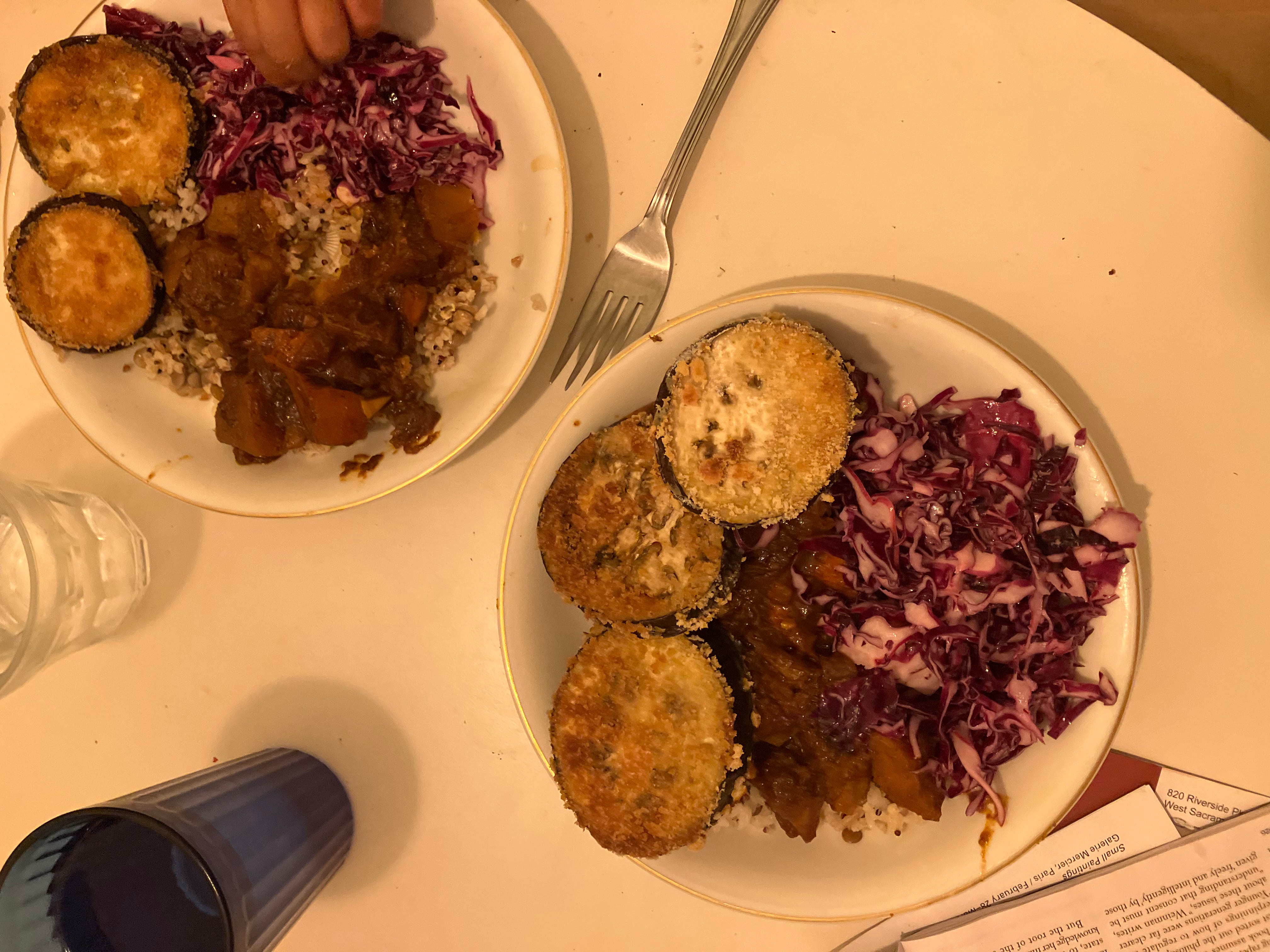
So here’s my first recipe of 2026, on theme and resolution ready: Japanese Curry with Eggplant Tonkatsu. It checks all the boxes—comforting, cozy, relatively simple, and packed with veggies. Just the kind of thing I want to eat when the news is alarming but the year is fresh enough that change still seems possible for all.
Let me know if you try it, and what resolutions are on your mind for 2026 and beyond!
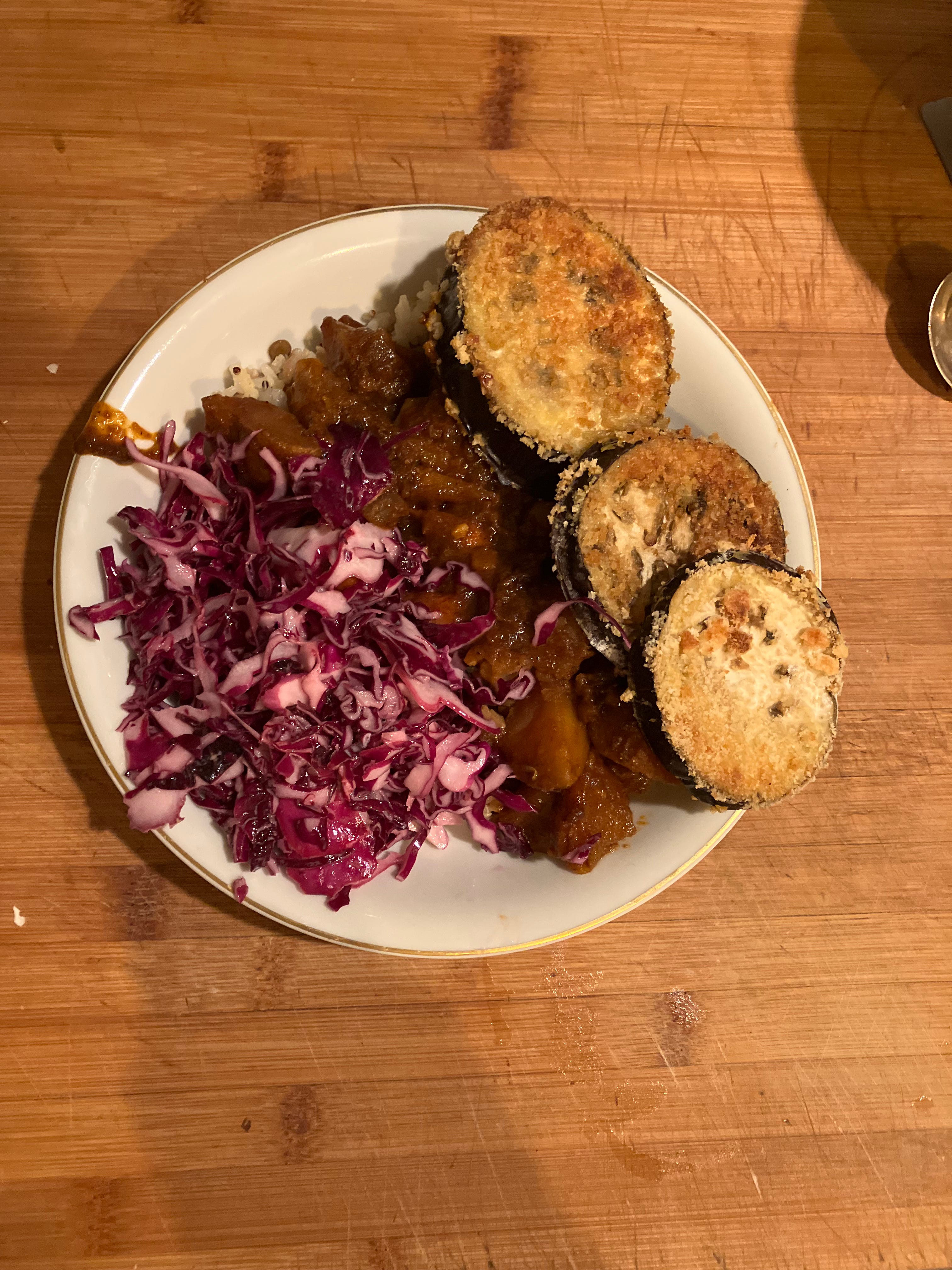
Japanese Curry With Eggplant Tonkatsu
Ingredients:
1 small Italian eggplant
¼ cup flour
½ cup panko
1 egg
1 tbsp high-heat oil, like avocado or vegetable
1 onion
3 cloves garlic
2 inches ginger
1 tbsp tomato paste
2 cups broth
1 tbsp honey
1 tbsp soy sauce
½ small apple
1 carrot
1 large potato
1 block curry roux (make it yourself using 1 tbsp Japanese curry, 1 tsp garam masala, 1 tbsp butter, and 1 tbsp flour)
Method:
First, start your eggplant. Preheat the oven to 425 and slice the eggplant and salt before dipping in flour, then egg, then panko. Put on a well-oiled tray, and bake for 20 minutes, flipping halfway through.
While your eggplant bakes, make your curry. Finely chop your onion, garlic, and ginger and cook until very soft with a little color, about 15 minutes. Then add in your tomato paste, stirring until it darkens slightly, and finishing with broth, soy sauce, and honey. Finely grate the half apple and stir the pulp into the curry sauce. Lower to a gently bubbling simmer.
Slice your root vegetables into 1- to 2-inch irregular segments, and stir into your curry. Cover, and leave simmering for an additional 20 minutes.
While the curry finishes cooking, make your roux if you’re opting to do a homemade version. Melt your butter, then stir in your flour and both curries, mixing until a thick, aromatic paste forms. Remove from the heat, and stir into your finished curry, simmering for a few more minutes until it becomes delightfully thick and sweet.
Serve the curry with your eggplant tonkatsu, a side of rice, and pickles if you have them. Eat up and feel virtuous about starting your year off right.
Emily Beyda’s writing has appeared in the Los Angeles Times, Built, Refinery29, Smartmouth, Fodors, the Thrillist, the Austin Chronicle, and more. Her novel, “The Body Double,” was published in 2021.
